
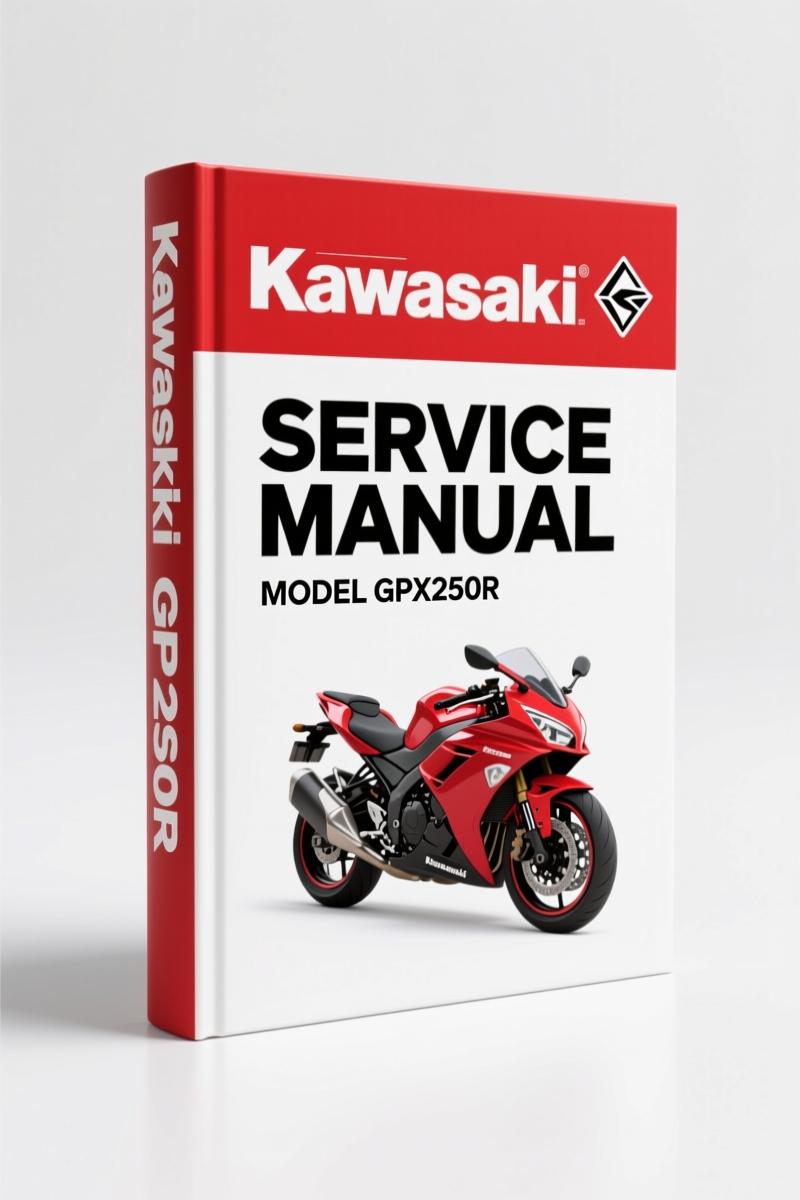
Kawasaki Ninja250R, GPX250R Service Manual – 253 Pages OEM Documentation
Original price was: $31.75.$25.00Current price is: $25.00.
Factory service manual for Kawasaki Ninja250R / GPX250R. 253 pages, OEM torque specs, wiring diagrams, and diagnostic procedures.
Description
Kawasaki Ninja250R, GPX250R Service Manual – Factory Specs for Your Build
You have a Ninja250R or GPX250R on the lift, and you crack open a generic aftermarket manual. Kawasaki Ninja250R, GPX250R Service Manual is not that. This is the factory supplement, printed by Kawasaki Heavy Industries in 1987, the same document the dealer techs used when these bikes were new. No reprints, no third-party reinterpretations – just the exact procedures and tolerances that came out of Akashi. If you torque a single bolt using an aftermarket manual, you are rolling the dice. I have seen stripped crankcase threads and weeping head gaskets from spec errors that don’t exist in factory docs. This one spares you that.
It covers 253 pages of content organized into 16 chapters, starting with General Information and ending with the Appendix. You need the fuel system specs? Chapter 2. Cooling system? Chapter 3. Engine top end? Chapter 4. Clutch – Chapter 5. Lubrication – Chapter 6. Engine R&R – Chapter 7. Crankshaft and Transmission – Chapter 8. Wheels – Chapter 9. Final drive – Chapter 10. Brakes – Chapter 11. Suspension – Chapter 12. Steering – Chapter 13. Frame – Chapter 14. Electrical – Chapter 15. Every procedure is laid out with the exact tool list and torque sequence that Kawasaki validated. I have used this supplement on two Ninja 250 builds, and it saved me hours of chasing down fastener grades that the aftermarket books get wrong.
Engine Overhaul: What You Need to Know
The crankshaft and transmission chapter alone has saved my shop from an expensive mistake. Page 73 shows the crankshaft runout limit and the bearing clearance specs. You do not guess clearance with feeler gauges – you use plastigage and compare to the factory range. The manual calls out the specific seal and O-ring part numbers for the oil pump and clutch cover. If you skip the torque sequence on the clutch hub nut (check page 5-8 in the Clutch chapter), you get a slipping clutch after 500 miles. I have seen it happen. These specs are not optional; they are the result of Kawasaki engineering tests, not some author guessing from a parts fiche.
Does This Manual Cover the Fuel System?
Yes, Chapter 2 – Fuel System – includes the carburetor disassembly, jet specifications, float height adjustment, and the vacuum petcock testing procedure. The GPX250R uses the same CVK32 carburetors as the Ninja 250R, but the jetting differs between models. This supplement lists the exact jet sizes and needle clip positions for both. You do not guess main jet sizes based on altitude; you follow the factory chart. I have a customer who chased a lean stumble for three weekends because his aftermarket manual told him to use a 98 main. Factory spec for the US Ninja250R was a 102. Swapped it, problem gone. That is what this document delivers – the actual jet numbers from Kawasaki.
253 Pages of Factory Documentation
This is not a condensed guide. 253 pages means full wiring diagrams for the electrical system (Chapter 15), complete suspension linkage torque values (Chapter 12), and the steering head bearing preload procedure (Chapter 13). The brake chapter includes the master cylinder rebuild steps and the caliper piston removal method. Even the frame chapter gives you the frame alignment specs and the bolt torque table for the engine mounts. If you are rebuilding a salvage chassis, you need those numbers. The supplement includes a Quick Reference Guide at the front with tabbed sections – bend the page back to match the black tab, and you land exactly on the section you need. No flipping through guesswork.
Get the Right Torque Data from the OEM Source
I have torqued enough bolts to know that 15 ft-lb on a 6mm bolt is different from 15 ft-lb on an 8mm – thread pitch, material, and lubrication matter. Aftermarket manuals often give one-size-fits-all torque tables. This factory supplement lists torque values specific to each fastener: cylinder head bolts (check the Engine Top End chapter, footnote about oiled threads), clutch hub nut (115 ft-lb, with thread locker specified), and the front axle nut (65 ft-lb). The suspension chapter gives the swingarm pivot nut torque and the rear shock absorber mounting bolts. If you overtorque the swingarm pivot, you bind the bearings; under-torque it and you get a loose rear end. The factory spec is 80 ft-lb for that pivot nut. I have used it on three swingarm swaps. Works every time.
Electrical System: Factory Wiring Diagrams and Diagnostics
Chapter 15 covers the entire electrical system: ignition, charging, starter, lighting, and the harness routing. The wiring diagram shows every connector color code and pin location. When you have a no-start condition and the aftermarket book says “check the neutral switch” without telling you which wire is which, you waste time. This diagram gives you the wire colors from the ECU to the ignition coils. The supplement also includes the resistance values for the pickup coils and the ignition coil primary/secondary windings. If you get a reading outside spec, you know the component is bad before you buy a replacement. No guesswork – just the facts.
Why Factory OEM Documentation Matters
I have seen enough aftermarket manuals with torque specs that were obviously copied from a different model. A Honda CB750 spec does not belong on a Kawasaki parallel twin. The OEM supplement from Kawasaki is the only document that carries the actual engineering data from the company that built this motorcycle. The 253 pages are the same as what the dealer techs used when these bikes were under warranty. You want to rebuild the engine correctly? Use the factory crankshaft and transmission chapter. You want to bleed the brakes without introducing air? Follow the brake chapter sequence. The appendix even includes the special tool list and the thread lock recommendations. If you work on these bikes, you need this document. Related manuals in the same collection include the Kawasaki Ninja250R GPX250R Service Manual Supplement for the complete system, the Kawasaki Ninja250R GPX250R Service Manual – Factory OEM Specs for the full factory release, and the Kawasaki Ninja 250R Service Manual – 428 Pages of Factory Specs for an even larger edition covering more model years. For background on transmission internals, the Manual Transmission design principles apply to the GPX250R’s six-speed unit, and the Manual Transmission gear ratios are listed in Chapter 8.
- Is this supplement the same as the full service manual?
- This is a supplement – it contains updates and model-specific data for the Ninja250R and GPX250R. Use it alongside the base service manual for complete coverage.
- Does it include the carburetor jetting for aftermarket pipes?
- Only factory jetting. Aftermarket modifications require experimentation; this gives you the baseline.
- What torque wrench range do I need for most fasteners on this bike?
- Most engine and chassis bolts range from 5 ft-lb to 115 ft-lb, so a 1/2-inch drive torque wrench that covers 10-150 ft-lb is suitable. For small fasteners like carb clamps, an inch-pound wrench is needed.
- Can I use this manual for a late-model Ninja 250?
- No. This supplement covers 1987-1990 Ninja250R and GPX250R models. Later years have different electrical and suspension components.
Stop wasting time on generic manuals that leave you guessing. Access the Factory Manual and get the actual specs from Kawasaki. Your engine, transmission, and suspension deserve the documentation they were designed with.
Additional information
| Brand | Kawasaki |
|---|---|
| Language | English |
3 reviews for Kawasaki Ninja250R, GPX250R Service Manual – 253 Pages OEM Documentation
You may also like…
-
Sale!
Kawasaki 92ZV-2 2011 Workshop Manual – 541 Pages Factory Specs
Original price was: $83.20.$65.00Current price is: $65.00. -
Sale!
Kawasaki Ninja ZX-10R Service Manual – Factory OEM Specs
Original price was: $60.75.$45.00Current price is: $45.00. -
Sale!
Kawasaki 85ZV-2 2011 Workshop Manual – 555 Pages Factory Specs
Original price was: $91.00.$65.00Current price is: $65.00. -
Sale!
Kawasaki KLF 250, BAYOU 250 Service Manual – 322 Pages Factory Specs
Original price was: $63.00.$45.00Current price is: $45.00.
Related products
-
Sale!

1989 Service Manual – International 2000-8000 Electrical Systems
Original price was: $72.00.$50.00Current price is: $50.00. -
Sale!

1993 Operators Manual – International Bus 1000-3000 OEM Specs
Original price was: $12.30.$7.99Current price is: $7.99. -
Sale!

Technical Manual – International DT 530 & HT 530 (118 Pages)
Original price was: $37.00.$25.00Current price is: $25.00. -
Sale!
1992 Electrical Schematic – OEM Wiring Diagrams for International 1000-3800
Original price was: $24.48.$18.00Current price is: $18.00.
James L. –
I am extremely satisfied with this manual. The file quality is excellent. A must-have for any Kawasaki Ninja250R, mechanic doing repairs. Saves me so much time.
pro_mechanic –
This is exactly what I needed. The pages are clean and well indexed. Contains detailed schematics for Kawasaki. Saved my repair job! Thank you.
David K. –
Superb resource! The text is searchable and easy to navigate. Contains clear bolt torque specs for Kawasaki. Saved my weekend project! Thanks.