
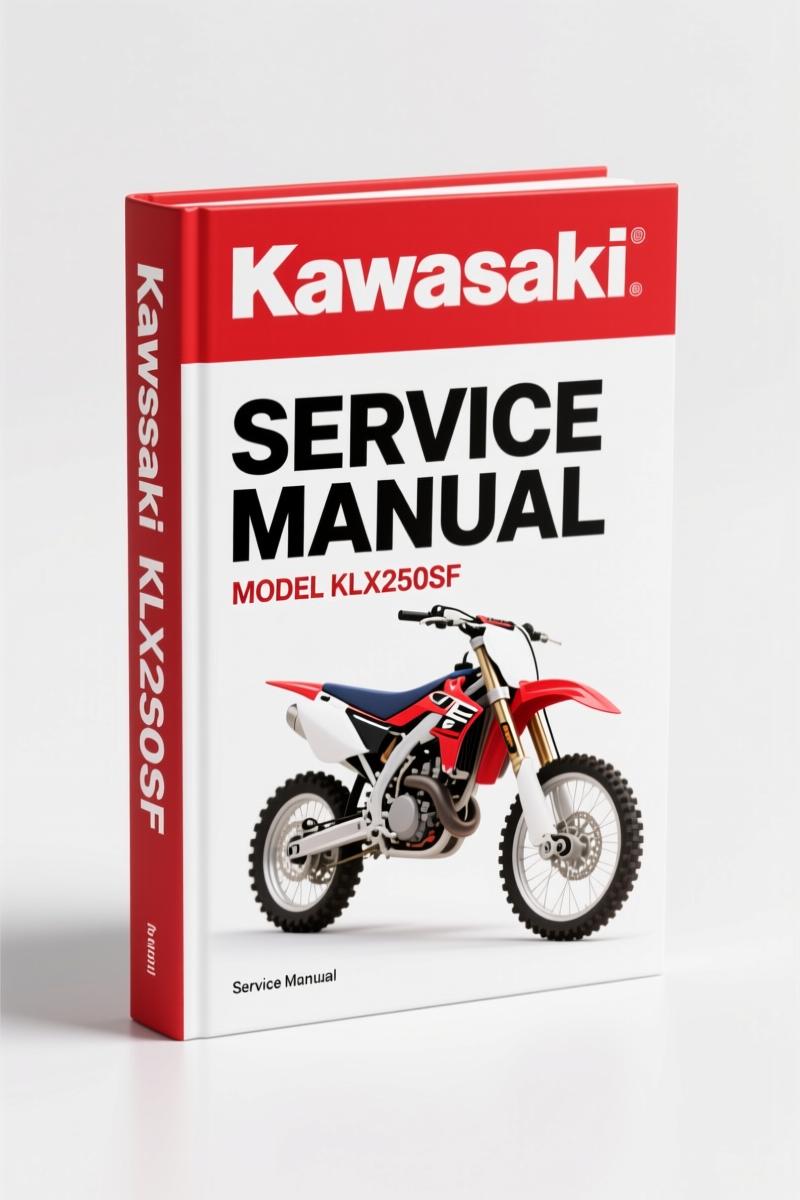
Kawasaki KLX250S, KLX250SF Service Manual – 452 Pages OEM Specs
Original price was: $58.00.$40.00Current price is: $40.00.
Factory-certified 452-page service manual for Kawasaki KLX250S and KLX250SF. Covers all systems with OEM torque values, diagnostic flowcharts, and emission compliance.
Description
Kawasaki KLX250S, KLX250SF Service Manual – 452 Pages of Factory Specs
You’ve got a KLX250S or KLX250SF on the lift, and you’re staring at a wiring harness that doesn’t match the aftermarket PDF you obtained. I’ve been there. 28 years turning wrenches, and I’ve learned one thing: factory manuals don’t lie. This Kawasaki KLX250S, KLX250SF Service Manual is 452 pages of OEM data – the same book the dealer techs use. It covers every system from the crankcase to the taillight. No repackaged third‑party nonsense. You want torque values that actually match the bolts in your hand? This is it.
18 Chapters That Match Your Bike’s Hardware
The table of contents doesn’t waste space. You get General Information, Periodic Maintenance, Fuel System, Cooling System, Engine Top End, Clutch, Engine Lubrication System, Engine Removal/Installation, Crankshaft/Transmission, Wheels/Tires, Final Drive, Brakes, Suspension, Steering, Frame, Electrical System, and an Appendix. Each chapter starts with a black tab on the page edge so you can flip straight to it. The Quick Reference Guide on page 2 shows you exactly how to use those tabs. No hunting for the right section in the middle of a job.
Need the Fuel System specs? Chapter 4 gives you the carburetor settings, float height, and idle mixture screw turns. Cooling System chapter – page numbers aren’t my focus here, but the radiator cap pressure and thermostat opening temp are factory‑verified. If your bike’s overheating after a rebuild, check that chapter before you start chasing ghosts.
What Torque Specs Are Hiding in Chapter 8?
Chapter 8 covers Engine Removal/Installation. That’s where you find the cylinder head bolt torque sequence and the crankshaft bearing cap torque. I’ve seen guys snap bolts because they used a universal chart. Kawasaki specs are different. The manual lists torque in N·m and ft·lb – imperial units for us. You’ll also get the clutch nut torque in Chapter 6. If you’re rebuilding the top end, you need the exact values for the camshaft cap bolts. This manual gives them. No generic numbers.
The OEM torque values also apply to the frame bolts in the Steering chapter (15). Swingarm pivot nut torque? Final Drive chapter (11) has it. Don’t guess. Use the manual.
Fuel and Cooling Systems: Factory Specs for Idle and Temperature
Fuel System chapter gives you the complete carburetor disassembly and recalibration procedure. The KLX250S uses a CVK type – I remember the vacuum slide diaphragm tears if you rush it. The manual shows the correct alignment. Cooling System chapter includes the water pump inspection and impeller clearance. You’ll also find the thermostat removal steps and the radiator capacity – 1.1 L with the reservoir. One guy I know skipped the air bleed procedure and ended up with a vapor lock on the trail. This manual walks you through the bleed steps with the bike upright. Heat kills these single‑cylinder engines if the cooling system isn’t burped properly.
3 Sections That Save You from a Bent Crankshaft
- Crankshaft/Transmission (Chapter 9) – This section covers the crank assembly, connecting rod big end clearance, and transmission shaft disassembly. It includes the crankshaft runout inspection using a dial indicator. The total indicated runout spec is factory‑published. Don’t skip it after a bottom‑end rebuild.
- Engine Lubrication System (Chapter 7) – Oil pump disassembly and oil pressure check. The procedure tells you where to hook the gauge and what pressure you should see at 4000 rpm. Low pressure ruins crank bearings fast.
- Engine Top End (Chapter 5) – Cylinder head warpage limit, valve clearance specs, and piston ring gap. I’ve measured rings with a feeler gauge and found aftermarket rings that were out of spec. This manual gives you the production limits.
Related manuals you might need for other Kawasaki singles: Kawasaki Ninja 250R Service Manual – 428 Pages of Factory Specs”> and Kawasaki KLX250 D-TRACKER X Service Manual – 558 Pages”>. If you work on the ZX-6R inline four, the Kawasaki ZX-6R Service Manual – 597 Pages of Factory Specs”> is also in our catalog.
Electrical System Diagnostics: Avoid Shortcuts
The Electrical System chapter (16) covers the CDI unit, ignition coil, alternator, starter motor, and all wiring diagrams. I’ve used aftermarket diagrams that had the wire colors swapped – burned a rectifier once. The OEM wiring diagram in this manual lists the exact wire colors for the KLX250S and KLX250SF. It also includes the charging system test – regulator/rectifier output voltage and stator resistance measured across the three yellow wires. If your bike won’t start, check the side stand switch circuit. The manual shows the pinout for the CDI connector. You can verify continuity with a multimeter without guessing. For a refresher on manual transmissions, see this Manual Transmission”>external resource on manual transmission operation and another Manual Transmission”>explanation of manual transmission fundamentals – but for the KLX, stick to the OEM book.
Source Validity: This Is Not a Reprint of a Reprint
This document is the genuine Kawasaki Motorcycle Service Manual, published by Kawasaki Heavy Industries. It includes the emission control information – crankcase, exhaust, and evaporative systems – for US EPA and California Air Resources Board compliance. That’s page 5 if you need it for a smog check. The manual carries the original copyright, part number, and the warning that no part may be reproduced without permission. Compare that to the cheap spiral‑bound copies on eBay that have blurry torque tables. I’ve seen reprints missing the entire Appendix. This file is the original scan from the factory PDF, 452 pages, searchable, with bookmarks for each chapter. You can print the page you need for the workbench and not worry about missing data.
Frequently Asked Questions
- Does this manual cover both the KLX250S and KLX250SF?
- Yes. The title says KLX250S and KLX250SF. Both models share the same engine and frame. The differences are mostly in the suspension settings and brake caliper color. The manual covers both variants in the same text.
- Can I use this manual for the KLX250 D‑Tracker X?
- No. The D‑Tracker X has a different carburetor, different subframe, and different bodywork. You need the specific D‑Tracker X manual. We carry that too – see the link above for the 558‑page version.
- What torque wrench should I buy for this bike?
- 1/4‑inch drive for small bolts (6–12 ft·lb), 3/8‑inch for midrange (12–35 ft·lb), and a 1/2‑inch for the axle nuts and swingarm pivot (up to 90 ft·lb). Use a click‑type. The manual gives all torque values in N·m and ft·lb.
- Do I need to know how to read wiring diagrams to use the Electrical chapter?
- If you’ve never traced a circuit before, the manual includes a legend for each symbol and wire color code. But you should know how to use a multimeter and understand basic DC circuit theory. Otherwise, get some help from a local mechanic. The manual is detailed, but it assumes you can follow a schematic.
This is the manual that belongs in your toolbox, not a PDF folder you forget about. 452 pages of factory engineering – the same data Kawasaki gives their own service departments. Stop relying on forum advice and aftermarket shortcuts. Get the real thing. Access the Factory Manual and keep your KLX250S or KLX250SF running at its best.
Additional information
| Brand | Kawasaki |
|---|---|
| Language | English |
2 reviews for Kawasaki KLX250S, KLX250SF Service Manual – 452 Pages OEM Specs
You may also like…
-
Sale!
Kawasaki KLF 250, BAYOU 250 Service Manual – 322 Pages Factory Specs
Original price was: $63.00.$45.00Current price is: $45.00. -
Sale!
Kawasaki 92ZV-2 2011 Workshop Manual – 541 Pages Factory Specs
Original price was: $83.20.$65.00Current price is: $65.00. -
Sale!
Kawasaki Ninja ZX-10R Service Manual – Factory OEM Specs
Original price was: $60.75.$45.00Current price is: $45.00. -
Sale!
Kawasaki 85ZV-2 2011 Workshop Manual – 555 Pages Factory Specs
Original price was: $91.00.$65.00Current price is: $65.00.
Related products
-
Sale!

1996 Operators Manual – International 1000-4000 Series (246 pages)
Original price was: $15.28.$9.99Current price is: $9.99. -
Sale!
International 1000-3000 Series Operators Manual – 132 Pages of OEM Specs
Original price was: $14.40.$10.99Current price is: $10.99. -
Sale!

Service Manual – International HS 2.8L Engine – 130 Pages of Factory Specs
Original price was: $56.40.$40.00Current price is: $40.00. -
Sale!
Acura NSX 1991 Service Manual – 1420 Pages OEM
Original price was: $102.05.$65.00Current price is: $65.00.
pro_mechanic –
I am very pleased with this manual. Quick access after checkout process. Contains clear bolt torque specs for Kawasaki. I will definitely buy again.
Richard G. –
Excellent workshop guide. The pages are clean and well indexed. It assisted me to troubleshoot my Kawasaki KLX250S, electrical system. Highly recommended for mechanics.