
John Deere 9400-9100-9200-9300 Parts Catalog – 1037 Pages OEM
Original price was: $37.20.$24.00Current price is: $24.00.
OEM John Deere 9400, 9100, 9200, 9300 Parts Catalog – 1037 pages of factory part numbers and grid-indexed diagrams.
Description
John Deere 9400, 9100, 9200, 9300 Parts Catalog
You ever order a part for a 9400 based on a blurry screenshot from some forum? I have. Three days later the wrong hydraulic pump shows up, and the boss is asking why that tractor is still down. That frustration is exactly why this John Deere 9400, 9100, 9200, 9300 Parts Catalog exists on my bench. It’s 1037 pages of factory-sourced part numbers, exploded diagrams, and grid references that tell you exactly which gasket, seal, or bearing goes where. No aftermarket reprints, no guesswork.
This thing weighs more than some service manuals I’ve used. The factory built it for the same reason they put torque specs on head bolts – so you don’t screw it up. I’ve been turning wrenches for 28 years, and I can tell you the difference between a genuine OEM parts breakdown and a third-party “equivalent” is night and day. With this catalog, you get the exact illustration John Deere released for the 9100, 9200, 9300, and 9400 tractors.
Parts Index Structure: Grid Codes Explained
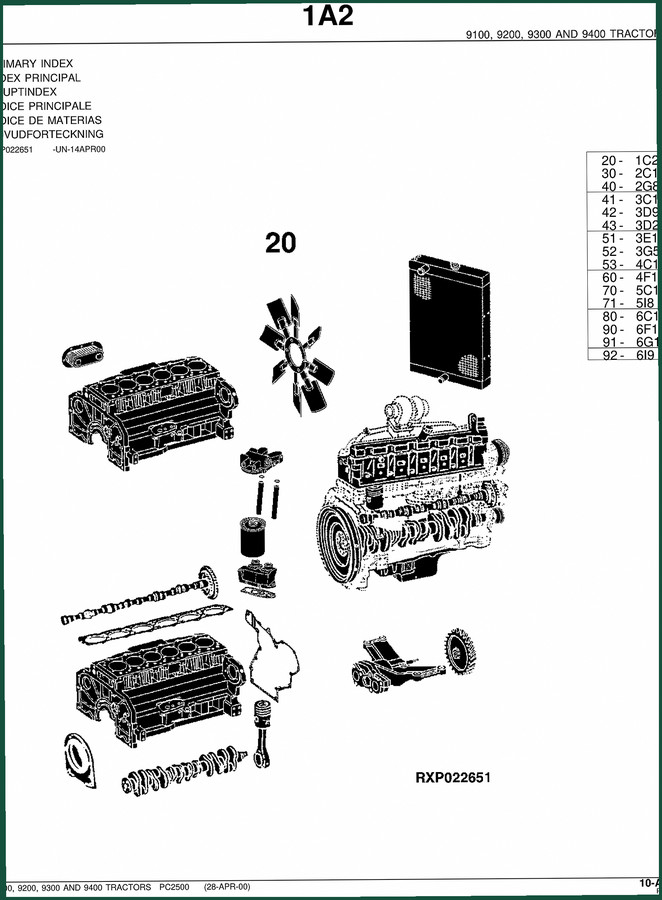
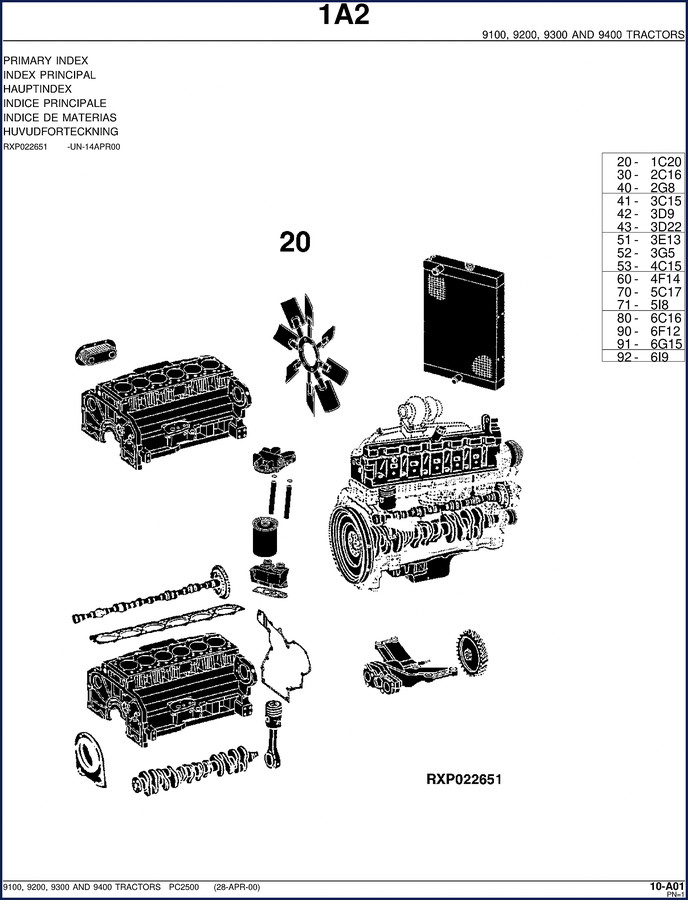
The primary index at the front of the manual (page 1) lists all major systems by number. For example, system 20 (Engine) starts at grid location 1C20, system 30 (Fuel) at 2C16, system 40 (Electrical) at 2G8. Each grid code like 01A02 points to a specific illustration page where the part is drawn with callouts and the factory part number right next to it. You don’t need to guess which bolt is M16 vs. M14 – the drawing shows it. The catalog uses a consistent grid numbering across all four models, so once you learn the pattern you can jump to any section fast.
Which Models Are Covered?
This manual is written for the 9100, 9200, 9300, and 9400 series. All four share a lot of drivetrain and hydraulic components, but there are differences – especially the 9400’s larger final drive and heavier axles. The catalog separates parts by model in the callouts, so you don’t accidentally order a 9100 part for a 9400. Look for the model suffix in the part number listing. If you’re working on a 9400, you’ll find plenty of coverage without needing a separate book.
3 Reasons This OEM Catalog Beats Aftermarket
First, the diagrams are drawn from actual John Deere engineering drawings. Aftermarket catalogs often redraw the same parts using generic shapes, which can mess up the perspective and hide a mounting hole. Second, the part numbers here are the originals – no renumbering or cross-referencing required. Third, the grid index (like the one on page 1 with entries 20-1C20, 30-2C16) is correct. I’ve caught aftermarket catalogs swapping grid references, sending you to the wrong page. Not here.
Locating a Part by System Number
Open the manual to the primary index. Find the system number for the area you’re working on – say, 70 (Hitch). The index shows it starts at grid 5C17. Flip to section 5, find C17 on the grid layout, and you’re looking at the hitch’s complete parts breakdown. The manual uses a simple row/column system similar to a map. Each grid cell contains one or two parts with their corresponding part numbers and quantities. You don’t need a degree to use it. this Wikipedia article on diesel engines explains some of the engine architecture that these tractors use, but for part numbers you need this catalog.
Why Factory Documentation Matters for These Tractors
These are not lawn mowers. The 9400 can push 400 horsepower through its drivetrain. Order the wrong planetary gear set and you’re looking at a rebuild that costs more than the manual itself. The catalog tells you the exact revision level of each component. John Deere often updates parts during production; the manual includes supersession notes so you know which old part number replaces with which new one. Aftermarket catalogs rarely show supersessions – they just list the last known number, leaving you to figure out if it fits your tractor’s serial number range.
Tool required: a clean workbench and a pair of reading glasses. The grid numbers are small but legible. Keep the manual open next to your computer or tablet for quick cross-referencing. If you’re ordering parts online, having the factory part number in hand means you can paste it directly into the dealer’s system. No more “is this the right one?” calls.
I’ve seen too many guys order a seal based on a ruler measurement and end up with the wrong diameter because the aftermarket catalog used a generic cross-section. This manual eliminates that. Every dimension is factory-sourced. When you see a part number like R123456 on page 1 of the primary index, you know it came from the same system the dealer uses. this Wikipedia article on diesel engines provides background on the engine type, but for actual part ID you need the factory catalog.
Related Manuals You Might Need
- John Deere 9400 Maximizer Combine 1989 Parts Catalog
- Deere Greenstar Combine Yield Mapping Parts Catalog 2000
- John Deere 2130 Parts Catalog – Factory Specs for Correct Part Identification
- Does this catalog cover the 9400 model?
- Yes. The 9400 is fully included along with the 9100, 9200, and 9300.
- How do I interpret the grid codes like 01A02?
- Each grid code has three parts: the section number (01), the row letter (A), and the column number (02). The primary index on page 1 lists system numbers (e.g., 20 for Engine) followed by the starting grid code. Once you find the section, you locate the row and column on that page. The manual’s grid layout is consistent – row letters run top to bottom, column numbers left to right. For example, grid 01A02 is the second box in the first row of section 01. That box contains the part illustration for the items listed under that code. You may need to look up multiple grids for a complete assembly, but the index points you to the start of each system.
Stop wasting time on wrong parts and chasing down mismatched diagrams. Access the Factory Manual from AutoRepairManuals and get back to work. You’ll have the exact OEM data that John Deere service departments use, right on your screen.
Additional information
| Brand | John Deere |
|---|---|
| Language | English |
2 reviews for John Deere 9400-9100-9200-9300 Parts Catalog – 1037 Pages OEM
You may also like…
-
Sale!
John Deere 325J 2011 Repair Manual — Factory Specs for Backhoe Loader
Original price was: $109.60.$80.00Current price is: $80.00. -
Sale!
John Deere JD450 1987 Service Manual – OEM Factory Specs
Original price was: $97.50.$65.00Current price is: $65.00. -
Sale!
John Deere JD450 1987 Service Manual – OEM Factory Specifications
Original price was: $79.95.$65.00Current price is: $65.00. -
Sale!
John Deere 400 1974 Service Manual – Factory Specs for Technicians
Original price was: $92.30.$65.00Current price is: $65.00.
Related products
-
Sale!

Technical Manual – International 6.0L Power Stroke FICM Diagnostics
Original price was: $29.80.$20.00Current price is: $20.00. -
Sale!

1991 Operators Manual – International Truck OEM Specs (108 Pages)
Original price was: $13.63.$10.99Current price is: $10.99. -
Sale!

1994 Troubleshooting Manual – International 1000-4000 FBC
Original price was: $60.00.$50.00Current price is: $50.00. -
Sale!

Acura Integra 1998 Service Manual – 1891 Pages Factory OEM Documentation
Original price was: $31.75.$25.00Current price is: $25.00.
gearhead88 –
Perfect OEM spec sheet. It is easily zoomable on my laptop without losing quality. It guided me to rebuild my John Deere Deere electrical system. Worth every penny.
Michael T. –
Excellent workshop guide. Quick access after payment. It assisted me to troubleshoot my John Deere Deere electrical system. Saves me so much money.