
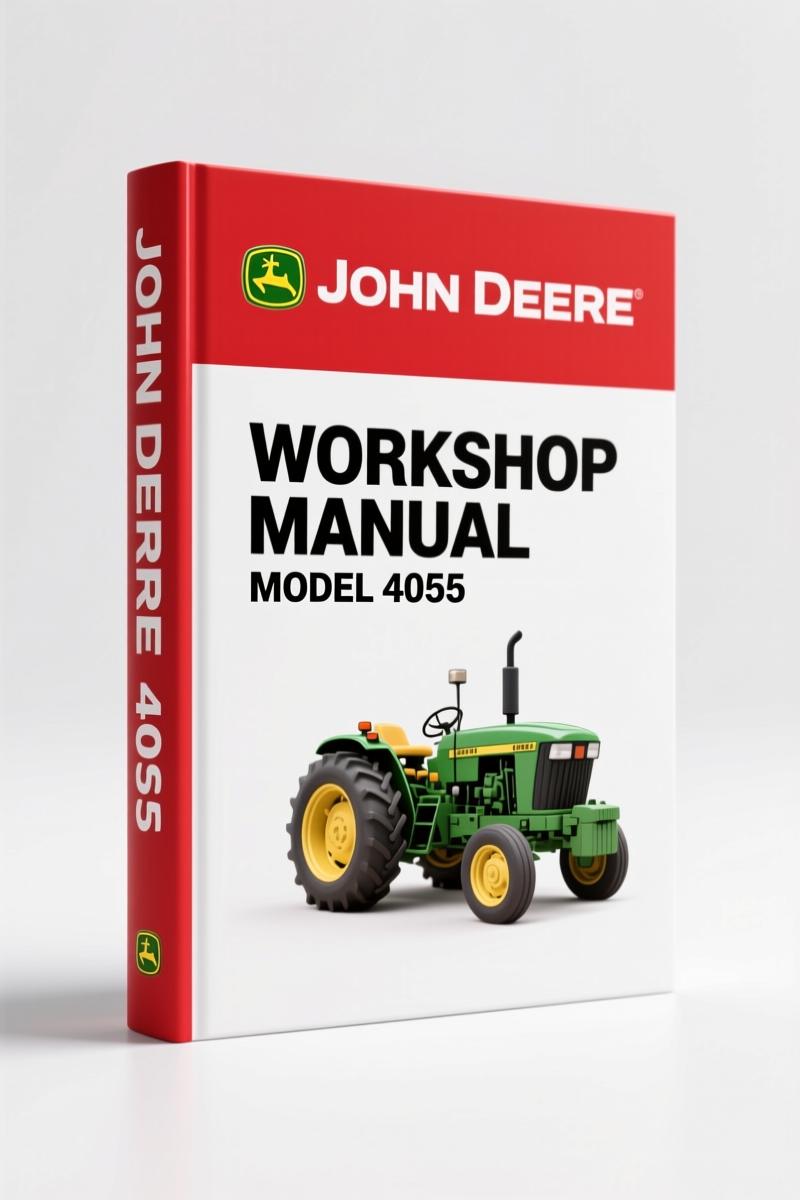
John Deere 4055-4755 Workshop Manual – 203 Pages of OEM Specs
Original price was: $89.05.$65.00Current price is: $65.00.
OEM workshop manual covering 4055, 4255, 4455, 4555, 4755 tractors – 203 pages of factory procedures, torque specs, and diagnostic data.
Description
John Deere 4055, 4255, 4455, 4555, 4755 Workshop Manual
If you are elbow-deep in a 4055 or any of the 55-series tractors and you need the exact factory bleed procedure for the brakes, you do not grab some aftermarket reprint. You grab the actual John Deere workshop manual that came off the dealer’s shelf. This is that book—203 pages of real OEM data, not a photocopy of a photocopy. I have used these manuals for years, and I can tell you the difference between this and a third-party PDF is the difference between a torque wrench you trust and one you found in a barn.
Every section in this manual starts with the serial number plate locations so you can positively ID your machine. The basic serial number is on the rear of the transmission case, engine number on the right side of the block behind the injection pump, transmission on the left side, front-wheel drive on the right rear of the axle housing, hydraulic pump on the top right of the pump housing, and Sound-Gard body on the windshield wiper motor access door header. That attention to detail carries through the whole document.
Brake Valve Bleeding: Not Optional
The brake chapter runs from page 180 to 184. Bleeding is on page 181, and the brake valve service is on page 182. If you skip the bleeding sequence listed there, you will have a soft pedal and a bad day. The manual also covers the accumulator, pistons, plates, and discs. I have seen guys try to wing it and end up ordering a new brake valve because they forced something. The factory procedure tells you exactly how to adjust the linkage and what to look for. Torque specs are given in foot-pounds, not Newton-meters that someone converted wrong.
Cooling System: Thermostats and Water Manifold
Radiator removal is on page 51, fan and viscous clutch on page 52, water pump on page 53, and thermostats with the water manifold on page 54. These tractors run hot in the Texas summer, and if you install the thermostat backwards or miss the gasket orientation on the manifold, you will be pulling it apart again. The manual includes the exact coolant capacity and tells you where the bleed ports are. Do not guess—it’s all in the book.
Engine Assembly: Getting It Right the First Time
Engine disassembly and reassembly starts on page 28. Cylinder head work is page 29, valve adjustment on page 30, valve seats and guides on page 31, valve springs and rotators on page 32. Then you get into the bottom end: pistons and rings on page 39, cylinder sleeves on page 40, rod and piston units on page 38. Crankshaft and bearings on page 43. The manual includes the engine break-in procedure on page 50—something most aftermarket books leave out. If you rebuild a John Deere engine without that break-in sequence, you are asking for scored cylinders.
Hydraulic System: Control Valve and Electro-Hydraulic Hitch
The hydraulic chapter is deep. It covers the main hydraulic system starting on page 201, reservoir and filters on page 202, main pump on page 217, control valve on page 221, rockshaft housing on page 229, electro-hydraulic hitch on page 241, and selective control valves on page 260. If you are troubleshooting a hitch that drifts or a SCV that sticks, you need the factory schematic and the exact clearances. This manual gives you that. The charge pressure specs are right there—no flipping between sections.
Electrical System: Alternator and Regulator Diagnostics
Starting motor on page 81, neutral start switch on page 82, Intellitrak warning system on page 83. The alternator and regulator section on page 78 includes the test procedures that a multimeter can verify. I have used these to track down intermittent no-start conditions in the field. The wiring diagrams are factory-correct, not redrawn by someone who thought a ground wire is optional.
Who Needs This Manual?
This is for the owner-operator who works on his own 4455 or 4755 and wants to avoid tearing down a perfectly good component because he followed a YouTube video. It is also for the shop technician who needs the exact torque for the cylinder head bolts and the valve adjustment sequence. The manual covers both Perma Clutch and Power Shift transmissions, Quad-Range, and the front-wheel drive system. If you are a home garage guy who has a 4055 in the shed, you will save the cost of this manual the first time you replace a water pump without breaking the housing.
OEM vs. Aftermarket: Why This Matters
Aftermarket manuals often skip steps like the aneroid adjustment on the Diesel system (page 67) or the static timing procedure (page 66). They leave out the transfer pump specs (page 64) and the injection nozzle pressures (page 71). I have seen aftermarket books that just say “remove and install” with no torque values. This John Deere manual gives you the factory sequence for bleeding the fuel system after filter changes (page 62). It includes the specific adjustment for the differential lock control valve (page 171). That is the difference between a job that passes a test drive and one that comes back.
Related Manuals
- John Deere Powertech 4.5L & 6.8L 2004 Workshop Manual (678 pages)
- John Deere 4050 4250 4450 4650 4850 Shop Manual
- JOHN DEERE 4050-4850 Series Tractor Workshop Manual
Frequently Asked Questions
- Does this manual cover the 4955?
- Yes, the 4955 is included in the index and throughout the book.
- What about the Power Shift transmission? Is the overhaul procedure in here?
- The Power Shift transmission section starts on page 121. It covers the traction clutch for Power Shift on page 133. The manual includes disassembly, inspection, and assembly steps with all clutch pack clearances and hydraulic circuit tests. You get the factory specs for the shift solenoids and the pressure regulator. If you are rebuilding a Power Shift, you need this book to get the clutch clearances right—aftermarket sources will give you generic values that can burn up a $2,000 clutch pack.
You have two choices: grab a generic PDF that leaves out half the torque values, or access the Factory Manual that has every spec the dealer uses. I have been turning wrenches for almost three decades, and I would not rebuild a 4755 without this book on the bench. Get the real thing—203 pages, OEM data, no shortcuts.
Additional information
| Brand | John Deere |
|---|---|
| Language | English |
2 reviews for John Deere 4055-4755 Workshop Manual – 203 Pages of OEM Specs
You may also like…
-
Sale!
John Deere JD450 1987 Service Manual – OEM Factory Specs
Original price was: $97.50.$65.00Current price is: $65.00. -
Sale!
John Deere 325J 2011 Repair Manual — Factory Specs for Backhoe Loader
Original price was: $109.60.$80.00Current price is: $80.00. -
Sale!
John Deere 400 1974 Service Manual – Factory Specs for Technicians
Original price was: $92.30.$65.00Current price is: $65.00. -
Sale!
John Deere JD450 1987 Service Manual – OEM Factory Specifications
Original price was: $79.95.$65.00Current price is: $65.00.
Related products
-
Sale!

1995 Operators Manual – International 1000-4000 Series | OEM Documentation
Original price was: $12.49.$9.99Current price is: $9.99. -
Sale!
1991 Electrical Schematic – 112-Page OEM Wiring Diagram for International 1000-3000 Series
Original price was: $22.75.$17.50Current price is: $17.50. -
Sale!

1989 Service Manual – International 2000-8000 Electrical Systems
Original price was: $72.00.$50.00Current price is: $50.00. -
Sale!

Service Manual – International HS 2.8L Engine – 130 Pages of Factory Specs
Original price was: $56.40.$40.00Current price is: $40.00.
Richard G. –
Excellent quality! Instant access after payment. Every spec sheet is included for John Deere Deere. I will recommend this shop to others.
pro_mechanic –
This is just what I required. The file is very clear. Contains clear schematics for John Deere. Saved my repair job! Thank you.