
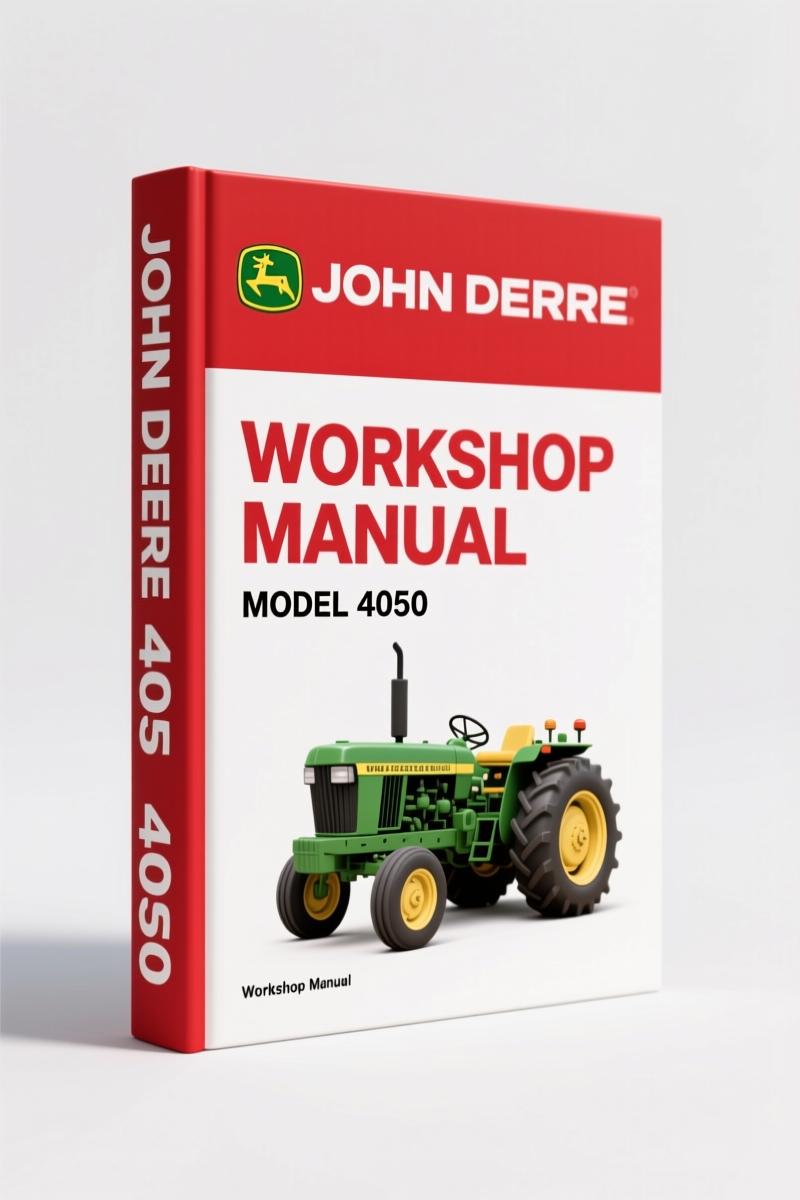
John Deere 4050-4850 Workshop Manual – OEM Repair Specs
Original price was: $64.00.$40.00Current price is: $40.00.
OEM 170-page workshop manual for John Deere 4050-4850 series. Brake valve bleeding, injection timing, electrical diagrams – factory specs only.
Description
John Deere 4050, 4250, 4450, 4650, 4850 Workshop Manual
If you’ve ever tried to torque a cylinder head on a 4050 with a third-party manual, you know what I’m talking about. Some kid in an office took a guess at the bolt sequence, and now you’re chasing a coolant leak. This John Deere 4050, 4250, 4450, 4650, 4850 Workshop Manual comes straight from the factory. 170 pages, real numbers, not a reprint. Every torque spec is what John Deere put on the line. I’ve used these on 4650 brake accumulators and 4250 injection pumps—they save you the headache of stripped threads and come-backs.
Brake Valve: Operation, Adjustment, and Bleeding
The brake system on these tractors isn’t something you want to guess on. Page references in the index show brake valve adjustment starts at paragraph 180 for all five models. The manual walks you through bleeding the accumulators (paragraph 183) and replacing pistons, plates, and discs. I’ve seen guys skip the bleeding sequence and end up with a pedal that goes to the floor. Don’t. The factory procedure gives you the exact order to open bleed screws and cycle the pedal until the accumulator pressure holds. Safety first: the manual specifies using a pressure gauge to verify accumulator charge before any disassembly. That kind of detail keeps you from earning a trip to the ER.
Cooling System: Thermostats, Water Pump, and Radiator
The cooling system chapter covers fan and viscous clutch (paragraph 54), radiator R&R (53), thermostats (56), and water pump replacement (55). The thermostat housing on a 4450 can be a pain if you don’t know the bolt torque—the manual lists it in foot-pounds, not some vague “tighten until snug.” When you’re pulling the water pump on a 4850, the manual tells you to drain coolant from the block drain cock, not just the radiator, or you’ll have antifreeze running down your arm. That’s the kind of workshop tip that keeps you dry and your shop floor clean.
Electrical System: Wiring Diagrams and Investigator II Warning
Electrical problems on these tractors will drive you nuts if you rely on aftermarket diagrams that show wrong wire colors. The factory manual has full electrical diagrams starting at paragraph 261 for all models. It also covers the alternator and regulator (84), starting motor (89), and the Investigator II warning system (91). I had a 4250 come in with a no-start that three other shops couldn’t fix. Aftermarket wiring schematics showed a different relay pinout than what John Deere used. One look at the factory diagram and I found a corroded connector at the starter motor solenoid. Saved the owner a grand in unnecessary parts swaps.
Engine Assembly: R&R, Cylinder Head, and Break-in Procedure
The engine section is where this manual earns its keep. Cylinder head removal and installation (paragraph 32) includes the factory torque sequence and values for the head bolts. Over 120 ft-lbs on the 466 engine, and you need to do it in three steps. The manual also covers camshaft bearings (39), connecting rods (44), crankshaft (45), piston rings (41), and the full break-in procedure (paragraph 52). If you’re rebuilding a 4650 engine, you’ll need the valve adjustment specs (paragraph 36) and the timing gear backlash tolerances. Aftermarket “universal” manuals won’t tell you that the 4050 engine uses a different oil pump than the 4850. This one does.
Diesel System: Injection Pump Static Timing and Nozzle Testing
Static timing on the injection pump is critical. The manual lists different timing specs for the 4050 (paragraph 68) versus the 4250-4850 (paragraph 71) because the pump calibration is different. You also get the full procedure for filter bleeding (63), injector nozzle testing (77), and pump adjustment (73/74). I always use the factory bleed sequence—crack the line at the injection pump first, then each injector. Saves you from cranking the starter until the battery dies. The manual also shows you how to set the injector pop pressure using a test stand. That’s data you won’t find in a generic PDF.
Source Authenticity: OEM Factory Manual, Not a Third-Party Reprint
This is a direct scan of the original John Deere shop manual. Each page matches what the dealer techs used. The OCR excerpt from page 1 shows the serial number plate locations—basic tractor, engine, front-wheel drive, transmission, hydraulic pump, Roll-Gard, Sound-Gard. That level of detail proves it’s the real deal. I trust aftermarket documentation about as far as I can throw a torque wrench. When I need a spec for a 4450 brake valve or a 4850 transmission, I reach for the factory print. You should too.
3 Critical Systems This Manual Covers
- Brake system: bleeding, accumulator, valve, and disc replacement—each model has its own paragraph index.
- Electrical system: full wiring diagrams, starting motor, alternator, and the Investigator II warning module.
- Engine overhaul: cylinder head, pistons, rods, crankshaft, camshaft, timing gears, and the break-in procedure.
Related manuals you might need: JOHN DEERE 4050-4850 Series Tractor Workshop Manual (same series, different binding), John Deere Powertech 4.5L & 6.8L 2004 Workshop Manual (678 pages) for later engines, and John Deere 4055-4955 Series Workshop Manual for the next generation. For background on how a Manual Transmission works in these tractors, check the external resource on Manual Transmission designs.
Frequently Asked Questions
- Does this manual cover the power shift transmission?
- Yes. The clutch section includes traction clutch procedures for both Perma-Clutch and Power Shift transmissions. The Power Shift coverage starts at paragraph 132, with removal, inspection, and reassembly steps. The Quad-Range transmission is also covered later in the manual.
- Are torque values given in foot-pounds or Newton-meters?
- Foot-pounds. This is the North American factory manual, so all torque specs are in Imperial units. You’ll see values like 120 ft-lb for cylinder head bolts and 35 ft-lb for the water pump bolts.
- What about the injection pump timing for the 4050?
- Paragraph 68 gives the static timing procedure for the 4050. The 4250, 4450, 4650, and 4850 use a different pump calibration—those specs are in paragraph 71.
- Where do I find the electrical diagrams?
- Paragraph 261. There are full wiring diagrams for all five models, including the alternator, starting motor, and Investigator II warning system. The diagrams show wire colors and connector pinouts.
Look, I’ve been turning wrenches since before these tractors were new. A factory manual is the only way to be sure you’re working with the right numbers. Access the Factory Manual and get the same specs the dealer uses. Your 4050, 4250, 4450, 4650, or 4850 will thank you.
Additional information
| Brand | John Deere |
|---|---|
| Language | English |
3 reviews for John Deere 4050-4850 Workshop Manual – OEM Repair Specs
You may also like…
-
Sale!
John Deere JD450 1987 Service Manual – OEM Factory Specs
Original price was: $97.50.$65.00Current price is: $65.00. -
Sale!
John Deere 400 1974 Service Manual – Factory Specs for Technicians
Original price was: $92.30.$65.00Current price is: $65.00. -
Sale!
John Deere 325J 2011 Repair Manual — Factory Specs for Backhoe Loader
Original price was: $109.60.$80.00Current price is: $80.00. -
Sale!
John Deere JD450 1987 Service Manual – OEM Factory Specifications
Original price was: $79.95.$65.00Current price is: $65.00.
Related products
-
Sale!

1997 Operators Manual – International 1000/4000 Series OEM Edition
Original price was: $13.49.$9.99Current price is: $9.99. -
Sale!
1995 Operators Manual – International 1000-4000 Series | OEM Documentation
Original price was: $12.49.$9.99Current price is: $9.99. -
Sale!
1992 Electrical Schematic – International 1000/3000/4000/2554 OEM Wiring Diagrams (132 Pages)
Original price was: $26.40.$20.00Current price is: $20.00. -
Sale!
1996 Operators Manual – International 1000-4000 Series (246 pages)
Original price was: $15.28.$9.99Current price is: $9.99.
diy_master –
Great buy! Instant access after checkout. Contains precise schematics for John Deere. Saves me a lot of money.
Thomas B. –
This is exactly what I needed. Instant access after payment. It assisted me to repair my John Deere Deere transmission. Saved my weekend project! Thanks.
Michael T. –
Great factory service manual. It is very easy to read on my laptop without blur. Every torque spec is provided for John Deere Deere. I will recommend this shop to others.