
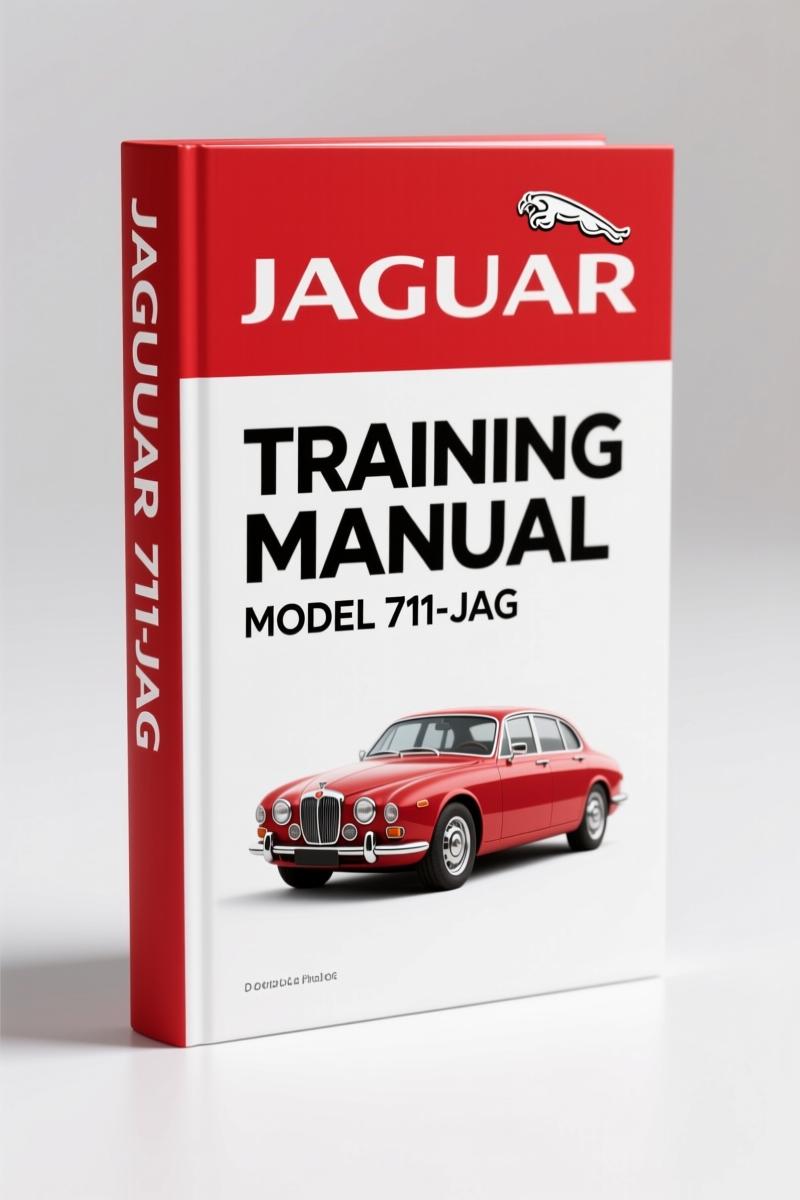
Jaguar 711-JAG 2011 Training Manual – OEM Climate Control Systems
Original price was: $41.40.$30.00Current price is: $30.00.
202-page OEM training manual for Jaguar climate control systems. Covers X350, X150, X250, X351, diagnostics, and refrigerant cycles.
Description
Jaguar 711-JAG 2011 Training Manual
Look, if you’re chasing a climate control gremlin on a Jaguar and you pull out a generic manual that tells you “all A/C systems are basically the same,” you’re asking for a head gasket-level headache. I’ve seen guys waste a full day chasing a pressure reading because the aftermarket chart was off by 15 psi. That doesn’t happen when you’re working from the actual factory training material. This Jaguar 711-JAG 2011 Training Manual was printed by Jaguar Land Rover North America LLC in March 2011. It runs 202 pages and it’s not a repair manual — it’s the technical training course they gave to dealer techs. You want to understand how Jaguar climate control systems work at the system level before you start swapping parts? This is your blueprint.
I’ve been torquing bolts since before some of you were born, and I can tell you the difference between this and a Haynes is night and day. Haynes tells you where the bolts are. This tells you why the system behaves the way it does — what the refrigerant is doing in the evaporator, how the control loop works, and how to read a pressure gauge set like a factory diagnostician. That’s the stuff that stops you from guessing.
Why This Training Manual Beats a Chilton’s
Aftermarket manuals lift data from multiple sources, sometimes wrong, sometimes outdated. This one is a direct OEM publication from Jaguar for the 711-JAG course. It’s not a reprint. It’s not a scan of a scan. Every diagram and pressure range came from the same engineers who designed the HVAC modules in the X350, X150, X250, and X351 platforms. If you’ve ever had a customer’s XJ come back with a low-side pressure complaint because you used generic R134a specs, you know exactly what I’m talking about. Factory spec is the only spec. Period.
System Fundamentals: More Than Just Refrigerant
The manual opens with Principles of Heat, Refrigeration Cycles, and Heating Cycles. Most DIY guys skip this because they want to get to the “fix.” That’s a mistake. You can’t diagnose a TXV restriction if you don’t understand subcooling and superheat. This section covers it with actual refrigerant behavior, not theory you’ll never use. And it uses Imperial units — pressures in psi, temperatures in °F. No conversion math needed on the shop floor.
X350, X150, X250, X351 – What’s Covered?
Each chassis gets its own chapter with Refrigeration System, Heating and Ventilation System, and Control System. That means you get the specific component locations, blower motor configurations, and blend door actuators for that model year range. For example, the X351 section covers the 2011 XJ — that’s the one with the dual-zone automatic and the rear auxiliary unit. If you’ve ever tried to figure out why the rear vents blow hot while the front blows cold, this is where you find out it’s a refrigerant flow issue, not a blend door problem. The auxiliary climate control system for the X350 is also detailed separately — something most aftermarket manuals bundle into one vague paragraph.
Climate Controlled Seats – Factory Procedure
Heated and cooled seats are a separate chapter. It breaks down the principles of operation for 2008–2009 XJ, 2009 onward XF, 2010 onward XK, and 2011 onward XJ. That’s important because the Peltier module and the blower control strategy changed between years. I’ve seen guys replace the seat module twice only to find out the wiring harness had a broken pin — because they didn’t have the factory test procedure. This manual gives you the operation sequence so you can diagnose without throwing parts at it.
System Diagnostics: Using Pressure Gauges the Right Way
The System Diagnostics section includes Pressure Gauge Diagnostics, Leak Detection, and Service. This isn’t a generic “low side low = low refrigerant” chart. It walks you through what the pressure readings actually mean on a running system, with the compressor cycling and without. If you’re a home garage enthusiast, this is the part that keeps you from overcharging the system and blowing a seal. And it tells you how to safely recover and recharge — which, by the way, is legally required in most of North America. Don’t vent refrigerant into the atmosphere. The manual won’t teach you to do that, but it will teach you the proper service procedure.
If you want a broader Automotive Industry Overview, that’s fine, but for Jaguar climate control, stick with OEM. Don’t confuse this with a Manual Transmission guide — this is purely climate control systems.
FAQ – What You’re Probably Wondering
- Is this a repair manual or a training manual?
- Training manual. It teaches theory and diagnostics, not step-by-step replacement.
- Will this manual help me fix the AC on my 2011 Jaguar XJ?
- Yes, but with a caveat. The X351 chapter covers the 2011 XJ’s climate control system at the system level — how the refrigerant circuit works, how the control unit processes inputs, and how the auxiliary unit operates. You will understand why something fails, but you still need a factory service manual for torque specs, wiring pinouts, and component removal procedures. This training manual gives you the diagnostic reasoning so you don’t waste time. I’ve used it to teach new techs how to approach a no-cool complaint without touching a single tool until they know what to test.
- Does it include wiring diagrams?
- It covers the control system operation — sensor inputs, actuator outputs, and communication between modules — but it doesn’t include full wiring schematics with connector views and pin numbers. You’ll want the Jaguar workshop manual for that. This training manual is about understanding the logic, not tracing every wire.
- What about refrigerant types and pressures?
- The System Fundamentals chapter explains the properties of R134a and the refrigeration cycle. The Pressure Gauge Diagnostics section shows you how to interpret high-side and low-side readings under different conditions. Specific charge quantities and pressure tables are not listed here — those vary by model and ambient temperature. Always cross-reference with the vehicle’s underhood label or the service manual.
Bottom line: If you’re serious about working on Jaguar climate control, you need the factory training material. This 202-page manual from 2011 is the real deal. Don’t get burned by aftermarket garbage. Access the Factory Manual and start diagnosing like a dealer tech.
Additional information
| Brand | Jaguar |
|---|---|
| Language | English |
3 reviews for Jaguar 711-JAG 2011 Training Manual – OEM Climate Control Systems
You may also like…
-
Sale!
Jaguar XK, XJ, S-Type, X-Type 2008 Diagnostics Manual – 152 Pages of Factory OBD II Data
Original price was: $62.55.$45.00Current price is: $45.00. -
Sale!
Jaguar XF 2014 Workshop Manual – OEM Factory Specs for X250 Series
Original price was: $60.30.$45.00Current price is: $45.00. -
Sale!
Jaguar XK, XF, XJ 2010 Diagnostics Manual – Factory OBD System Description
Original price was: $54.00.$40.00Current price is: $40.00. -
Sale!
Jaguar XK, XJ, S-Type, X-Type 2002 Training Manual – 246 Pages
Original price was: $158.00.$100.00Current price is: $100.00.
Related products
-
Sale!

1993 Electrical Schematic – International 1000/3000/4000 Bus Chassis OEM Wiring Diagrams
Original price was: $29.26.$22.00Current price is: $22.00. -
Sale!
Acura NSX 1991 Service Manual – 1420 Pages OEM
Original price was: $102.05.$65.00Current price is: $65.00. -
Sale!

Technical Manual – International 6.0L Power Stroke FICM Diagnostics
Original price was: $29.80.$20.00Current price is: $20.00. -
Sale!

2011 Parts Catalog – International Truck OE Parts Documentation (1786 Pages)
Original price was: $34.50.$25.00Current price is: $25.00.
Richard G. –
Excellent OEM spec sheet. It is easily zoomable on my iPad without blur. A must-have for any Jaguar 711JAG mechanic doing maintenance. Great value for money.
David K. –
Great buy! Immediate link after checkout process. It guided me to rebuild my Jaguar 711JAG transmission. Great value for money.
pro_mechanic –
Perfect OEM spec sheet. The pages are clean and well indexed. Contains precise schematics for Jaguar. Saves me a lot of time.