
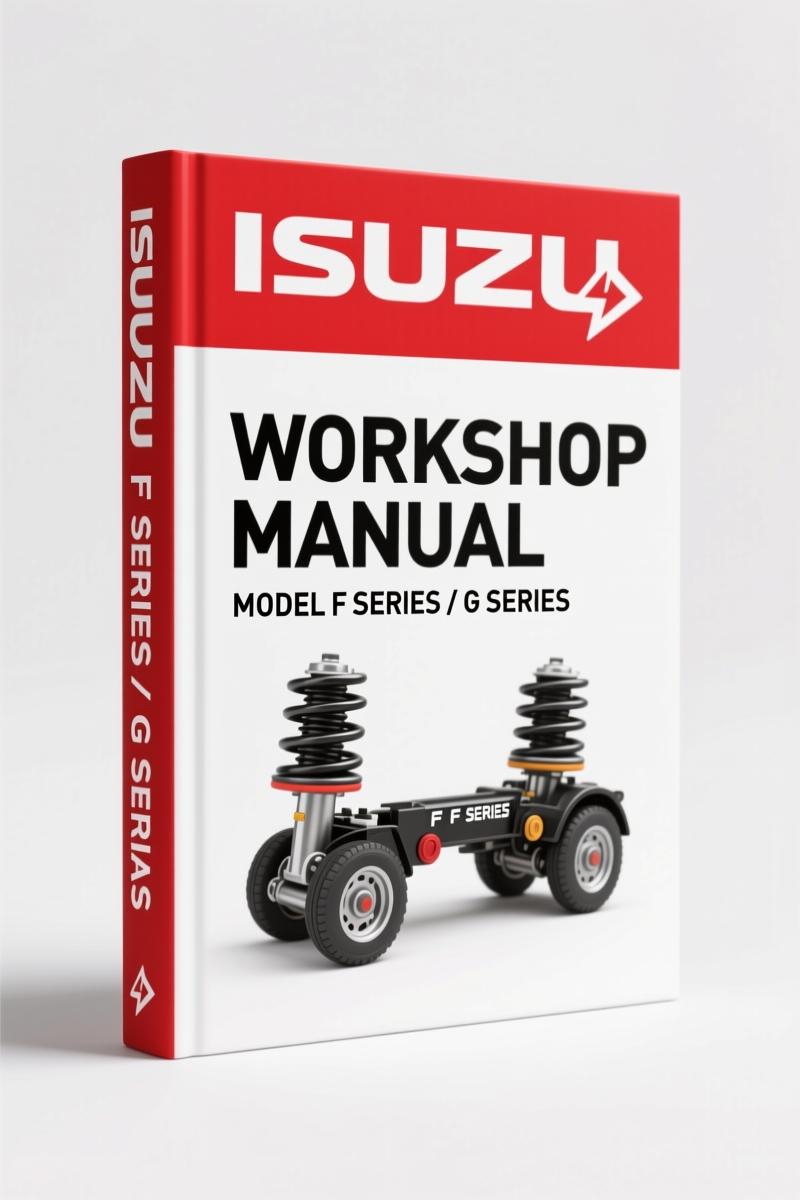
Isuzu F Series, G Series Workshop Manual – 396 Pages | OEM Specs
Original price was: $38.40.$30.00Current price is: $30.00.
Factory workshop manual for Isuzu F Series & G Series 4HK1 engine. Torque tables, failure checklists, cooling and fuel system procedures.
Description
Isuzu F Series, G Series Workshop Manual – 4HK1 Engine
Factory documentation is the difference between a job that holds together and a comeback that costs you a Saturday. That’s why this Isuzu F Series, G Series Workshop Manual for the 2008-2009 model years belongs on your bench, not buried in a folder. It’s 396 pages of OEM-sourced procedures for the 4HK1 diesel engine—no guesswork, no third-party translations, just the data Isuzu put into the truck at the factory.
I’ve torqued head bolts on enough 4HK1s to know that one wrong spec turns a job into a leak. This manual gives you the same numbers the line techs used. You want the tightening sequence for the cylinder head? It’s in the Cylinder Head section, with the torque values laid out per step. You need to know why the engine cranks but won’t fire? The Failure Phenomenon List (page 1B-14) walks you through nine symptoms including black smoke, white smoke, knocking, and charging failure. Each symptom has a diagnostic tree, not a paragraph of theory.
Engine Mechanical (4HK1): Full Disassembly and Inspection
The Engine Mechanical section covers the 4HK1 from the timing gear train to the cylinder block. There’s a removal and installation procedure for every major component—cylinder head cover, rocker arm shaft, camshaft assembly, pistons, crankshaft. Inspection instructions are included, like how to measure bearing clearance and check valve stem seals. If you’re rebuilding this engine, you’ll use the Special Tool list on page 1B-21 to make sure you have the right gear before you start. Skipping that step is how parts get damaged.
Every major assembly has its own “List of Tightening Torques.” The Cylinder Head section, for example, has a dedicated torque table. Use it. Don’t guess. I’ve seen warped heads from overtightening and blown gaskets from undertightening. The manual also covers the Valve Stem Seal and Valve Spring disassembly, the Flywheel removal, and the Front Cover installation—each with its own component diagram and fastener specs.
Diagnostics and Failure Phenomenon List
This isn’t a repair manual that hides the troubleshooting. The 4HK1Engine section starts with a Functional Inspection checklist and a Description of Function and Operation. Then it drops the Failure Phenomenon List. You get straight to “Engine does not run” and “Engine cranks but does not start.” Each phenomenon has a dedicated page with possible causes, inspection points, and corrective actions. For example, “Phenomenon: There is Much Black Exhaust Smoke” lists fuel injection timing and turbocharger issues. No fluff, no filler. You read the symptom, you test the listed components. If you need the fuel system further, the Engine Fuel (4HK1) section has its own failure list for “Starting is Difficult” and “Hunching when idling.”
Torque Specs and Tightening Procedures
Torque specs are scattered throughout the manual, but they’re always tied to a specific component. The Timing Gear Train has a tightening torque list. The Rocker Arm Shaft Assembly has its own. The Crankshaft, the Flywheel, the Cylinder Head—each gets its own table. I’d bet the primary specifications table on page 1B-21 includes the compression pressure and valve clearance values. That page is the one you’ll flag with a sticky note. Manuals from aftermarket publishers often round values or omit them. This one doesn’t. It’s OEM data, matched to the production line.
Engine Cooling and Fuel Systems Coverage
Beyond the mechanical side, this manual includes Engine Cooling (4HK1) and Engine Fuel (4HK1). The cooling section covers the water pump, thermostat, radiator, and drive belt. It includes a “Phenomenon: The Engine has Overheated” diagnosis just like the mechanical section. The fuel system section deals with the injection system, including “Phenomenon: Insufficient output” and “Phenomenon: Engine does not stop.” If you’re chasing a drivability problem, you’ll want both the mechanical and fuel diagnostics open. For broader vehicle coverage, check the 2008-2009 Isuzu F & G Series Suspension Workshop Manual and the Isuzu F & G Series 2008-2011 Workshop Manual if you need later model years. The engine control data is also available in the 2008-2009 Isuzu F&G Series 4HK1 Engine Control Manual.
OEM Documentation vs Aftermarket – Why It Matters
Aftermarket manuals rearrange content, omit safety warnings, and transcribe torque values wrong. This is the original factory publication. The wiring diagrams, tightening sequences, and diagnostic flows are identical to what Isuzu supplies to dealerships. You don’t have to wonder if the spec for the cylinder head is correct—it came from the assembly line. For a broader understanding of automotive industry standards, see Automotive Industry Overview. If you’re working on a manual transmission variant, refer to Manual Transmission for additional context.
396 pages, OEM data, no guesswork. If you’re paying shop rates for a 4HK1 rebuild or sinking your own Saturday into it, this manual pays for itself on the first torque spec you get right.
- Does this manual cover the 4HK1 engine?
- Yes, it covers the 4HK1 diesel engine in the F and G Series from 2008-2009.
- Are the torque specifications in imperial units?
- Yes, all torque specs are listed in foot-pounds (ft-lb) and inch-pounds (in-lb) where applicable. The manual uses imperial units throughout.
- What if I have a different Isuzu model?
- This manual is specific to the F Series and G Series with the 4HK1 engine. If you have a different model or year, you’ll need the corresponding factory manual. The table of contents shows that the manual covers only the engine section (1B, 1C, 1D, etc.) – the rest of the vehicle systems are not included in this volume. For non-engine repairs, you need separate manuals.
- Is this a reprint or a scanned PDF?
- It is a digital scan of the original factory-issued workshop manual, identical to what Isuzu dealers used.
Stop chasing wrong numbers. Access the Factory Manual and get the same data Isuzu techs rely on.
Additional information
| Brand | Isuzu |
|---|---|
| Language | English |
2 reviews for Isuzu F Series, G Series Workshop Manual – 396 Pages | OEM Specs
You may also like…
-
Sale!
Isuzu NPR, W3500, NQR, NPR-HD, NRR 2006 Service Manual – 37 Pages
Original price was: $93.00.$60.00Current price is: $60.00. -
Sale!
Isuzu AA-6SD1T Workshop Manual – 243 Pages of OEM Engine Service Data
Original price was: $89.70.$65.00Current price is: $65.00. -
Sale!
Isuzu FRR WT5500 2002 Service Manual | Factory Specs
Original price was: $92.40.$60.00Current price is: $60.00. -
Sale!
Isuzu FRR 1997 Service Manual – 755 Pages of Factory Specs
Original price was: $85.80.$65.00Current price is: $65.00.
Related products
-
Sale!

Technical Manual – International 6.0L Power Stroke FICM Diagnostics
Original price was: $29.80.$20.00Current price is: $20.00. -
Sale!

International 1000-3000 Series Operators Manual – 132 Pages of OEM Specs
Original price was: $14.40.$10.99Current price is: $10.99. -
Sale!

2011 Parts Catalog – International 7400 SFA 6X6 – 1886 Pages of OEM Part Numbers
Original price was: $32.00.$25.00Current price is: $25.00. -
Sale!
1996 Operators Manual – International 1000-4000 Series (246 pages)
Original price was: $15.28.$9.99Current price is: $9.99.
William H. –
Excellent factory service manual. Immediate link after checkout process. Contains precise schematics for Isuzu. I will recommend this shop to others.
James L. –
I am extremely satisfied with this purchase. The file is high resolution. A must-have for any Isuzu F owner doing repairs. Saves me so much dollars.