
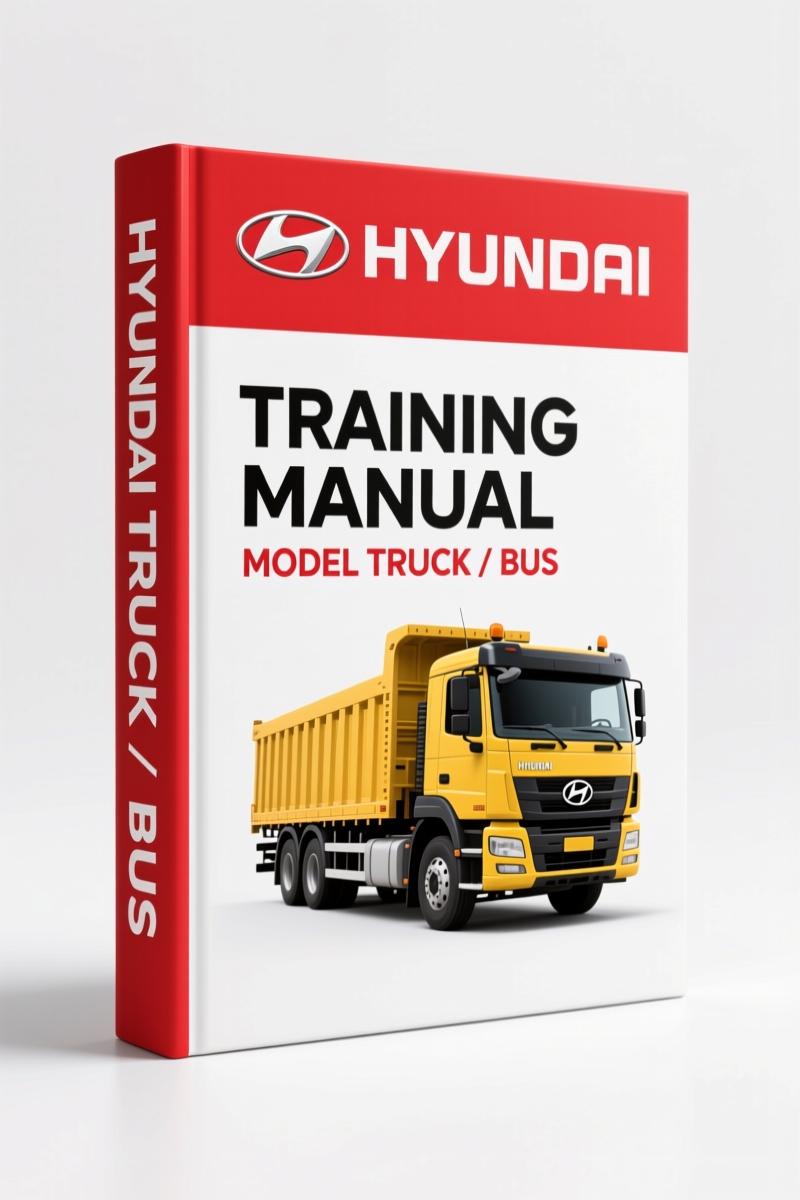
Hyundai Truck, Bus 2003 Training Manual – A/C System Factory Specs
Original price was: $34.50.$25.00Current price is: $25.00.
Factory training manual for Hyundai Truck and Bus A/C systems – 74 pages of refrigerant cycle theory and diagnostic procedures.
Description
Hyundai Truck, Bus 2003 Training Manual – Factory A/C Documentation
Look, I’ve pulled wrenches on everything from flatbed tow trucks to shuttle buses. When an A/C system goes down on a commercial vehicle in San Antonio heat, you don’t have time to guess. This Hyundai Truck, Bus 2003 Training Manual – specifically for their Truck and Bus line – is the same binder the factory techs used at Chonan Technical Service Training Center. It’s 74 pages of pure refrigerant circuit education, from the Carnot cycle to charging R-134a. Here’s why it belongs on your bench.
Cooling Cycle: Understanding Refrigerant Flow
Chapter 2 dives into the cooling cycle – and I mean the real physics, not some fluff. You get the standard vapor-compression cycle on page 19, the Carnot refrigeration cycle on page 15, and the expansion process on page 18. If you’re diagnosing a system that’s not pulling down, you need to understand wet compression versus dry compression (page 17). That section alone has saved me from condemning a compressor that was just slugging liquid.
Refrigerant Types and R-134a Specifications
Chapter 3 covers refrigerants from the ground up. Page 26 explains why Hyundai switched to R-134a – the purpose behind the change – and page 27 gives the full properties of R-134a. If you’re servicing a 2003-era Hyundai bus or truck, you aren’t dealing with R-12. This manual spells out the requirements a refrigerant must meet (page 22). That keeps you from cross-contaminating during charge work.
Vehicle A/C System: Real-World Application
Chapter 4 (page 29) maps the refrigerant flow and temperature-pressure changes through a truck or bus system. This isn’t a generic diagram – it’s laid out for Hyundai’s actual plumbing. You see where the condenser sits, how the receiver drier ties in, and what pressures you should expect. The Hyundai diagrams on page 32 are worth the price of the manual if you’ve ever chased a blockage in a long hose run.
How to Deal with A/C Components: Safe Handling
Chapter 6 is the section you read before you touch a wrench. It covers the compressor (page 50), condenser (page 52), receiver drier (page 52), expansion valve (page 53), evaporator (page 54), and A/C pipes (page 55). Each subsection gives you handling precautions and mounting procedures. The notes on compressor oil (page 50) are critical – the wrong viscosity kills the bearing in a month. That’s the kind of detail aftermarket manuals skip.
Servicing the A/C System: Correct Charge Procedure
Chapter 7 walks you through the tools you need (page 57), discharging (page 60), evacuating (page 62), and charging (page 65). The evacuation sequence is explicit – hold vacuum for a minimum time, then check for leak-down. If you’ve ever had a customer come back with a warm cab because you didn’t pull a deep enough vacuum, you’ll appreciate the factory spec on page 63. I keep a copy of these pages laminated in my service cart.
Diagnosis of A/C System: Pressure Inspection
Chapter 8 (page 67) gives you the diagnostic flow when the system isn’t cooling. You start with an inspection of refrigerant condition (page 67) – looking for bubbles, foam, or oil streaks. Then pressure inspection on page 69 – high-side and low-side readings mapped to specific faults. Stuck expansion valve? Clogged condenser? The chart on page 70 tells you before you start swapping parts. That’s how you avoid turning a two-hour diag into a two-day parts swap.
This Training Manual is an OEM product from Hyundai Motor Company’s Chonan Technical Service Training Center, 2003 publication. It is not a third-party copy or reprint. The 74 pages cover the Cooling cycle, refrigerant theory, component service, and troubleshooting for the entire Hyundai Truck and Bus line. If you are maintaining a fleet of commercial vehicles, this documentation pays for itself the first time you diagnose a tricky no-cool condition without calling the dealer.
Related documentation you should consider: the Hyundai Electrical System Training Manual covers the wiring behind the HVAC controls, and the HMC CV Identity Design Guidelines Truck & Bus gives you the vehicle specs. For brake systems, see the Hyundai Commercial Vehicles Brake System Training Manual. For broader industry context, refer to the Automotive Industry Overview and the Internal Combustion Engine background.
- Does this manual cover the entire A/C system?
- Yes. From the compressor to the evaporator, including pressure switches and thermistors. It does not cover heater core repair, only the refrigeration circuit.
- What year models are included?
- The manual is titled 2003 and applies to all Hyundai Truck and Bus models produced around that year. The content is based on the latest specs available at publication, so it covers 2002-2004 vehicles primarily. Use it as a training reference for similar model years.
- Is this manual for passenger cars?
- No. It is exclusively for Hyundai commercial vehicles – trucks and buses.
- Can I use this manual for diagnosing my own fleet?
- Absolutely. If you are a fleet mechanic or a serious DIYer with a Hyundai commercial vehicle, this gives you the factory theory and service procedures. The diagnosis chapter on page 67 walks you through pressure inspections and refrigerant condition checks that apply directly to real-world troubleshooting. I have used the expansion valve handling section (page 53) to repair a bus A/C that two other shops misdiagnosed. The manual assumes you have basic A/C tools but does not skip steps. It is particularly strong on explaining why you do each step – not just how. That kind of understanding prevents comebacks.
Access the Factory Manual now and keep it in your shop library. When a Hyundai bus rolls in with a warm cab, you will have the original factory resource – not some generic rewrite – to get it blowing cold again.
Additional information
| Brand | Hyundai |
|---|---|
| Language | English |
2 reviews for Hyundai Truck, Bus 2003 Training Manual – A/C System Factory Specs
You may also like…
-
Sale!
Hyundai HDF50III, HDF70III Service Manual – Factory Repair Specs
Original price was: $70.20.$45.00Current price is: $45.00. -
Sale!
Hyundai HDF15-5, HDF18-5 Service Manual – 227 Pages
Original price was: $61.65.$45.00Current price is: $45.00. -
Sale!

Hyundai HD65, HD72, County Training Manual – A/C Diagnostics
Original price was: $65.00.$50.00Current price is: $50.00.
Related products
-
Sale!

2012 Service Manual – Body Builder Electrical Systems 480 Pages
Original price was: $48.28.$34.00Current price is: $34.00. -
Sale!

1992 Electrical Schematic – OEM Wiring Diagrams for International 1000-3800
Original price was: $24.48.$18.00Current price is: $18.00. -
Sale!

2006 Service Manual – International DT 466E, 530E Diesel Engine
Original price was: $67.50.$50.00Current price is: $50.00. -
Sale!

Technical Manual – International 6.0L Power Stroke FICM Diagnostics
Original price was: $29.80.$20.00Current price is: $20.00.
gearhead88 –
This is exactly what I was looking for. The file quality is excellent. Contains clear schematics for Hyundai. Saved my weekend project! Thanks.
Robert M. –
Perfect workshop guide. The text is searchable and well indexed. Every spec sheet is included for Hyundai Truck,. Saved my weekend project! Thanks.