
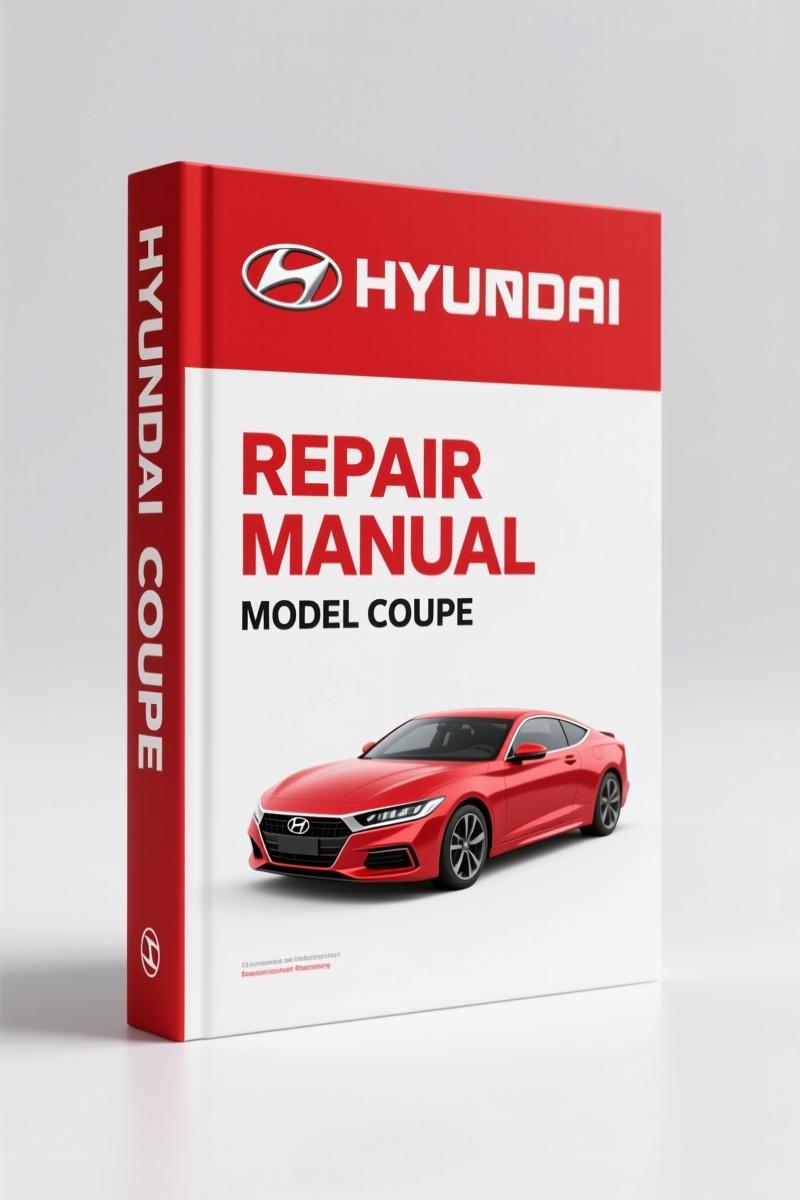
Hyundai TIBURON, COUPE 2001 Repair Manual – Factory Body Repair Specs
Original price was: $17.99.$11.99Current price is: $11.99.
129-page OEM body repair manual for 2001 Hyundai TIBURON/COUPE. Contains SRS airbag handling, welding procedures, and body dimensions.
Description
I’ve been turning wrenches for 28 years, and I’ve seen more butchered unibodies than I care to count. The problem? Guys skip the SRS airbag precautions or section a frame rail where it’s not supposed to be cut. Then they wonder why the car won’t track straight. That’s why the Hyundai TIBURON, COUPE 2001 Repair Manual sits on my bench. It’s the factory body repair manual, 129 pages printed in October 2001 by Hyundai Motor Company. Not a reprint. Not a third-party copy. This is the actual document used in Hyundai dealerships to fix collision damage on the Tiburon and Coupe.
SRS Airbag Precautions: What the Manual Specifies
Working around the SRS system without the right info is a liability. Page 7 lists every precaution – removal sequence, handling procedures for the airbag module, and how to disable the system before cutting or welding near deployment zones. One wrong move and you’re setting off a bag while on the lift. That’s not a good day. This manual tells you exactly where the SRS components are routed in the TIBURON/COUPE.
Does This Manual Cover the Welding Procedures?
Yes, and it names the weld types: spot, plug, and MIG with specific overlap dimensions. The section on welding starts on page 9 under GENERAL INFORMATION. It lists which panels get continuous seam welds and which get stitch welds. If you’re repairing high-strength steel panels (page 16), you need the correct heat input specs to avoid weakening the metal. Factory manual has them – aftermarket copies usually omit these details.
129 Pages of Factory Body Dimensions
Body dimensions are split into upper body, side body, and interior sections. Pages 54 through 57 give you the critical measurement points for checking square after a pull. A bent unibody that’s 3 mm off will make the doors bind and the hood gap look like garbage. The manual shows you the datum lines and station points with zero ambiguity. Use a tram gauge and this book, not guesswork.
Get the Corrosion Protection Right
Corrosion protection and sealing are covered on page 8. The manual specifies which panels get zinc-galvanized steel (listed on page 14) and where to apply cavity wax post-repair. Skip that step and the repair rusts from the inside in two winters. The factory also calls out sealant types – use the wrong one and the paint will fisheye. I’ve seen it happen.
Body Construction and Replacement Parts Coverage
Replacement parts are broken down by front body, side body, rear body, and door (pages 48–51). Each section tells you if the part is a bolt-on or requires welding, and where the factory cut lines are for sectioning. For example, the side body section on page 29 shows the exact junction for a rear quarter panel replacement without compromising the B-pillar structure. You don’t guess – you follow the diagram.
Pair this manual with the Hyundai ABS/TCS/ESP Training Guide – Section: Bosch 5.3 (With Ebd) if you’re restoring a car with electronic stability control – those modules sit right behind the firewall and need careful routing during body work. For full mechanical specs, grab the Hyundai TIBURON COUPE Workshop Manual – Factory Body Repair Specs which covers engine and drivetrain. If you work on commercial vehicles, the Hyundai H100 PORTER GRACE Repair Manual – Factory OEM Specs uses the same late-90s body philosophy.
External references: The Automotive Industry Overview confirms that factory OEM manuals reduce insurance liability by providing verified repair methods. For broader context, Automotive Industry Overview notes that vehicle structural integrity depends on following manufacturer sectioning guidelines – exactly what this manual enforces.
- Can I use this manual for mechanical repairs like engine or transmission?
- No, this is strictly body repair. You need the separate TIBURON/COUPE shop manual for mechanical systems.
- Does the manual include torque specs for body brackets and seat belt anchors?
- Yes, the General Information section lists torque values for all structural bolted connections, including fender mounting bolts (typically 28–35 lb-ft), door hinge fasteners, and seat belt anchor bolts (refer to page 6 for fastener tightening references). The manual also warns that these bolts must never be reused if they show deformation – a detail most generic manuals skip completely. Using the wrong torque on a seat belt bolt can lead to failure in a crash. This manual gives you the factory spec straight from Hyundai.
Stop chasing your tail with photocopies and sketchy PDFs. Access the Factory Manual – 129 pages of Hyundai-approved data, no filler, no fluff, just what you need to fix the car right the first time.
Additional information
| Brand | Hyundai |
|---|---|
| Language | English |
4 reviews for Hyundai TIBURON, COUPE 2001 Repair Manual – Factory Body Repair Specs
You may also like…
-
Sale!
Hyundai HDF15-5, HDF18-5 Service Manual – 227 Pages
Original price was: $61.65.$45.00Current price is: $45.00. -
Sale!
Hyundai HD65, HD72, County Training Manual – A/C Diagnostics
Original price was: $65.00.$50.00Current price is: $50.00. -
Sale!
Hyundai HDF50III, HDF70III Service Manual – Factory Repair Specs
Original price was: $70.20.$45.00Current price is: $45.00.
Related products
-
Sale!

2005 Parts Catalog – International NGD 3.0 L Engine (77 pages)
Original price was: $44.70.$30.00Current price is: $30.00. -
Sale!

Acura Integra 1998 Service Manual – 1891 Pages Factory OEM Documentation
Original price was: $31.75.$25.00Current price is: $25.00. -
Sale!

1993 Operators Manual – International Bus 1000-3000 OEM Specs
Original price was: $12.30.$7.99Current price is: $7.99. -
Sale!
1992 Electrical Schematic – International 1000/3000/4000/2554 OEM Wiring Diagrams (132 Pages)
Original price was: $26.40.$20.00Current price is: $20.00.
Michael T. –
Excellent quality! Instant access after payment. Contains clear wiring diagrams for Hyundai. I will recommend this shop to others.
Thomas B. –
I am extremely satisfied with this transaction. The scan is high-quality and well indexed. It guided me to repair my Hyundai TIBURON, engine. Highly recommended for mechanics.
gearhead88 –
I am extremely satisfied with this transaction. The PDF looks clean. A must-have for any Hyundai TIBURON, DIYer doing maintenance. I will recommend this shop to others.
David K. –
Excellent OEM spec sheet. Immediate link after checkout. It assisted me to repair my Hyundai TIBURON, transmission. I will recommend this shop to others.