
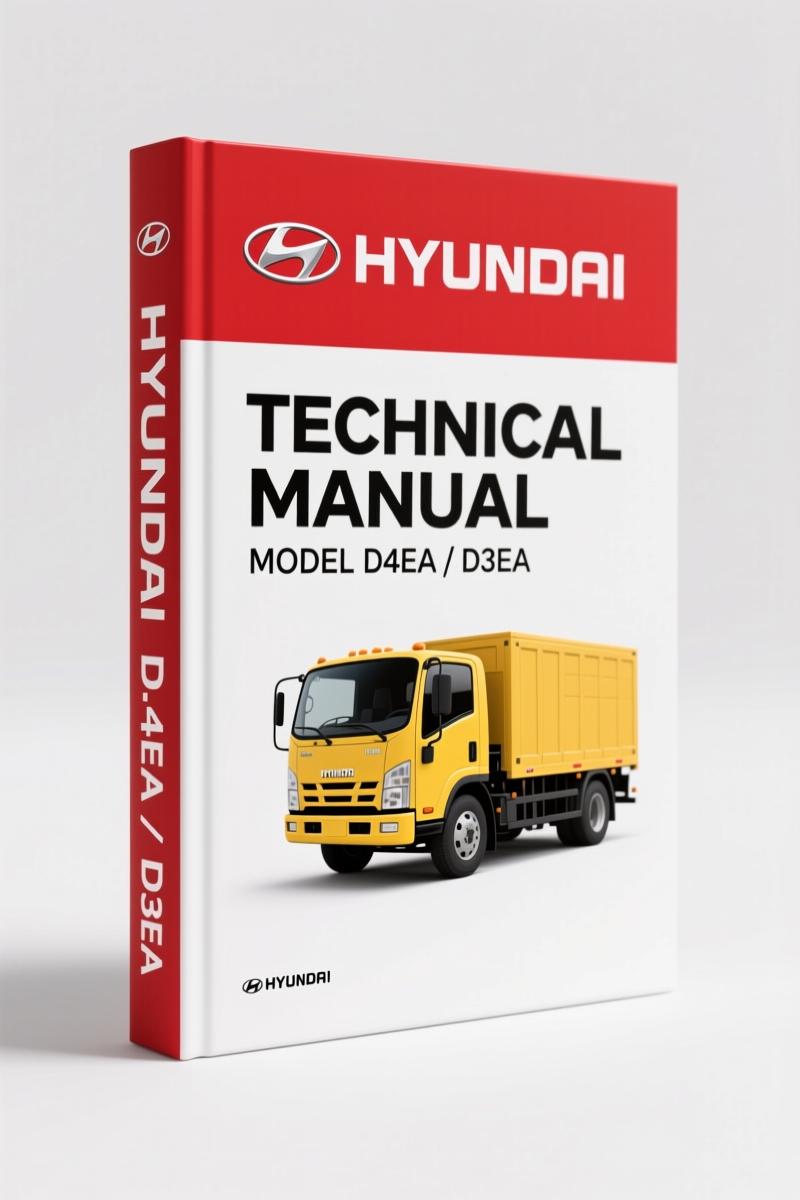
Hyundai D4Ea Technical Manual – Factory Engine Specs & Repair
Original price was: $29.03.$22.50Current price is: $22.50.
Factory document for D4EA engine: 90 pages covering mechanical systems, cylinder head specs, cooling, lubrication, and timing. Metric units, OEM torque data.
Description
Hyundai D4Ea Technical Manual – 90 Pages of Factory Diesel Engine Data
If you are working on a Hyundai D4Ea diesel engine, you need the actual factory Technical Manual, not some aftermarket rewrite that leaves out half the torque specs. I have seen too many guys try to wing it with generic diesel guides and end up with a cylinder head that leaks or a timing system that jumps a tooth. This manual is 90 pages of straight OEM content – the same documents Hyundai dealerships use. Page 2 carries a warning you cannot ignore: the injection system runs at 1850 bar. That is not a joke. You let pressure bleed off for 30 seconds after shutdown, or you get fuel injection that can penetrate skin. The manual tells you that in plain language because Hyundai expects technicians to read it before touching anything.
Working on these engines means dealing with the Engine Mechanical System – the block, main moving system, cooling, lubrication, intake/exhaust, cylinder head, and timing system. Each section is laid out in sequence with part numbers, wear limits, and overhaul steps. Page 5 includes specifications you will need for every rebuild: bore 83 mm, stroke 92 mm, compression ratio 17.7:1, firing order 1-3-4-2. Also valve timing angles – intake opens 7° BTDC, closes 43° ABDC; exhaust opens 52° BBDC, closes 6° ATDC. If you are checking camshaft wear, the cam height limits are right there: intake minimum 34.197 mm, exhaust minimum 34.070 mm.
Engine Block and Cylinder Head: Factory Clearances and Limits
The manual covers the Cylinder head gasket surface flatness – max 0.03 mm, limit 0.2 mm – and oversize valve seat rework dimensions for both intake and exhaust. For example, intake 0.3 mm oversize hole diameter is 29.968-30.000 mm. Valve guide oversize holes are also listed for 0.05 mm, 0.25 mm, and 0.50 mm increments. You do not guess these numbers; the manual gives them in both metric and imperial. Same for the engine block bore wear limits. If you have a D4Ea that has been overheated, you need these spec to decide whether to bore or replace.
7 Systems Covered in the Hyundai D4Ea Technical Manual
Seven distinct system sections run from General (with that high-pressure fuel warning) through to Timing System. The Cooling System section tells you the exact coolant flow route, thermostat rating, and water pump removal procedure. The Lubrication System covers oil pump specs, relief valve settings, and oil filter bypass details. Each section has its own torque table – not generic values, but the Nm (lb-ft) numbers for that specific bolt or nut on the D4Ea. I have used these tables on the bench; they match the bolts on the engine.
Does This Manual Cover the Fuel Injection System?
It covers the safety procedures and high-pressure pump removal. But the manual focuses on the mechanical side of the engine – it does not dive into injector calibration or ECU tuning. What it does give you is the exact procedure for removing the injector and high-pressure pump (with the engine off and after waiting 30 seconds). The caution about absolute cleanliness is emphasized: one speck of dirt in a 1850 bar system can destroy an injector tip. For inline pump work, pair this manual with the Hyundai Kia D4Ea D3Ea Engine Mechanical Manual”>Hyundai Kia D4Ea D3Ea Engine Mechanical Manual for overlapping specs.
Torque Specs and Fluid Capacities: Where to Find Them
Torque values are scattered through every system section, not just in the front. Page 3 and 4 have the main torque charts – but the cylinder head bolts get their own listing in the Cylinder Head Assembly section, and the main bearing cap bolts are in Main Moving System. You need to flip to each section because the values change with bolt grade and location. For fluid capacities, the manual does not list them in a single table – they are embedded in the cooling and lubrication chapters. But the OEM numbers are there if you read carefully.
Source Validity: Why OEM Beats Aftermarket
Aftermarket manuals will tell you the D4Ea has a compression ratio around 17:1. This one says 17.7:1. That half-point difference matters when you are checking leak-down numbers. Aftermarket reprints often skip the torque tables or show generic diesel values. This is a direct scan of the Hyundai factory document – page numbers intact, safety warnings in bold, and the “WARNING” block about high-pressure fuel is exactly as Hyundai wrote it. For electrical schematic work on related models, check the Hyundai D4Ea, G4KA, G4FC 2010 Electrical Schematic – Factory Specs”>Hyundai D4Ea, G4KA, G4FC 2010 Electrical Schematic – Factory Specs. For a broader view of diesel engine mechanical systems, see the Hyundai Universe Technical Manual – 16-Page OEM Spec Reference”>Hyundai Universe Technical Manual – 16-Page OEM Spec Reference.
Get the Right Torque Data: Avoiding Leaks and Failures
One wrong torque on a cylinder head bolt can cause a head gasket leak within 500 miles. The manual includes the tightening sequence and angle specifications for the D4Ea head. Same for main bearing caps: you need the correct angle after the initial torque. The timing system section gives you the belt tension and alignment marks – not a generic “tighten until snug” instruction. If you do not have this manual, you are guessing. I have seen too many engines come back with oil leaks because someone used a generic torque value from a forum.
FAQ: Common Questions About This Hyundai D4Ea Technical Manual
- How many pages does the manual have?
- 90 pages of OEM content, including full torque tables and specifications for the D4Ea engine.
- Does it cover the timing belt replacement procedure?
- Yes. The Timing System section covers belt tension, alignment marks, and replacement steps. It does not include water pump removal, but the Cooling System section addresses that separately.
- Can I use this manual for the D4EB or other Hyundai diesel variants?
- No. This manual is specifically for the D4Ea. Other variants like D4EB have different bore/stroke and injection systems. Using specs from this manual on a different engine can cause serious damage. Always use the manual matched to your engine code.
- What safety warnings are in the manual?
- Page 2 carries a prominent warning about the high-pressure fuel system (1850 bar). It also warns against working on the fuel system with the engine running or within 30 seconds after shutdown. Additional cautions about cleanliness and injector handling are repeated throughout the General section.
If you want to avoid comebacks, stuck bolts, and blown gaskets, get the factory data on your workbench. Access the Factory Manual now and print the torque tables to keep in your toolbox.
- Related: Hyundai Kia D4Ea D3Ea Engine Mechanical Manual”>Hyundai Kia D4Ea D3Ea Engine Mechanical Manual
- Related: Hyundai D4Ea, G4KA, G4FC 2010 Electrical Schematic – Factory Specs”>Hyundai D4Ea, G4KA, G4FC 2010 Electrical Schematic – Factory Specs
- Related: Hyundai Universe Technical Manual – 16-Page OEM Spec Reference”>Hyundai Universe Technical Manual – 16-Page OEM Spec Reference
- External: Automotive Industry Overview”>Automotive Industry Overview
- External: Manual Transmission”>Manual Transmission
Additional information
| Brand | Hyundai |
|---|---|
| Language | English |
2 reviews for Hyundai D4Ea Technical Manual – Factory Engine Specs & Repair
You may also like…
-
Sale!

Hyundai HDF15-5, HDF18-5 Service Manual – 227 Pages
Original price was: $61.65.$45.00Current price is: $45.00. -
Sale!

Hyundai HDF50III, HDF70III Service Manual – Factory Repair Specs
Original price was: $70.20.$45.00Current price is: $45.00. -
Sale!

Hyundai HD65, HD72, County Training Manual – A/C Diagnostics
Original price was: $65.00.$50.00Current price is: $50.00.
Related products
-
Sale!

1993 Electrical Schematic – International 1000/3000/4000 Bus Chassis OEM Wiring Diagrams
Original price was: $29.26.$22.00Current price is: $22.00. -
Sale!

Technical Manual – International 6.0L Power Stroke FICM Diagnostics
Original price was: $29.80.$20.00Current price is: $20.00. -
Sale!

1991 Operators Manual – International Truck OEM Specs (108 Pages)
Original price was: $13.63.$10.99Current price is: $10.99. -
Sale!

2012 Service Manual – Body Builder Electrical Systems 480 Pages
Original price was: $48.28.$34.00Current price is: $34.00.
gearhead88 –
I am so happy with this purchase. It is very easy to read on my iPad without blur. Contains detailed bolt torque specs for Hyundai. Saved my weekend project! Thanks.
Robert M. –
This is exactly what I was looking for. The file quality is excellent. Contains detailed schematics for Hyundai. Saved my repair job! Thank you.