
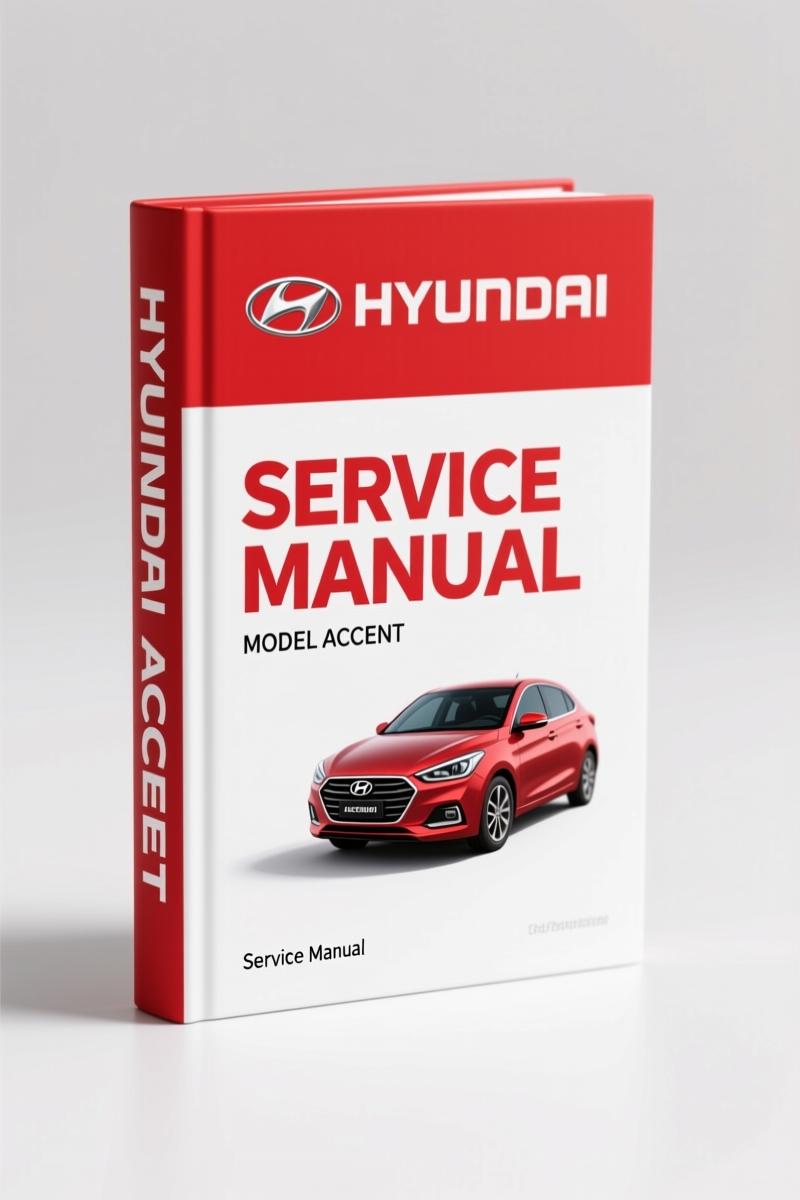
Hyundai ACCENT 2009 Service Manual – 1924 Pages of Factory Specs
Original price was: $24.00.$20.00Current price is: $20.00.
Factory service manual for Hyundai ACCENT 2009. 1924 pages covering engine, electrical, fuel, suspension, brake. OEM specs for professional repair.
Description
Hyundai ACCENT 2009 Service Manual
If you are pulling a head on a 1.6 DOHC Accent and don’t have the factory specs, you are working blind. I have seen more than one customer bring in a car with a warped head because someone guessed on the torque sequence. This manual is 1924 pages of Hyundai ACCENT 2009 Service Manual data – straight from the OEM. No aftermarket rewrite, no guesswork. You get the same document the dealer techs use. I want you to read the VIN decoding on page 2 of the General Information section – that alone tells you exactly which engine, transaxle, and restraint system you are dealing with. That is the kind of detail that keeps you from ordering the wrong part.
Engine Mechanical System (EM): What the Factory Wants You to Do
Chapter 2 – EM covers the 1.6 DOHC engine from block to valve cover. The manual gives you the exact bearing clearance specs, ring end gap tolerances, and – this is important – the head bolt torque procedure in the correct order. Do not skip the sequence. I have seen engines knock because someone tightened the intake side first. The manual spells it out. It also includes the engine number location (page GI-4) so you can verify the production year and displacement before you order pistons. If you are rebuilding, you need this chapter.
Electrical and Body Electrical – 2 Chapters That Save Your Weekend
Chapters EE (Engine Electrical) and BE (Body Electrical System) cover the charging, starting, and all body electronics. The wiring diagrams in EE are laid out by system – not generic. Need the crank position sensor pinout? It is in there. The BE section includes the interior lighting, power windows, and the dreaded BCM. I watched a guy spend three hours tracing a parasitic draw because he used a generic diagram. Factory wiring is color-coded and component-located. The manual also includes the ABS system under Brake System (BR) – but if you need a deeper dive on ABS logic, check the Hyundai ABS/TCS/ESP Training Guide – Section: Bosch 5.3 (With Ebd). That training guide is a separate resource, but the factory manual gets the basics right.
Does This Manual Cover the Fuel System?
Yes – Chapter FL (Fuel System) is dedicated to the fuel delivery, injectors, and the evaporative emission controls. The manual gives you the fuel pressure spec – not a range, a specific value – and the procedure for checking it at the service port. If you are replacing the fuel pump, the manual tells you the exact fastening torque for the module lock ring. Aftermarket manuals often skip that and you end up with a leak. Do not risk fire. The Fuel System chapter also ties into EC (Emission Control System) for the purge solenoid and canister. These are separate chapters, but they work together. For a related older model, the Hyundai Accent Excel 2000 Body Repair Manual covers the body structure on that generation, but for the 2009 driveability, stick to this 2009 manual.
Now, let’s talk about the Suspension System (SS) and Steering System (ST). Chapter 10 (SS) covers front and rear suspension, including the strut assembly, lower control arm, and stabilizer bar. The manual includes the wheel alignment specs – caster, camber, toe – with the acceptable tolerances. Do not trust a generic alignment rack printout without confirming it against these factory values. I have seen cars pull right because the shop used spec for a different model year. Chapter 11 (ST) covers the steering column, rack, and power steering pump. The torque for the steering column bolts is critical for safety – the manual lists it. I also recommend the Hyundai ACCENT 2006 Body Repair Manual if you are doing body panel replacement, but for mechanical alignment, use the 2009 service manual.
3 Reasons to Choose an OEM Service Manual Over Aftermarket
First, the torque specs. The manual gives you bolt torque for every fastener – from the brake caliper bracket (80 ft-lbs, for example) to the transmission bellhousing bolts. Aftermarket manuals often round or generalize. Second, the diagnostic logic. The factory manual includes system function tests – not just component tests. For the Brake System (BR), it includes the ABS hydraulic control unit bleed procedure. Third, the safety information. The Restraint System (RT) chapter covers the SRS deployment procedure, the side airbag warning label locations (page 4 mentions the caution labels for airbag handling). You are dealing with explosive devices – you want the OEM procedures.
Torque Specs and Fluid Capacities – Factory Data You Can Trust
Every bolt in the 2009 Accent has a specified torque in the relevant chapter. For example, the cylinder head bolts: the manual gives the angle-tightening sequence. The transaxle fluid capacity for the M5CF1 manual transaxle is listed in the MT chapter. The automatic transaxle (A4AF3) fluid type and capacity are in AT. Do not top off with random ATF. The manual says the exact fill procedure. If you are working on the braking system, the BR chapter includes the brake fluid type (DOT 3 or 4) and the bleeding sequence. That is the kind of detail that keeps a pedal from feeling spongy. For more context on the automotive industry’s shift to digital manuals, see Automotive Industry Overview and also Automotive Industry Overview from a different perspective.
FAQ – Common Questions About This Manual
- Is this the same manual that Hyundai dealers use?
- Yes. It is the official factory service manual published for the 2009 Hyundai Accent. The same PDF that dealer techs access through Hyundai’s technical information system. No edits, no reprints.
- Does it cover the 1.6L CVVT engine?
- Yes. The engine identification section shows the engine code – 1.6 DOHC with CVVT. The manual covers both standard and CVVT variants. The timing chain replacement procedure is in the EM chapter.
- What about the automatic transaxle?
- The AT chapter covers the A4AF3 automatic transaxle. Includes the clutch pack clearance, valve body bolt torque, and the diagnostic trouble codes. You can rebuild it with this manual.
- Can I print this manual?
- The PDF is fully printable. 1924 pages – you can print specific sections as needed. No restrictions.
Look, I have been turning wrenches since before most of these cars were built. If you want to work on a 2009 Accent and do it right, you need the factory documentation. This is it – 1924 pages of OEM procedures, torque values, and wiring. Access the Factory Manual and get the job done without second-guessing.
Additional information
| Brand | Hyundai |
|---|---|
| Language | English |
3 reviews for Hyundai ACCENT 2009 Service Manual – 1924 Pages of Factory Specs
You may also like…
-
Sale!
Hyundai HDF50III, HDF70III Service Manual – Factory Repair Specs
Original price was: $70.20.$45.00Current price is: $45.00. -
Sale!
Hyundai HDF15-5, HDF18-5 Service Manual – 227 Pages
Original price was: $61.65.$45.00Current price is: $45.00. -
Sale!
Hyundai HD65, HD72, County Training Manual – A/C Diagnostics
Original price was: $65.00.$50.00Current price is: $50.00.
Related products
-
Sale!

1989 Service Manual – International 2000-8000 Electrical Systems
Original price was: $72.00.$50.00Current price is: $50.00. -
Sale!

2011 Parts Catalog – International 7400 SFA 6X6 – 1886 Pages of OEM Part Numbers
Original price was: $32.00.$25.00Current price is: $25.00. -
Sale!

2011 Parts Catalog – International Truck OE Parts Documentation (1786 Pages)
Original price was: $34.50.$25.00Current price is: $25.00. -
Sale!
2004 Acura TSX Wiring Diagram – 73-Page Factory Electrical Schematics
Original price was: $15.88.$9.99Current price is: $9.99.
Richard G. –
This is exactly what I required. The PDF looks clean. It assisted me to rebuild my Hyundai ACCENT transmission. Saves me so much money.
pro_mechanic –
I am so happy with this manual. Instant access after payment. Contains clear schematics for Hyundai. Saved my repair job! Thanks.
workshop_guy –
This is exactly what I was looking for. The PDF is very clear. Contains detailed schematics for Hyundai. Highly recommended for mechanics.