
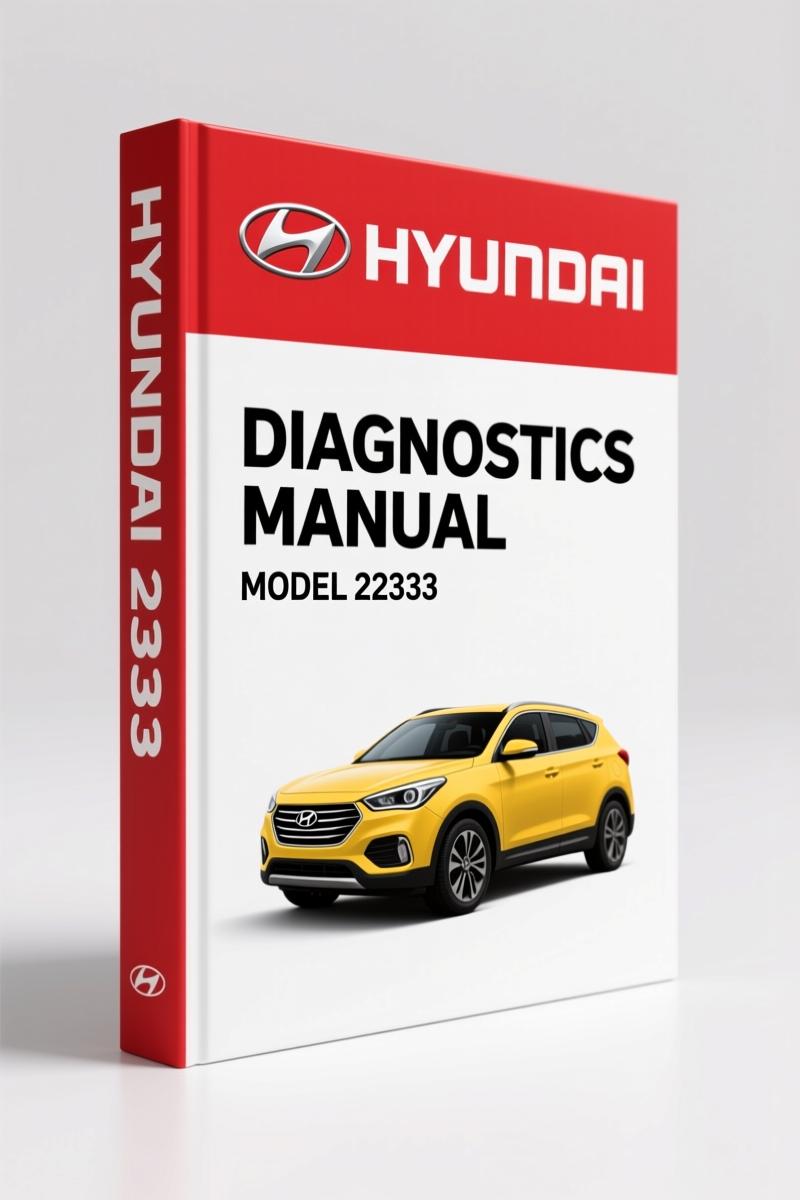
Hyundai 22333 Diagnostics Manual – OEM CEL Code Reference
Original price was: $37.54.$26.25Current price is: $26.25.
19-page OEM diagnostics manual for Hyundai 22333. Factory-specific CEL code definitions – P1100 to P1195. No generic interpretations.
Description
Let me save you some headache. I’ve seen techs spend half a shift chasing a code like P1123 or P1184 because they used a generic OBD-II decoder that says “fuel trim rich” without giving you the real Hyundai-specific meaning. That’s wasted time, and in my shop, time is money. The Hyundai 22333 Diagnostics Manual is 19 pages of factory trouble codes—no third-party interpretation. This is the exact document Hyundai built for their dealers. If you’re working on a 22333 and you don’t have this, you’re guessing.
MAP Sensor and Air Flow Codes (P1100–P1107)
Page 1 of the manual starts with the MAP sensor. P1100 “Map Sensor – Malfunction” is not the same as a generic P0106. The factory breaks down each failure mode: abnormal, low input, high input. Air flow codes P1104–P1107 follow the same breakdown. When you’re testing with a multimeter, you need to know what “low input” means for that specific sensor circuit. This manual gives you the exact code definitions so you know where to probe first. Skip the aftermarket lookup tables.
Fuel System and Pump Codes (P1108–P1119)
Fuel pump codes P1108 through P1111 cover abnormal, stuck on, and electrical faults. There’s also the ETS system (Electronic Throttle System) code at P1110—yes, that one lives inside the fuel pump block. That’s the kind of weird grouping you only get from factory documentation. P1112 and P1113 cover the manifold differential pressure sensor, and P1115 gives you coolant temperature input abnormal. If you’re swapping parts without cross-referencing these definitions, you’re burning money.
ETS and Governor System Codes (P1120–P1130)
P1120 appears twice: Electric Governor Malfunction and Inlet Metering Valve Malfunction. The manual keys each one to a specific subsystem. P1121 includes APS PWM output circuit and throttle position input abnormal. That’s critical for throttle-by-wire diagnostics. P1123 and P1124 cover fuel system rich/lean at idle. P1127 and P1128 do the same for part load. The code tables are arranged by system, not by number sequence—you’ll see P1127 listed as “Fuel System Rich – Part Load” followed by “Control Sleeve Position Sensor”. That’s the factory’s logic. Learn it.
Injection and Sensor Calibration Codes (P1131–P1155)
P1131 is injection quantity adjustment. P1134 is O2 sensor transition time (Bank 1/Sensor 1). P1135 is injection timing servo. P1140 is inlet air temperature sensor. P1141 and P1145 are slow and main duty solenoids. P1146 idle CO potentiometer—if you’re old school like me, you remember those. P1150 barometric pressure sensor, P1151–P1153 accelerator position sensor circuits. P1154 O2 transition time Bank 2/Sensor 1. P1155 limp home valve. Each code has the exact Hyundai definition so you don’t waste time on irrelevant tests.
Oxygen Sensor and Fuel Pressure Regulation (P1159–P1195)
P1159 variable induction system. P1162 high pressure pump and fuel line. P1166 and P1167 O2 sensor control adaptation for both banks. P1168–P1169 O2 heater power circuits. P1170 ECM barometric pressure sensor. P1171–P1179 ETS valve and motor faults—these are the ones that will drive you crazy if you don’t have the factory breakdown of stuck open, stuck close, motor open/short, power open, position feedback mismatch. P1180–P1184 are fuel pressure regulator codes, including open, short, power, and no activity. The manual ends with P1185–P1195 covering fuel position, low pressure, regulator stuck, leakage, governor deviation, intake throttle actuator, ETS limp home valve and related malfunction modes.
Does this manual include wiring diagrams or torque specs? No. This is a diagnostics manual—19 pages of pure code definitions and context. For the Hyundai 22333, that’s exactly what you need when the check engine light is on and you’re scrolling through a scan tool. You can pair it with a full service manual for repair steps, but if you’re diagnosing, start here.
Why OEM Trumps Aftermarket Code Lists
I’ve got a stack of aftermarket code books that list P1123 as “fuel trim rich” and leave you hanging. The Hyundai factory manual tells you it’s “Fuel System Rich – Idle” and ties it to idle speed control logic. That difference matters when you’re deciding whether to clean the throttle body or replace an injector. Aftermarket publishers rearrange codes, merge definitions, and drop sub-codes. This manual is a direct scan of the Hyundai dealer document. You get the original page layout, the exact wording, and the factory grouping. If you’ve been burned by a $20 eBook that reprints generic info, you know the value of this.
For related material, check out Hyundai Diagnostic Trouble Codes New 7th Edition if you need a broader code reference across multiple models. For engine-specific procedures, the Hyundai D4Dd Engine DTC Troubleshooting Manual – Section: P2504 goes deeper on that particular code. And if you’re working on the D4DD platform, Hyundai D4DD Engine DTC Trouble Shooting Procedures gives you step-by-step diagnostic flows. For general background on how OEM diagnostic systems evolved, you can read the Automotive Industry Overview and Automotive Industry Overview (note: that link is for reference only—Hyundai manuals live here at AutoRepairManuals).
FAQ
- How many pages is the manual?
- 19 pages. Exactly as scanned from the factory PDF.
- Will this manual tell me how to repair the problems it lists?
- This manual is a diagnostics reference, not a repair guide. It lists the trouble codes with their Hyundai-specific names and context (e.g., “P1162 High Pressure Pump & Fuel Line”). For repair procedures—torque specs, wiring diagrams, component removal—you need the factory service manual for the Hyundai 22333. But without the correct code definition, you can’t start the repair. Start here, then go to the service manual.
When the check engine light is on and you’re pulling codes on a Hyundai 22333, you need the real deal—not a generic table scraped from some forum. This 19-page factory diagnostics manual gives you the exact code definitions Hyundai uses. No fluff, no reprints. Every code from P1100 to P1195 is there, organized by system. If you want to stop chasing wrong leads, Access the Factory Manual.
Additional information
| Brand | Hyundai |
|---|---|
| Language | English |
2 reviews for Hyundai 22333 Diagnostics Manual – OEM CEL Code Reference
You may also like…
-
Sale!

Hyundai HD65, HD72, County Training Manual – A/C Diagnostics
Original price was: $65.00.$50.00Current price is: $50.00. -
Sale!
Hyundai HDF15-5, HDF18-5 Service Manual – 227 Pages
Original price was: $61.65.$45.00Current price is: $45.00. -
Sale!
Hyundai HDF50III, HDF70III Service Manual – Factory Repair Specs
Original price was: $70.20.$45.00Current price is: $45.00.
Related products
-
Sale!

2012 Service Manual – Body Builder Electrical Systems 480 Pages
Original price was: $48.28.$34.00Current price is: $34.00. -
Sale!

1996 Operators Manual – International 1000-4000 Series (246 pages)
Original price was: $15.28.$9.99Current price is: $9.99. -
Sale!
1993 Operators Manual – International Bus 1000-3000 OEM Specs
Original price was: $12.30.$7.99Current price is: $7.99. -
Sale!
1991 Electrical Schematic – 112-Page OEM Wiring Diagram for International 1000-3000 Series
Original price was: $22.75.$17.50Current price is: $17.50.
David K. –
Perfect factory service manual. The text is searchable and well indexed. Contains clear schematics for Hyundai. Saves me so much dollars.
Thomas B. –
Great factory service manual. The PDF is high resolution. Contains clear bolt torque specs for Hyundai. Great value for money.