
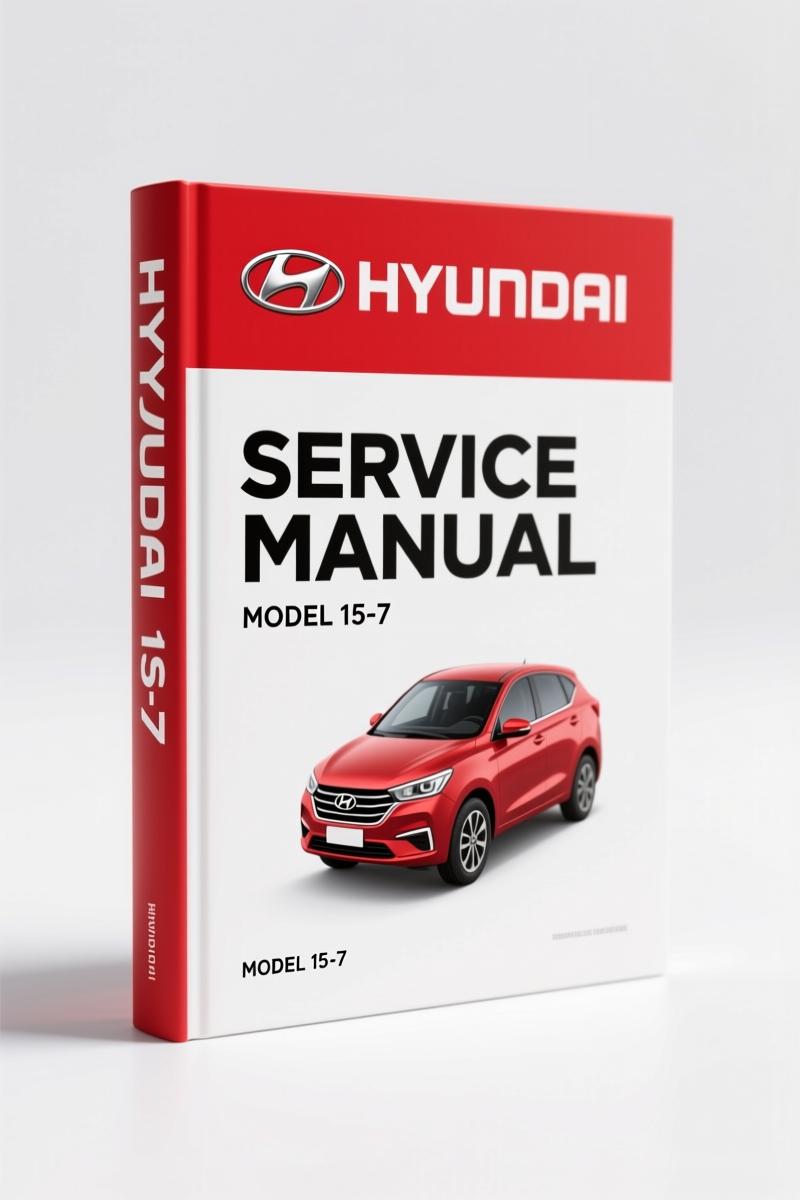
Hyundai 15-7 Service Manual – Factory Specs for Engine & Hydraulics
Original price was: $45.15.$35.00Current price is: $35.00.
OEM service manual for Hyundai 15-7: 119 pages of factory specs, engine overhaul, hydraulic system, and troubleshooting.
Description
Hyundai 15-7 Service Manual – What You Actually Get
I’ve seen it too many times – a guy brings in an excavator with a blown hydraulic line, pulls out some third-party PDF, and the torque values are off by 20 ft-lbs. Then he’s back ordering a new fitting because the old one stripped. The Hyundai 15-7 Service Manual is the original factory document. Not a copy. Not a reprint. 119 pages of the exact specs Hyundai used to build this machine. Page 1 identifies the model and serial number range (HY1570001~), so you know it’s the right document for your machine. Page 3 lays out the safety precautions and maintenance procedures that keep you from turning a minor repair into a major liability.
This manual is built for the guy who’s already got his hands dirty. It assumes you know which end of a wrench to use, but it doesn’t assume you’ve memorized the clearance for every valve or the charge pressure for the main pump. You get the whole picture: engine, main pump, control valve, joystick, slew motor, travelling motor, hydraulic cylinders, swivel joint, crawler, track components, and electrical equipment. Each section walks you through disassembly, inspection, reassembly, and the specific torque sequence that keeps the threads alive.
Engine Overhaul: What the 119 Pages Cover
Chapter 4 is the engine section. If you’re rebuilding the power plant, you need the factory piston-to-cylinder clearance, the valve lash settings, and the head bolt torque pattern. This manual gives you those numbers – not the ones some aftermarket writer guessed at. The same goes for the main pump (Chapter 5) and the hydraulic oil filter (Chapter 6). You get the flow rates, pressure relief settings, and filter bypass specs. No fluff, no filler. Just the raw data you need to button up the job and move on to the next ticket.
Valve and Cylinder Specs – Why You Need the Factory Numbers
Control valves (Chapter 7) and hydraulic cylinders (Chapter 11) are where most field repairs go wrong. A misadjusted spool or a cylinder with the wrong seal stack will leak down overnight. The manual shows you the exact shim thicknesses, spring free lengths, and O-ring part numbers. For the cylinder, you get the disassembly procedure with the correct tool list – you’ll need a seal driver, not a hammer and a screwdriver. Page 1 and page 3 are for identification and safety; the rest of the 119 pages are for getting the job done right.
Does This Manual Cover the Electrical System?
Yes, Chapter 18 is Electrical Equipment. If you’re chasing a no-start or a sensor fault, the wiring diagrams in this manual are from the factory floor. They show the actual wire colors, connector pinouts, and ground locations. No generic symbols, no “typical” circuits. You trace the feed from the battery to the ECM, check the voltage drop, and find the short. The troubleshooting section (Chapter 19) gives you a logical flow – start with the symptom, follow the test steps, and isolate the fault. It’s the same process Hyundai technicians use.
3 Reasons to Choose OEM Documentation for This Excavator
- Torque specs you can trust. Aftermarket manuals often round numbers or use a blanket value for all bolts. This manual lists the exact torque for each fastener – cylinder head, main bearing cap, track roller bolts, and more. Follow those numbers and you won’t be chasing leaks later.
- Step-by-step with safety warnings. The manual calls out when you need to relieve hydraulic pressure, when to support the boom, and when to lock out the slew control. It’s written for a repair shop, not a classroom.
- OEM part numbers. When you do need to replace a seal, a solenoid, or a track roller, the manual gives you the Hyundai part number. That saves you the “cross-reference” dance and gets the right part on the machine.
If you’re working on a 15-7, you already know that Hyundai builds these machines tight. The clearances are in the thousandths of an inch. Aftermarket documentation can’t reproduce that. This manual came from the same source that assembled the first unit off the line.
For related manuals, check out: Hyundai Santa Fe Service Manual 2001-2002 – 353 Pages OEM Factory Specs, Hyundai 75-7 Service Manual – OEM Factory Specs for Excavator Repair, and Hyundai Robex 36N-7 Service Manual – Factory Specs for Excavator Repair.
Get the Right Torque Data Before You Turn a Bolt
You don’t want to be the guy who torques a cylinder head bolt by feel. That’s how you get a blown head gasket on a job site. The Engine chapter (Chapter 4) lists the tightening sequence and the final torque value. If you’ve got a main pump that’s whining, the Main Pump chapter (Chapter 5) gives you the pressure test ports and the adjustment procedure. Every spec in this manual is in Imperial units – ft-lbs, psi, inches. No conversion guesswork.
For broader context on why OEM documentation matters, see Automotive Industry Overview and Automotive Industry Overview.
FAQ – Real Answers About the Hyundai 15-7 Service Manual
- How many pages is the Hyundai 15-7 Service Manual?
- 119 pages. It covers the entire machine from engine to undercarriage.
- Does this manual include torque specs for the track rollers?
- Yes, Chapter 17 (Track Roller) and Chapter 16 (Sprocket) list the bolt torque values and the bearing preload. The manual also covers the idler (Chapter 15) and spring case (Chapter 14). If you’re rebuilding the undercarriage, you need these numbers. The wrong torque on a track roller bolt can cause the roller to seize or the bolt to shear, which means a track-off on a slope. That’s a safety issue, not just a repair cost. The manual gives you the spec – use it.
- Is this a reprint of an aftermarket manual?
- No. This is a direct scan of the original Hyundai factory document. The same manual used by Hyundai dealers.
- What chapters cover the hydraulic system?
- Chapters 4 through 12 plus the hydraulic oil filter (Chapter 6). That includes the main pump, control valve, joystick, slew motor, travelling motor, cylinders, and swivel joint. Every component has its own disassembly and inspection procedure.
Stop wasting time with generic PDFs that leave you guessing. If you’re rebuilding a Hyundai 15-7, you need the factory specs. Access the Factory Manual and get the torque values, clearances, and wiring diagrams that came from the engineers who designed the machine.
Additional information
| Brand | Hyundai |
|---|---|
| Language | English |
2 reviews for Hyundai 15-7 Service Manual – Factory Specs for Engine & Hydraulics
You may also like…
-
Sale!
Hyundai HDF15-5, HDF18-5 Service Manual – 227 Pages
Original price was: $61.65.$45.00Current price is: $45.00. -
Sale!

Hyundai HD65, HD72, County Training Manual – A/C Diagnostics
Original price was: $65.00.$50.00Current price is: $50.00. -
Sale!
Hyundai HDF50III, HDF70III Service Manual – Factory Repair Specs
Original price was: $70.20.$45.00Current price is: $45.00.
Related products
-
Sale!

1995 Operators Manual – International 1000-4000 Series | OEM Documentation
Original price was: $12.49.$9.99Current price is: $9.99. -
Sale!
1991 Electrical Schematic – 112-Page OEM Wiring Diagram for International 1000-3000 Series
Original price was: $22.75.$17.50Current price is: $17.50. -
Sale!

1989 Service Manual – International 2000-8000 Electrical Systems
Original price was: $72.00.$50.00Current price is: $50.00. -
Sale!

2005 Parts Catalog – International NGD 3.0 L Engine (77 pages)
Original price was: $44.70.$30.00Current price is: $30.00.
workshop_guy –
Highly recommended! It is very easy to read on my tablet without blur. A must-have for any Hyundai 157 DIYer doing repairs. Highly recommended for mechanics.
Charles W. –
This is exactly what I required. The PDF looks clean. It guided me to rebuild my Hyundai 157 transmission. Saved my repair job! Thank you.