
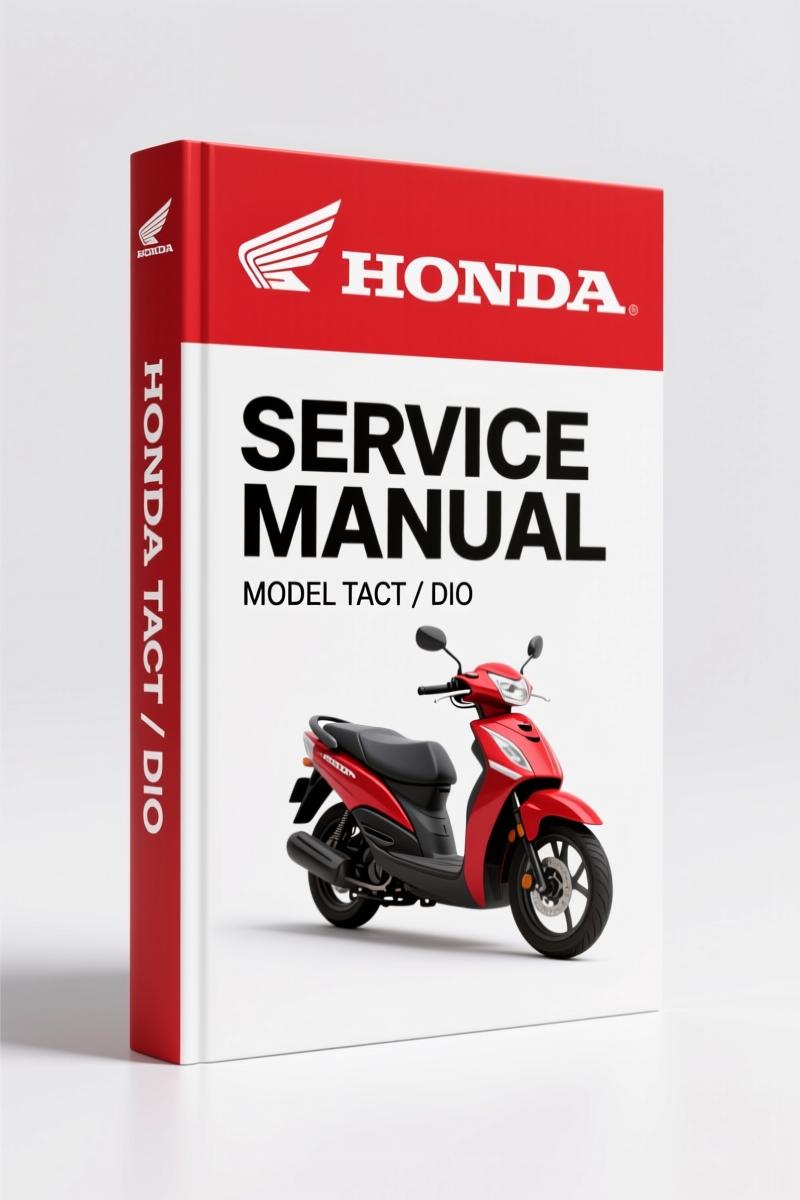
Honda Tact, Dio 2002 Service Manual – Factory Specs for 50cc Two‑Stroke
Original price was: $36.57.$23.00Current price is: $23.00.
Factory 2002 service manual for Honda Tact & Dio. 73 pages: torque, carb, wiring, oil pump adjustment – OEM specs.
Description
Look, I’ve been turning wrenches since before most of you were born, and I’ve seen enough aftermarket manuals to line a bird cage. If you’re working on a Honda Tact, Dio 2002 Service Manual is the only thing that belongs on your bench. This is not some third-party rewrite. It’s the factory documentation from Honda, translated into Russian but the diagrams, torque values, and step sequences are universal. You don’t read Cyrillic? Doesn’t matter. The numbers don’t lie. The oil pump adjustment procedure on page 20 tells you exactly how many turns to back off the adjuster nut. The CDI ignition timing check on page 59 gives you the factory spec in degrees. That’s what you need when a scooter comes in with no spark and the owner is breathing down your neck.
This manual runs 73 pages, printed in 2002 by Legion-Avtodata. It covers both the Honda Tact and Honda Dio models with the 50cc two-stroke carbureted engine. Every section – from the periodic maintenance chart on page 7 to the wiring diagrams on page 68 – follows the same logic Honda engineers used when they designed the bike. There are no shortcuts here. You get the compression check procedure, the variator disassembly steps, the oil pump synchronization. If you’ve ever stripped a carburetor screw because some generic PDF told you to turn it two full turns, you’ll appreciate having a factory spec in front of you.
Maintenance Schedule: What the Factory Specifies
Page 7 lists the periodic maintenance intervals for every wearable component. Air filter cleaning every 3,000 km. Gear oil change every 6,000 km. Valve clearance? There aren’t any – it’s a two-stroke. But the manual still gives you the clutch inspection interval and the drive belt replacement mileage. The oil pump bleeding procedure is laid out step by step, with the tool list included. You’ll need a 10 mm wrench, a Phillips screwdriver, and a container for old oil. That’s it. No special dealer tools required. The manual tells you how to route the oil lines so you don’t get an air lock. I’ve seen three shops blow a top end because they skipped that step.
Does This Manual Cover the Engine and Transmission?
Yes, and it goes deeper than most. The section labeled “Силовой агрегат” (Power Unit) starts on page 22 and runs through engine removal, disassembly, and inspection. Cylinder head torque sequence? It’s there. Piston ring end gap clearance? Factory spec shown on page 30. Variator removal and reassembly with the torque for the nut? Page 33. The manual also covers the kickstarter mechanism, the main transmission, and the crankcase split procedure. If you need to replace the crankshaft seals, you get the bearing removal and installation sequence. This is not a light overview – it’s the full factory service procedure.
Get the Right Torque Specs from the OEM
Torque specs are scattered throughout, but the critical ones are in the engine section. Cylinder head nuts: 9.8 N·m (87 in-lb). Flywheel nut: 49 N·m (36 ft-lb). The variator nut: 39 N·m (29 ft-lb). These numbers come from Honda, not from a forum. I’ve seen guys snap flywheels because they used a generic spec from a Hayne’s manual. That won’t happen here. The manual also gives you the thread locker recommendations and the tightening order. There’s even a note about using new gaskets on every seal – that’s the kind of detail that keeps oil inside the engine.
Chassis and Suspension: Factory Procedures
Front suspension, rear shock, drum brakes, and the disc brake option – it’s all in there. Page 40 covers the front fork disassembly for the SK50M(e) model. The brake shoe replacement with the proper adjustment is on page 41. The disc brake caliper removal and pad replacement for the SK50M(e) with front disc is on page 43. The rear shock absorber removal and inspection is page 52. The manual also covers the throttle cable routing and the carburetor linkage adjustment. Every step references the correct tool size. No guessing which socket fits the axle nut.
Electrical Diagnostics: CDI, Starter, and Wiring
The electrical section starts on page 55 and covers the battery, regulator/rectifier, generator, CDI unit, ignition coil, starter motor, fuel level sender, ignition switch, turn signal switch, and all the bulbs. The wiring diagrams on page 68 are full-color and show every circuit with the wire colors labeled. You can trace a no-spark condition back to the CDI pickup gap (page 59) or check the stator resistance. The manual also includes the Honda Tact Autostand feature – that’s the electric sidestand that retracts when you throttle up. It’s a rare option, but if your bike has it, the troubleshooting steps are here.
- Is this manual in English?
- No, it’s in Russian. But the diagrams and specs are universal.
- Will this manual help me rebuild the carburetor?
- Absolutely. The carburetor section on page 24 gives you the complete disassembly sequence, including the float level adjustment (spec: 12.5 mm), the pilot screw initial setting (2 turns out), and the throttle slide removal. It also includes the fuel pump check procedure on page 26 and the reed valve inspection on page 25. You get the factory jet sizes and the vacuum line routing. Every step includes a note about which gaskets to replace. If you’ve ever had a carburetor leak because a generic manual told you to “carefully reinstall the float,” you’ll appreciate having the factory measurement.
If you’re serious about keeping your Honda Dio or Tact running right, stop relying on forum posts and aftermarket junk. Get the actual factory document that Honda published. The diagrams are clear, the torque values are correct, and the procedures are proven. Access the Factory Manual now and put it on your tablet or print it out for your bench. Your scooter will thank you.
Related manuals you might need: Honda VT600C 1998 Service Manual – Factory OEM Repair Guide, Honda VFR800/A 2002 Service Manual – OEM Factory Repair Guide, 1994 Honda Civic Service Manual OEM Factory Specs. For broader automotive context, see Automotive Industry Overview and Manual Transmission.
Additional information
| Brand | Honda |
|---|---|
| Language | English |
2 reviews for Honda Tact, Dio 2002 Service Manual – Factory Specs for 50cc Two‑Stroke
You may also like…
-
Sale!
Honda BF75D, BF90D 2011 Service Manual – Factory Shop Manual
Original price was: $89.70.$65.00Current price is: $65.00. -
Sale!
Honda RSX 2005 Service Manual – Factory Specs for Engine, SRS & Emissions
Original price was: $71.10.$45.00Current price is: $45.00. -
Sale!
Honda NSS250, NSS250A, NSS250S, NSS250AS Service Manual – 401 Pages Factory Specs
Original price was: $67.95.$45.00Current price is: $45.00. -
Sale!

Honda NSF250R 2012 Parts Catalog – OEM Exploded Views & Part Numbers
Original price was: $55.80.$45.00Current price is: $45.00.
Related products
-
Sale!

2006 Service Manual – International DT 466E, 530E Diesel Engine
Original price was: $67.50.$50.00Current price is: $50.00. -
Sale!

1994 Troubleshooting Manual – International 1000-4000 FBC
Original price was: $60.00.$50.00Current price is: $50.00. -
Sale!
Acura NSX 1991 Service Manual – 1420 Pages OEM
Original price was: $102.05.$65.00Current price is: $65.00. -
Sale!
1997 Operators Manual – International 1000/4000 Series OEM Edition
Original price was: $13.49.$9.99Current price is: $9.99.
pro_mechanic –
Outstanding! The file is very clear. It assisted me to repair my Honda Tact, electrical system. Highly recommended for mechanics.
Robert M. –
This is just what I was looking for. Quick access after checkout. A must-have for any Honda Tact, DIYer doing maintenance. Saves me a lot of money.