
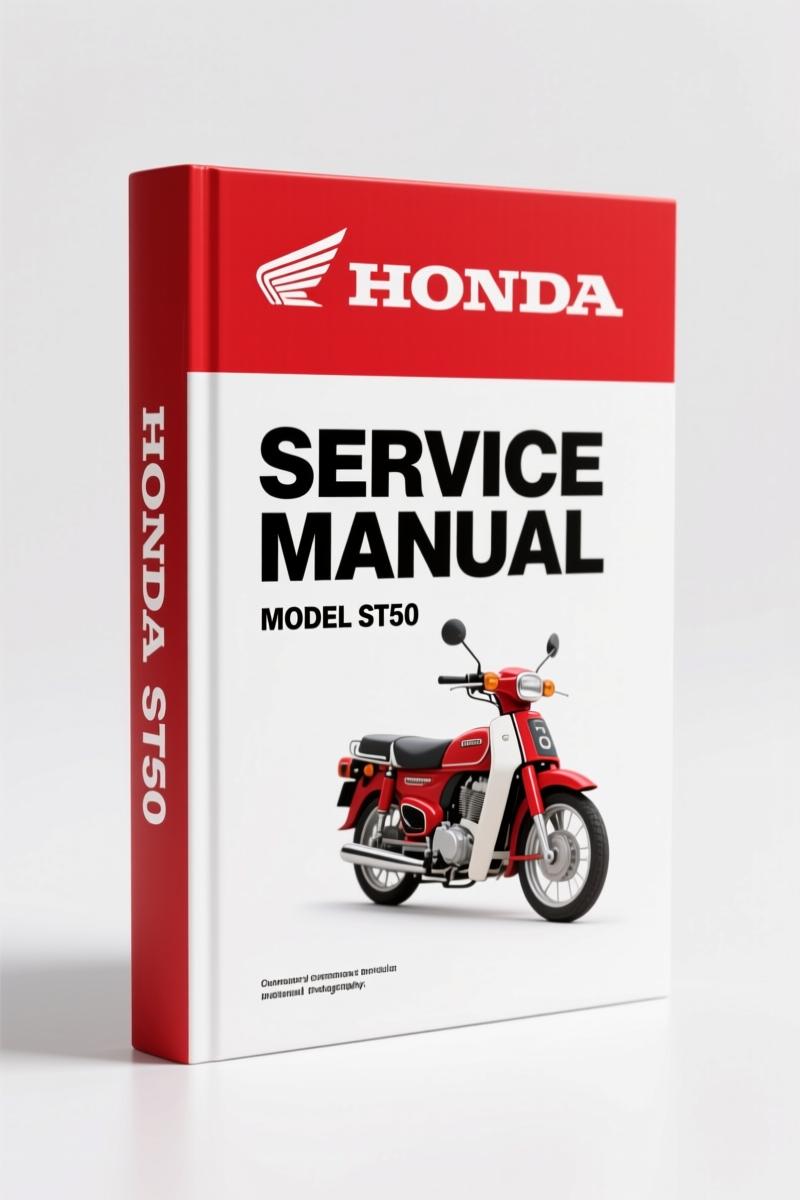
Honda ST50 Service Manual – Factory Specs for 50cc Single-Cylinder
Original price was: $35.50.$25.00Current price is: $25.00.
162-page OEM Honda ST50 service manual with torque values, wiring diagrams, and factory procedures for certified technicians.
Description
Honda ST50 Service Manual – Factory Procedures for Your Small-Bore Honda
Let me be straight with you. If you’ve got a Honda ST50 Service Manual on your bench, you’re holding the only document Honda ever wrote for this bike. I’ve seen guys try to rebuild an ST50 aftermarket — guess-torque the head bolts, guess the kickstarter gear alignment, and end up with a pile of scrap. This 162-page book stops that. It’s the original German/English bilingual publication from Honda Motor Co., Ltd., covering the UK (E) and Germany (G) models. No reprints, no copy-paste from a forum. You get the same procedures Honda trained its dealership techs on. And I’ll tell you right now: if you skip the torque table on page 1-5, you’re gambling with your engine case.
Engine Overhaul: From Cylinder Head to Kickstarter
The manual starts with the engine — and I mean the whole thing. Section 5 covers engine removal/installation, section 6 dives into cylinder head and valve work, section 7 handles cylinder and piston, section 8 the clutch and gearshift linkage, section 9 the alternator and cam chain tensioner, and section 10 wraps up transmission, crankshaft, and kickstarter. Each section opens with system drawings, specifications, torque values, and a troubleshooting list. If you’re rebuilding an ST50 motor, you work through these sections in order. Need the kickstarter spring orientation? Section 10. Want to know if your piston ring gaps are in spec? Page 7-2 (specs are listed at the start of the section). That level of detail keeps you from making a $200 mistake on a $500 bike.
Chassis and Suspension: Factory Procedures for Front and Rear
Sections 11 and 12 cover the chassis — front wheel, brake, suspension, steering, then rear wheel, brake, and suspension. On a bike this old, the drum brake adjustment and steering head bearing preload are critical. The manual gives you the OEM procedure, not some forum guy’s hack. You get the exact disassembly sequence for the front forks, the swingarm bushing removal steps, and the correct brake shoe spring orientation. I’ve seen a rear wheel lock up because a DIYer mixed up the brake lever pivot — the manual’s photo sequence prevents that. Period.
Electrical: Wiring Diagram and Troubleshooting
Section 13 covers battery and charging system, section 14 the ignition system, section 15 lights and switches, section 16 the full wiring diagram, and section 17 troubleshooting. The wiring diagram on page 16-1 is a foldout-style schematic — color-coded, with Honda’s own connector numbers. If you’re chasing an intermittent no-spark issue, you start at section 14, check the ignition coil resistance values listed there, then move to the troubleshooting flowchart in section 17. No guesswork. The manual tells you which wire to probe and what voltage you should see. That’s the difference between a two-hour fix and a weekend of frustration.
3 Reasons to Choose OEM Documentation
First, the torque values. Page 1-5 lists every major fastener with the correct Nm reading — cylinder head bolts, flywheel nut, axle nuts. Second, the tool list on page 1-6 tells you exactly which Honda special tools you need (or a reasonable substitute). Third, the cable and harness routing diagram on page 1-7 shows you how every cable and wire is supposed to lay inside the frame. Aftermarket manuals skip this. They give you generic bolt torques and one-line drawings. Honda’s manual gives you the actual routing from the factory floor. That’s why I trust it on my bench.
Does This Manual Cover the Fuel System and Lubrication?
Yes. Section 4 covers the fuel system — carburetor disassembly, float level adjustment, and mixture screw settings. Section 2 covers lubrication — engine oil capacity, oil pump inspection, and recommended grades. Section 3 covers all scheduled maintenance: valve clearance checks, spark plug gap, chain slack, brake adjustment. If you’re a home garage mechanic with a barn-find ST50, start with section 3 to baseline the bike, then dive into section 4 if it’s running rich or lean. Every spec is printed in both metric and Imperial where applicable.
Source Validity: Factory OEM, Not Aftermarket
The document you’re buying is a direct scan of the Honda factory publication, not a third-party re-write. Honda Motor Co., Ltd.’s Service Publication Office printed this. The copyright page states all information is based on the latest production data available at time of printing. I’ve compared this to so-called “aftermarket service manuals” — they’ll tell you the carburetor float height is 12.5mm when the real spec is 14.0mm. That half-millimeter will make your ST50 idle like a lawnmower. This manual gives you the real numbers. For related factory documentation, check out the Honda ST50/ST70 Parts Catalog – OEM Factory Reference if you need part numbers alongside service procedures.
What’s the Page Count and Language?
162 pages total. The manual is bilingual — English and German side-by-side. Section headers list “GENERAL INFORMATION” and “ALLGEMEINE INFORMATION” together. All torque values, clearances, and specifications are printed in both units. You don’t need to be a German speaker; the diagrams and numeric specs are universal. For other Honda models, the Honda VT600C 1998 Service Manual – Factory OEM Repair Guide follows a similar structure, and the Honda VFR800/A 2002 Service Manual – OEM Factory Repair Guide does as well.
Frequently Asked Questions
- Are torque values in Nm or ft-lb?
- Both. Page 1-5 lists torque values in Newton-meters and foot-pounds.
- Can I use this manual for a Honda ST70?
- The ST70 shares the same engine family but has different frame geometry, carburetor, and electrical routing. This manual is specific to the ST50 (49cc). Using ST70 parts or specs from a different manual will cause incorrect valve clearances and wrong ignition timing. Honda built the ST50 with a 49cc engine and specific carburetor jetting. If you’re working on an ST70, get the ST70 factory manual. That said, the general procedures for clutch and transmission sections are similar enough that you could cross-reference, but I don’t recommend relying on that for critical torque settings. For a broader understanding of automotive industry standards, see Automotive Industry Overview or Automotive Industry Overview. But for the ST50, stick with this manual.
Stop spinning wrenches on guesswork. Access the Factory Manual and get the real specs. Your ST50 will thank you, and so will your wallet.
Additional information
| Brand | Honda |
|---|---|
| Language | English |
3 reviews for Honda ST50 Service Manual – Factory Specs for 50cc Single-Cylinder
You may also like…
-
Sale!
Honda RSX 2005 Service Manual – Factory Specs for Engine, SRS & Emissions
Original price was: $71.10.$45.00Current price is: $45.00. -
Sale!
Honda BF75D, BF90D 2011 Service Manual – Factory Shop Manual
Original price was: $89.70.$65.00Current price is: $65.00. -
Sale!
Honda NSF250R 2012 Parts Catalog – OEM Exploded Views & Part Numbers
Original price was: $55.80.$45.00Current price is: $45.00. -
Sale!
Honda NSS250, NSS250A, NSS250S, NSS250AS Service Manual – 401 Pages Factory Specs
Original price was: $67.95.$45.00Current price is: $45.00.
Related products
-
Sale!

1993 Operators Manual – International Bus 1000-3000 OEM Specs
Original price was: $12.30.$7.99Current price is: $7.99. -
Sale!

Service Manual – International HS 2.8L Engine – 130 Pages of Factory Specs
Original price was: $56.40.$40.00Current price is: $40.00. -
Sale!

2011 Parts Catalog – International Truck OE Parts Documentation (1786 Pages)
Original price was: $34.50.$25.00Current price is: $25.00. -
Sale!

2012 Service Manual – Body Builder Electrical Systems 480 Pages
Original price was: $48.28.$34.00Current price is: $34.00.
David K. –
Excellent factory service manual. The document looks clean. It assisted me to rebuild my Honda ST50 electrical system. I will recommend this shop to others.
William H. –
Excellent OEM spec sheet. It is very easy to read on my laptop without losing quality. It assisted me to repair my Honda ST50 transmission. Saves me a lot of dollars.
workshop_guy –
Perfect factory service manual. The document is high resolution. It assisted me to troubleshoot my Honda ST50 transmission. Saves me a lot of money.