
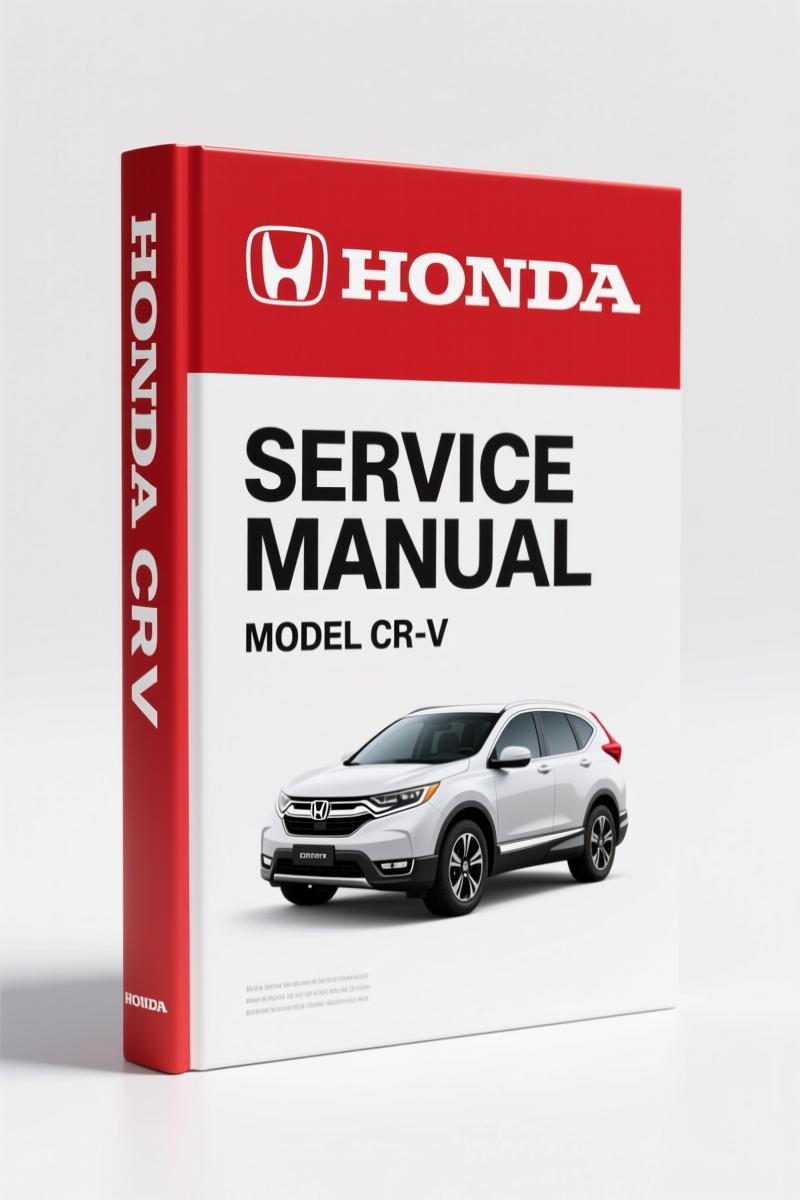
Honda CR-V Service Manual – Factory Engine Assembly Specs
Original price was: $31.60.$20.00Current price is: $20.00.
148-page factory service manual for Honda CR-V: engine assembly, torque values, special tools, OEM procedures. For certified technicians.
Description
Honda CR-V Service Manual
If you’ve ever chased a stripped bolt because some aftermarket manual gave you the wrong torque value, you know the frustration. I’ve seen it — a guy spends four hours on a timing chain job, then finds the crank bolt spec was off by 20 ft-lbs. That’s why I only trust factory documentation. This Honda CR-V Service Manual is the real deal: 148 pages of OEM data straight from Honda. No reprints, no third-party interpretation.
Engine Removal Procedure: What the Factory Manual Shows
You get the full engine removal sequence starting on page 5-3. That page lists the exact order: relieve fuel pressure, disconnect battery cables, remove the harness clamps, and drain fluids. Honda even tells you to mark all wiring and hoses to avoid misconnection. I’ve seen guys skip that step and spend an hour tracing a swapped vacuum line. The manual also calls out the special tools — universal eyelet 07AAK-SNAA120, engine hanger adapter VSB02C000015, and a front subframe adapter. If you don’t have them, you’ll be making phone calls mid-job.
Special Tools You Will Need
Page 5-2 lists the special tools table. One universal eyelet, one engine hanger adapter, and so on. The manual gives you the Honda tool numbers and quantities. Don’t waste money on a generic three-arm puller; get the factory stuff or rent it. The manual also includes the American Honda Tool and Equipment Program phone number — 1-888-424-6857 — if you need to order something. That’s the kind of detail aftermarket PDFs leave out.
148 Pages of OEM Specifications
This isn’t a condensed guide. 148 pages cover engine mechanical, assembly, removal, and installation. You get the torque values for every bolt in the engine mount system — side engine mount, transmission mount, lower torque rod, upper torque rod. Each replacement section has its own page: side engine mount replacement starts on page 5-22, transmission mount on 5-24. No flipping back and forth trying to piece together a procedure.
Does This Manual Cover the Fuel System?
Yes, but not in a separate chapter — it’s integrated into the engine removal steps. On page 5-3 you relieve fuel pressure (see page 11-317 for the detailed procedure). Then page 5-5 shows you how to disconnect the quick-connect fitting and fuel feed hose. If you need the full fuel system diagnostics, you’ll want a separate fuel system manual. But for an engine-out job, this gives you everything you need.
Torque Specs and Fluid Capacities
You’ll find drain plug torque, oil capacity (with API grade spec), and ATF drain procedure within the removal steps. The manual explicitly says to loosen the drain plug in the radiator and drain engine coolant (page 10-6), drain engine oil (page 8-10), and drain automatic transmission fluid (page 14-239). Those cross-references tell you where to look for the exact capacities. On page 10-6 you get the coolant fill amount in quarts. That’s factory data — not a generic ‘fill until it comes out’.
- Does this manual include wiring diagrams for the engine?
- No. This is a service manual focused on mechanical engine assembly and removal. For wiring, you need the separate electrical troubleshooting manual.
- How do I know these torque specs are correct for my model year?
- This manual covers the generation shown on the cover. If your CR-V is a different generation, the specs may differ. For example, later models have different engine mount torque values. Always verify the year range. If you need a 2007-2009 model, check out the Honda CR-V Service Manual (2007-2009) – Factory Brake & VSA for brake system specs. For earlier models, see Honda CR-V 1997-2000 Service Manual – Section: Restraints and Honda CR-V 1997-2000 Service Manual – Section: Special Information. Make sure you’re working with the right year.
Here’s the thing about OEM documentation: it’s tested and corrected by the manufacturer. Aftermarket guys rewrite the same steps and often drop half the torque values. I’ve compared three aftermarket manuals for the same engine — every one had a different crank bolt torque. That’s why I tell every tech in my shop: use factory or don’t touch the wrench. For a broader view of industry standards, the Automotive Industry Overview provides context, but it’s not a substitute for Honda-specific data. On the same site, the Automotive Industry Overview page explains why manufacturer documentation sets the baseline.
You need a manual that doesn’t waste your time with guesswork. This Honda CR-V Service Manual gives you the actual factory procedures, tool numbers, and torque specs. Access the Factory Manual and get back to working on your CR-V with confidence that the info is right.
Additional information
| Brand | Honda |
|---|---|
| Language | English |
4 reviews for Honda CR-V Service Manual – Factory Engine Assembly Specs
You may also like…
-
Sale!
Honda NSS250, NSS250A, NSS250S, NSS250AS Service Manual – 401 Pages Factory Specs
Original price was: $67.95.$45.00Current price is: $45.00. -
Sale!

Honda NSF250R 2012 Parts Catalog – OEM Exploded Views & Part Numbers
Original price was: $55.80.$45.00Current price is: $45.00. -
Sale!
Honda RSX 2005 Service Manual – Factory Specs for Engine, SRS & Emissions
Original price was: $71.10.$45.00Current price is: $45.00. -
Sale!
Honda BF75D, BF90D 2011 Service Manual – Factory Shop Manual
Original price was: $89.70.$65.00Current price is: $65.00.
Related products
-
Sale!

International 1000-3000 Series Operators Manual – 132 Pages of OEM Specs
Original price was: $14.40.$10.99Current price is: $10.99. -
Sale!

Technical Manual – International 6.0L Power Stroke FICM Diagnostics
Original price was: $29.80.$20.00Current price is: $20.00. -
Sale!

2011 Parts Catalog – International Truck OE Parts Documentation (1786 Pages)
Original price was: $34.50.$25.00Current price is: $25.00. -
Sale!
1989 Service Manual – International 1000-4000, 7000, 8000 Instruments
Original price was: $58.80.$40.00Current price is: $40.00.
William H. –
Excellent quality! It is easily zoomable on my iPad without blur. Every spec sheet is provided for Honda CRV. I will definitely buy again.
Michael T. –
Perfect OEM spec sheet. The PDF quality is excellent. It guided me to rebuild my Honda CRV transmission. Great value for money.
Charles W. –
Excellent workshop guide. The scan is high-quality and easy to navigate. Contains clear bolt torque specs for Honda. Saved my weekend project! Thanks.
pro_mechanic –
Superb resource! It is easily zoomable on my iPad without blur. A must-have for any Honda CRV DIYer doing repairs. Saves me a lot of money.