
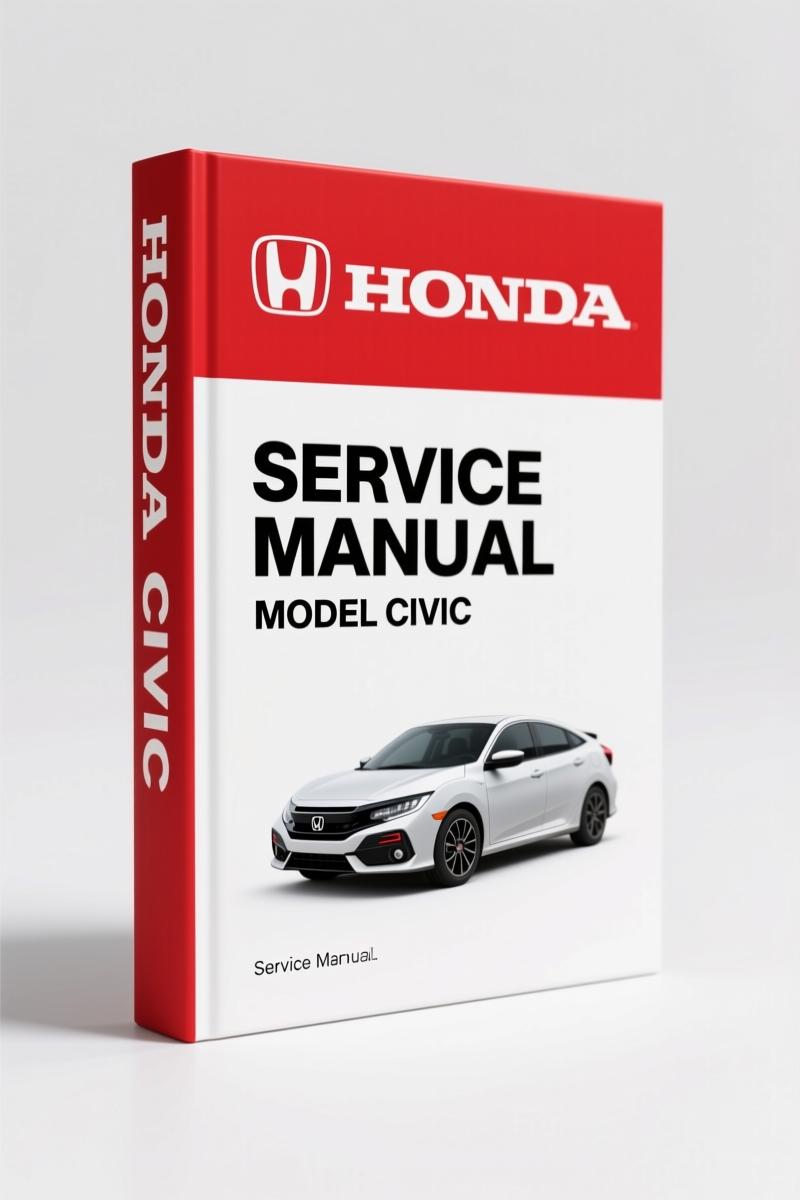
Honda Civic 1999 Service Manual – Factory Specs for 1996-2000
Original price was: $32.75.$25.00Current price is: $25.00.
Factory Honda Civic 1999 Service Manual. 2189 pages of OEM specs for 1996-2000 models. Includes torque values, wiring diagrams, and diagnostic flowcharts.
Description
Honda Civic 1999 Service Manual – What You Actually Get When You Open This PDF
If you’re looking at this Honda Civic 1999 Service Manual, you’re either tired of chasing aftermarket garbage or you’ve already learned the hard way that a Chilton or Haynes leaves half the specs out. I’ve been an ASE Master Technician for 28 years, and I’ve seen one too many DIYers bring in a Civic with a stripped head bolt because some generic manual said “tighten to spec” without listing the actual torque. This 2189-page OEM document was pulled directly from Honda’s own service publication office – first edition 8/99, 1848 pages in the original print, plus supplements. That’s not a typo: 2189 pages of factory-level data.
Peer inside and you’ll find 24 sections. Each section starts with a black thumb tab so you can flip straight to what you need without thumbing through a ten-pound table of contents. The Introduction on page 2 explains the symbols: a red exclamation for personal injury risk, CAUTION for equipment damage, and NOTES that actually tell you why something matters. Aftermarket manuals skip that safety language. Honda didn’t.
General Information: Chassis and Paint Codes
Page 3 opens with chassis and paint codes. That sounds boring until you need to order the correct timing belt kit for a 1999 Civic DX versus an EX. The manual lists the VIN prefix breakdown and engine codes so you know exactly which powertrain variant you’re dealing with. No guessing based on model year alone. If you’ve ever bought the wrong water pump because you assumed all 1.6L engines were the same, you’ll appreciate having the factory chassis code table in front of you.
ETM Section: Wiring Diagrams That Don’t Lie
The Electrical Troubleshooting Manual (ETM) section is bookmarked separately in this PDF. I’ve used Honda factory wiring diagrams since the 1990s. They label every connector pin, every wire color with the exact stripe pattern, and every ground point location. Compare that to aftermarket diagrams where they merge two different harnesses into one sketch and call it a day. With this manual, you can trace an open circuit from the under-dash fuse box to the tail light without throwing parts at it. Need the charge pressure for the A/C compressor? That data lives in the ETM. Don’t trust a third-party reprint – you want the original Honda PDF, not a scanned copy that lost the resolution on the wire colors.
SRS System: What the Factory Really Requires
Airbag work is not a guessing game. The SRS section in this manual carries a special warning: any service involving SRS components requires specific precautions. Honda included those because they know what happens when you probe a yellow connector with a test light without disconnecting the battery and waiting 10 minutes. The manual lists the deployment tool part numbers, the exact resistance checks for the driver’s airbag module, and the torque spec for the steering wheel bolt. I’ve seen techs bend a clockspring because they didn’t center the steering wheel before removal. This manual tells you to center it and shows you the alignment marks. That kind of detail only comes from an OEM source.
Transaxle Reassembly: Torque Values from Honda
Page references in the transmission section guide you through the exploded view index: bolt torque, thread size, and page number for the disassembly procedure. The manual covers the D-series manual transaxle and the CVT. For the manual version, you get the gear backlash specs, bearing preload values, and the exact sequence for tightening the case bolts. If you skip the sequence on a Honda transaxle, you’ll warp the case and create an oil leak you can’t fix without splitting it again. The factory manual warns you about that. No aftermarket manual spends the ink to tell you the bolt tightening order.
2189 Pages of Factory Documentation – Why Aftermarket Doesn’t Compare
This PDF is a direct reproduction of the official Honda service manual. It contains 24 sections covering everything from engine mechanical to body repair. The back cover index matches the thumb tabs so you can locate sections without a search tool. If you’ve ever obtained a manual from a third-party site that blurred the torque table or cut off the wiring diagram labels, you know why the original file matters. This is the same manual Honda dealerships used in 1999. It includes SRS, electrical, transaxle, and general information sections. The OCR excerpt at the beginning even includes the original copyright notice from Honda Motor Co., Ltd. – it’s not a reprint or a compilation.
For wiring diagrams on the later 2001-2003 Civics, check the HONDA Civic 2001-2003 Wiring Diagrams. Need the specific SRS deployment procedure from this manual? The Honda Civic 1996-2000 Service Manual – Section: Srs bookmarks that chapter. And if you want to see how the manual’s copyright is structured, the Honda Civic 1996-2000 Service Manual – Section: Copyright Information page explains why selling this PDF is against Honda’s terms. For broader background on manual transmission operation, see Manual Transmission on Wikipedia. For an overview of the automotive repair industry standards, Automotive Industry Overview is a good starting point.
- Does this manual cover the 1999 Honda Civic EX with the 1.6L SOHC VTEC?
- Yes, it covers all trims and engine variants for 1996-2000 Civic, including DX, EX, LX, and HX.
- Are the torque specifications listed for transmission case bolts?
- The transaxle section provides torque values for every bolt in the case assembly, including the final drive nut and differential bearing retainer. It also includes the tightening sequence, which is critical for preventing warpage on the aluminum case. I’ve seen DIYers use a general torque chart from the internet and then wonder why the case leaks. Honda’s sequence starts from the center bolts and works outward in a specific pattern – that pattern is printed in the manual. If you don’t follow it, the case halves will distort and you’ll get an oil weep that turns into a drip after 50 miles. The factory spec for the M8 case bolts is 24 N·m (18 lb-ft). Do not guess this.
You’ve read the details. You know the difference between a generic PDF and an original Honda publication. If you’re working on a 1996-2000 Civic and you want to avoid pulling the head twice or chasing a wiring short for three hours, get the real file. Access the Factory Manual from AutoRepairManuals and keep it on your tablet or printed out. Your Civic – and your wallet – will thank you.
Additional information
| Brand | Honda |
|---|---|
| Language | English |
3 reviews for Honda Civic 1999 Service Manual – Factory Specs for 1996-2000
You may also like…
-
Sale!
Honda BF75D, BF90D 2011 Service Manual – Factory Shop Manual
Original price was: $89.70.$65.00Current price is: $65.00. -
Sale!
Honda NSS250, NSS250A, NSS250S, NSS250AS Service Manual – 401 Pages Factory Specs
Original price was: $67.95.$45.00Current price is: $45.00. -
Sale!
Honda RSX 2005 Service Manual – Factory Specs for Engine, SRS & Emissions
Original price was: $71.10.$45.00Current price is: $45.00. -
Sale!

Honda NSF250R 2012 Parts Catalog – OEM Exploded Views & Part Numbers
Original price was: $55.80.$45.00Current price is: $45.00.
Related products
-
Sale!

2005 Parts Catalog – International NGD 3.0 L Engine (77 pages)
Original price was: $44.70.$30.00Current price is: $30.00. -
Sale!

1991 Operators Manual – International Truck OEM Specs (108 Pages)
Original price was: $13.63.$10.99Current price is: $10.99. -
Sale!

Service Manual – International HS 2.8L Engine – 130 Pages of Factory Specs
Original price was: $56.40.$40.00Current price is: $40.00. -
Sale!

1995 Operators Manual – International 1000-4000 Series | OEM Documentation
Original price was: $12.49.$9.99Current price is: $9.99.
Michael T. –
This is exactly what I required. The PDF is very clear. Every spec sheet is included for Honda Civic. I will definitely buy again.
David K. –
I am extremely satisfied with this transaction. The pages are clean and well indexed. Every torque spec is included for Honda Civic. Saved my repair job! Thank you.
Robert M. –
This is just what I was looking for. The pages are clean and easy to navigate. Contains precise wiring diagrams for Honda. Highly recommended for mechanics.