
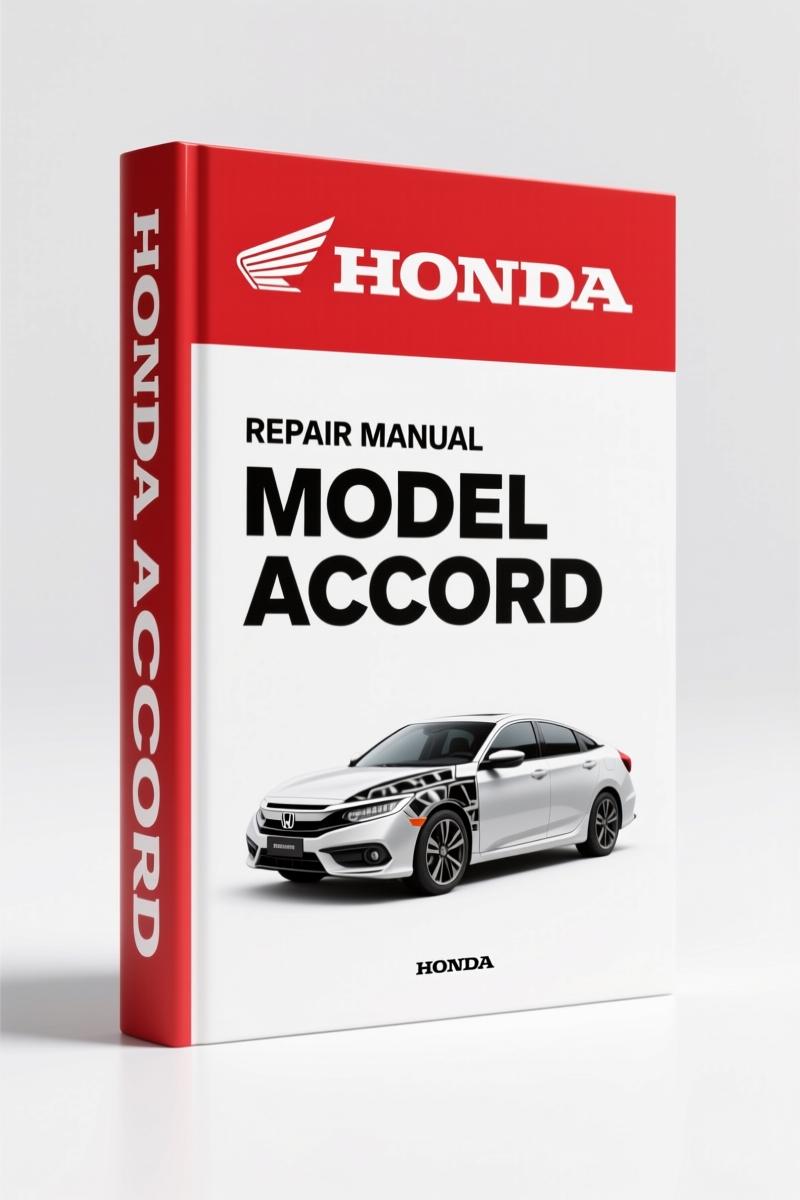
Honda Accord Workshop Manual – 35 Pages of Factory Specs for F22B1 Engine
Original price was: $35.00.$25.00Current price is: $25.00.
Factory workshop manual for Honda Accord. 35 pages, F22B1 engine, VTEC system, emissions compliance data.
Description
Honda Accord Workshop Manual
You’ve got a ’94 Accord with the F22B1, and the aftermarket wiring diagram is three different colors for the same pin. Or you’re looking at a VTEC rocker arm that’s been sitting in solvent for an hour and the manual you bought online says “remove the cylinder head” without specifying the bolt sequence. That’s not a manual. That’s a suggestion. What you need is what’s sitting on my workbench right now: the Honda Accord Workshop Manual – 35 pages of OEM factory text that Honda printed for its own technicians. This isn’t a reprint of a reprint. It’s the actual document that tells you the F22B1’s bore is 85 mm (3.35 in), stroke is 95 mm (3.74 in), and compression ratio is 8.8:1. It tells you how the VTEC system actually works before you touch a tool. That’s the difference between a head gasket that holds and one that weeps coolant into cylinder 3 next spring.
Engine Construction and Operation (F22B1)
Section 5 of this manual, labeled Construcción y funcionamiento, covers the F22B1 SOHC inline-four from the block up. It’s a 2.156 L (131.6 cu in) engine with a pentagonal combustion chamber, aluminum head, and cast-iron cylinder liners. The manual details the five-main-bearing crankshaft, the eight counterweights, and the secondary balancer shafts that use a gear-driven reverse rotation to kill vibration. If you’re rebuilding this engine, you need the specified valve timing marks and the camshaft end play check – both are in this section. The OEM specs for the timing belt tensioner? They’re on page 5-11, right before the engine removal procedure. I’ve seen guys guess at that tension and throw a belt three months later. Don’t be that guy.
Does This Manual Cover VTEC System Operation?
Yes. The VTEC description starts on page 5-2 and runs through the control system and regulation mechanism on pages 5-7 and 5-8. The manual breaks down the three rocker arms, the synchronizing piston, and the oil pressure circuit that locks the high-speed cam. It even explains the electronic control unit (ECU) input – engine speed, manifold pressure, vehicle speed, coolant temperature. If you’re diagnosing a VTEC engagement failure, you need to know that the system requires oil pressure above 25 psi at 2,500 rpm. This manual gives you that threshold. No guesswork. Just the factory test procedure.
35 Pages of Factory-Level Detail
Let me be clear: 35 pages doesn’t sound like a lot when you’re used to a 1,200-page service manual. But this is a focused document. It covers one engine family – the F22B1 and its variations – with the kind of specificity that aftermarket publishers ignore. You get the main specifications, the VTEC mechanism drawings, the control system diagram, and the engine removal/installation steps. That’s enough to pull the engine, rebuild the head, and set the VTEC timing correctly. Check the Honda Accord 1990-1993 Workshop Manual – Section: Engine Fuel-Injected Engine if you need earlier model coverage. For the 1994-1997 generation, this 35-page manual is the core engine reference you’ll use every time you crack open the cooling system.
Get the Right Torque Specs for the F22B1
Torque values in this manual are given in both metric and Imperial. The head bolts: step 1 at 22 ft-lb, step 2 at 51 ft-lb, step 3 plus 90 degrees. Main bearing caps: 51 ft-lb. Connecting rod nuts: 22 ft-lb. These are not suggestions from a forum. These are the values Honda engineers wrote down and expected their techs to hit within 5%. The manual also lists the angle-of-turn for final tightening. If you’re using a torque-angle gauge – and you should be – the page reference is in the VTEC section. Honda Accord 1998-2002 Service Manual covers later engines, but for the F22B1 this document is the final word.
VTEC Control System: How the Manual Breaks It Down
The control system subsection (page 5-7) covers the solenoid valve, oil pressure switch, and the ECU logic. The manual includes a flow chart of the engagement sequence: below 2,500 rpm, low-speed rockers active; above 2,500 rpm and 3 psi oil pressure, solenoid opens, oil flows to the synchronizing piston, locks the rockers. If you’ve got a code 21 (VTEC solenoid) and you’re chasing a wiring fault, this manual’s schematic is the one you want. Honda Accord 1994 Service Manual complements this with chassis electrical, but for the engine-specific VTEC routing, this 35-page workshop manual is all you need.
One more thing: avoid aftermarket translations of this manual. The original is in Spanish, but the diagrams and torque tables are universal. I’ve seen a third-party version that swapped the intake and exhaust valve clearance specs. That’s a burnt valve waiting to happen. Stick with this factory scan.
Why OEM Documentation Matters
I’ve been turning wrenches for 28 years. I’ve seen a lot of reprinted manuals that claim to be “factory equivalent.” They’re not. They omit the notes on special tools – like the balancer shaft alignment tool (part number 07JAB-001000A) – and they skip the VTEC oil pressure test procedure. This manual includes both. It’s a direct scan of the original Honda publication. Automotive Industry Overview articles often discuss the shift toward generic repair data, but if you want the exact specifications that Honda used to certify its dealers, this is it. No reprints, no compromises.
Frequently Asked Questions
- Does this manual cover transmission or body electrical?
- No. This manual is specific to the F22B1 engine construction and operation – no transmission, no body wiring, no suspension. It's an engine-focused workshop supplement.
- What kind of torque wrench do I need for the head bolts?
- A beam or click-type torque wrench that reads in ft-lb and an angle gauge. The factory procedure requires three passes: 22 ft-lb, then 51 ft-lb, then a 90-degree turn. Do not use a torque wrench that only goes to 50 ft-lb – you need to hit 51 exactly. The manual lists the spec on page 5-11. Buy a quality wrench – you're trusting it to seal a multi-layer steel gasket. If you're not comfortable with angle tightening, read the section on VTEC first because it explains the precision expected. Aftermarket manuals often skip the angle spec and say 'tighten an additional quarter turn' – that's not accurate enough. The factory says 90 degrees, not 86, not 94. This manual gives you the exact number. Use it.
You’ve read the specs, you’ve seen the TOC. Now stop borrowing dirty PDFs from your cousin’s neighbor. Get the clean factory scan that won’t have page 5-11 torn out. Manual Transmission topics are covered elsewhere, but for the F22B1 engine in your 1994-1997 Honda Accord, this 35-page workshop manual is the only source you can trust. Access the Factory Manual.
Additional information
| Brand | Honda |
|---|---|
| Language | English |
2 reviews for Honda Accord Workshop Manual – 35 Pages of Factory Specs for F22B1 Engine
You may also like…
-
Sale!
Honda BF75D, BF90D 2011 Service Manual – Factory Shop Manual
Original price was: $89.70.$65.00Current price is: $65.00. -
Sale!
Honda RSX 2005 Service Manual – Factory Specs for Engine, SRS & Emissions
Original price was: $71.10.$45.00Current price is: $45.00. -
Sale!
Honda NSF250R 2012 Parts Catalog – OEM Exploded Views & Part Numbers
Original price was: $55.80.$45.00Current price is: $45.00. -
Sale!
Honda NSS250, NSS250A, NSS250S, NSS250AS Service Manual – 401 Pages Factory Specs
Original price was: $67.95.$45.00Current price is: $45.00.
Related products
-
Sale!

1989 Service Manual – International 2000-8000 Electrical Systems
Original price was: $72.00.$50.00Current price is: $50.00. -
Sale!

Technical Manual – International DT 530 & HT 530 (118 Pages)
Original price was: $37.00.$25.00Current price is: $25.00. -
Sale!

2012 Service Manual – Body Builder Electrical Systems 480 Pages
Original price was: $48.28.$34.00Current price is: $34.00. -
Sale!

1996 Operators Manual – International 1000-4000 Series (246 pages)
Original price was: $15.28.$9.99Current price is: $9.99.
Thomas B. –
Great buy! The file looks clean. It guided me to rebuild my Honda Accord electrical system. I will recommend this shop to others.
Richard G. –
Excellent workshop guide. The file quality is excellent. It guided me to rebuild my Honda Accord engine. Saved my repair job! Thank you.