
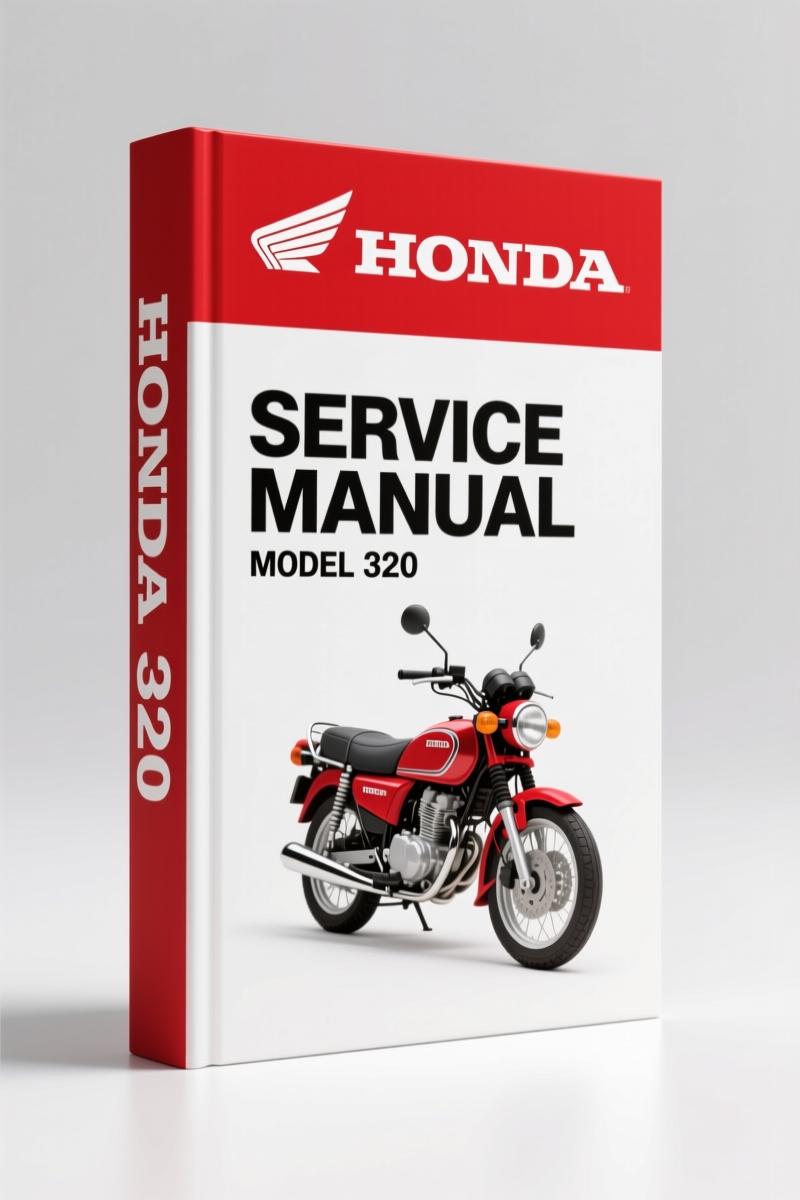
Honda 320 1988 Service Manual – Factory Specs for Maintenance and Repair
Original price was: $47.10.$30.00Current price is: $30.00.
1988 Honda 320 Service Manual: 393 pages of factory torque specs, fuel system, and emission control data. OEM-certified for professional repair.
Description
Honda 320 1988 Service Manual
You have a Honda 320 in the shop or your garage, and the aftermarket booklet says “tighten until snug.” That’s not a torque spec. That’s a leak, a stripped thread, or a warranty claim waiting to happen. The Honda 320 1988 Service Manual is the original factory document from Honda Motor Co., Ltd., printed in 1988, and it gives you the actual numbers, tolerances, and procedures that Honda engineers wrote. 393 pages of real service data, not an internet summary.
General Information and Safety Precautions
Section 1 kicks off with General Safety – the warnings you ignore at your own risk. It covers service rules, fastener reuse, ball bearing replacement, and a tool compatibility chart. The manual clearly states when a part must be replaced, not reused. That saves a comeback. If you’re used to aftermarket manuals that gloss over the “why,” this one tells you the “why” behind each torque sequence. The Safety Notice on page 4 spells out that even Honda’s own warnings can’t cover every tool or method you might use – it’s on you to satisfy yourself that your method won’t cause injury. I respect that honesty.
Does the Honda 320 1988 Service Manual Cover the Fuel System?
It does. Fuel system coverage starts in Section 8. The manual walks through troubleshooting (8-2), system description (8-3), then gets into the meat: accelerator pump operation, fuel line inspection, and the full carburetor disassembly sequence from 8-9 to 8-17. The pilot screw adjustment procedure (8-18) is critical to get right on these models because of emission limits. Section 8-23 covers limit cap installation, and 8-24 goes into accelerator pump adjustment. You also get the secondary air supply system in Section 7, which ties into the fuel/emission loop. No guesswork – you see the factory diagram and the adjustment range.
Maintenance: Fuel Line to Valve Clearance
Section 2 is your maintenance bible. It covers the fuel line (2-2), throttle (2-3), oil pump and line (2-4), carburetor choke (2-5), air cleaner (2-6), crankcase breather (2-7), spark plug (2-8), and valve clearance adjustment (2-9). If you skip decarbonizing (2-15) on a 320 that’s been sitting, you’re asking for hot spots and pre-ignition. The manual gives the sequence. Also covered: carburetor synchronization (2-16), radiator coolant (2-17), cooling system (2-18), secondary air supply (2-19), transmission oil (2-20), drive chain (2-21), final drive oil (2-25), battery (2-26), brake fluid (2-27), brake shoe wear (2-28), brake system (2-29), brake light switch (2-30), headlight aim (2-31), clutch system (2-32), side stand (2-33), suspension (2-34), spark arrester (2-35), wheels/tires (2-36), steering head bearings (2-38), and wheel alignment (2-39). That’s a full checklist, not a list of suggestions.
393 Pages of Factory Service Data
This manual is dense. 393 pages of printed, bound OEM content from Honda Japan. It’s not a reprint of a reprint – it’s a scanned photocopy of the original, which Honda no longer prints. The contents span from General Information through Section 25 (electrical). You get engine testing (Section 3: compression and leak-down testing), lubrication (Section 4: wet/dry sump, two-stroke systems, premix, oil pump bleeding, pressure relief valve), cooling system (Section 5: radiator cap test, thermostat, coolant testing), exhaust system (Section 6), emission controls (Section 7: AVCV, secondary air supply, noise emission labels), then the full cylinder head section (Section 9: valve train, camshaft, valve guides and seats), cylinder/piston (Section 10), clutch (Section 11: wet multiplate centrifugal, hydraulic clutch bleeding, slave cylinder), V-Matic belt drive (Section 12: drive pulley, driven pulley, clutch shoe replacement), and transmission (Section 13). For comparison, the Manual Transmission”>Manual Transmission section alone includes gear shift lifter and power flow diagrams. This is what you use when the job pays by the hour.
OEM vs Aftermarket: Why This Manual Wins
Aftermarket manuals love to say “refer to manufacturer specifications” – meaning they didn’t print them. This manual prints them. The torque values, the clearance ranges, the fluid capacities – they come from Honda’s own Service Publications Office from September 1988. The Automotive Industry Overview”>Automotive Industry Overview confirms that OEM documentation is the only reliable source for safety-critical specs. The Honda 320 1988 Service Manual includes the original Part No. 61CM000C and its safety warnings are printed in bold type – reading them is not optional. If you’re a DIY guy working on your own bike, or a shop owner who doesn’t want to eat a head gasket job that fails because you reused a stretch bolt, this is your insurance.
FAQ
- Does this manual cover the Honda 320 specifically, or is it generic?
- It covers the entire Honda Common Service Manual for motorcycles, scooters, and ATVs, but you must use it together with the Model Specific Service Manual for the 320. The manual itself states on page 5: “Refer to the Model Specific Service Manual for the model you are servicing for adjustments, maintenance and repair information not common on that model.” So yes, it covers all common systems – fuel, engine, transmission, chassis, electrical – but the exact maintenance intervals and model-specific part numbers come from the second book.
- Can I use this manual if I’ve never worked on a carburetor before?
- Yes, but read Section 8 from start to finish first. The manual explains system descriptions before disassembly. If you skip the trouble shooting in 8-2, you’ll waste time. It’s written for technicians, but the steps are clear if you take them in order.
- What’s the most important safety warning in this manual?
- The Safety Notice warns that not every possible hazardous method can be covered. You must ensure your own method doesn’t cause injury. That’s page 4.
- How many pages and what year was it published?
- 393 pages, printed in Japan by Honda Motor Co., Ltd. in 1988.
Related Manuals: Honda VT600C 1998 Service Manual – Factory OEM Repair Guide”>Honda VT600C 1998 Service Manual | Honda VFR800/A 2002 Service Manual – OEM Factory Repair Guide”>Honda VFR800/A 2002 Service Manual | 1994 Honda Civic Service Manual OEM Factory Specs”>1994 Honda Civic Service Manual
Stop chasing internet forum advice. Access the Factory Manual and put a real set of specs on your bench. The Honda 320 1988 Service Manual is the same book Honda dealers used when this machine was new. You need that level of detail to do the job right, whether you are replacing a fuel line or rebuilding the carburetor. Get the factory data, torque to the numbers, and move on to the next job.
Additional information
| Brand | Honda |
|---|---|
| Language | English |
2 reviews for Honda 320 1988 Service Manual – Factory Specs for Maintenance and Repair
You may also like…
-
Sale!
Honda NSF250R 2012 Parts Catalog – OEM Exploded Views & Part Numbers
Original price was: $55.80.$45.00Current price is: $45.00. -
Sale!
Honda BF75D, BF90D 2011 Service Manual – Factory Shop Manual
Original price was: $89.70.$65.00Current price is: $65.00. -
Sale!
Honda RSX 2005 Service Manual – Factory Specs for Engine, SRS & Emissions
Original price was: $71.10.$45.00Current price is: $45.00. -
Sale!
Honda NSS250, NSS250A, NSS250S, NSS250AS Service Manual – 401 Pages Factory Specs
Original price was: $67.95.$45.00Current price is: $45.00.
Related products
-
Sale!

2011 Parts Catalog – International Truck OE Parts Documentation (1786 Pages)
Original price was: $34.50.$25.00Current price is: $25.00. -
Sale!

Service Manual – International HS 2.8L Engine – 130 Pages of Factory Specs
Original price was: $56.40.$40.00Current price is: $40.00. -
Sale!

1989 Service Manual – International 1000-4000, 7000, 8000 Instruments
Original price was: $58.80.$40.00Current price is: $40.00. -
Sale!
1993 Electrical Schematic – International 1000/3000/4000 Bus Chassis OEM Wiring Diagrams
Original price was: $29.26.$22.00Current price is: $22.00.
Michael T. –
Five stars! It is easily zoomable on my tablet without blur. Contains clear bolt torque specs for Honda. Saved my repair job! Thank you.
David K. –
I am extremely satisfied with this purchase. It is easily zoomable on my laptop without losing quality. Every spec sheet is provided for Honda 320. Worth every penny.