
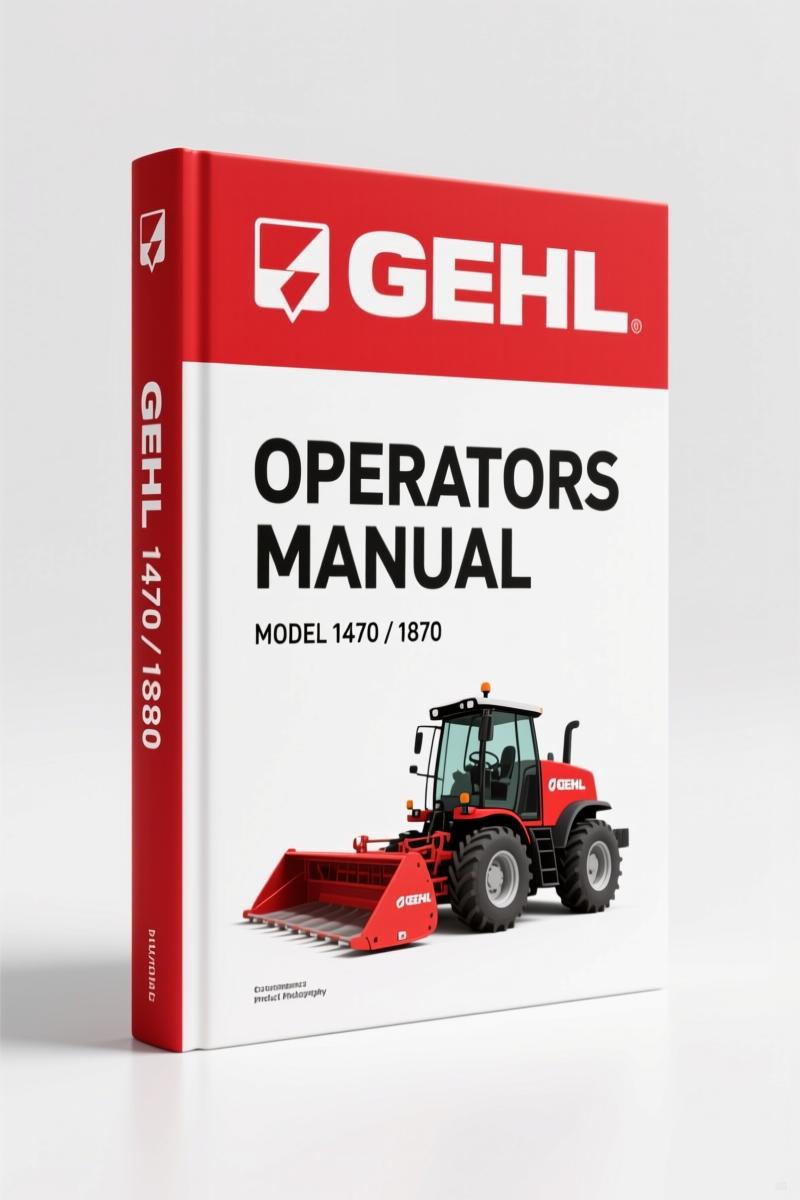
GEHL 1870, 1470 Operators Manual – Factory Specs & Maintenance
Original price was: $12.99.$9.99Current price is: $9.99.
Factory operator’s manual for GEHL 1470/1870 balers. 92 pages covering specs, safety, operation, maintenance, and troubleshooting.
Description
GEHL 1870, 1470 Operators Manual – What’s Actually Inside
I’ve been turning wrenches for 28 years, and I can tell you one thing: a baler that’s out of adjustment will cost you a day of frustration and a field of missed hay. If you’re running a GEHL 1870, 1470 Operators Manual (92 pages) is the real deal. It’s the same document your dealer uses, and it’s what I grab when I need to sort out a twine tie problem or a belt tracking issue. This isn’t some aftermarket summary – it’s the original GEHL factory print, Form No. 904578.
Specifications You Can Actually Use
Page 3 kicks off with the hard numbers – bale capacity, PTO speed requirements, and machine weight. You need these specs to match your tractor’s output and to confirm tire pressures. The manual spells out the bale diameter range and the pickup width. If you’ve ever guessed at a PTO shaft length and had it bind up, you’ll appreciate the exact driveline angles given here. Don’t rely on a generic baler chart; this data is specific to the 1470 and 1870 models.
Safety Section: Non-Negotiable
Pages 8 through 14 cover safety decals, operational hazards, and the lockout procedure for the pickup and belts. I’ve seen guys lose fingers because they skipped the part about hydraulic pressure bleed-down. This chapter lists every decal on the machine and where it goes – a must if you’re replacing faded stickers. The manual doesn’t assume you know which levers are safe to touch; it tells you, in plain English, with diagrams.
7 Systems Covered in the Service Chapter
The Operation chapter (pages 21-31) walks you through starting, baling, and stopping sequences. The Adjustment chapter (pages 32-39) covers belt tension, tailgate latch play, and twine disk timing. Lubrication (pages 40-43) gives you grease points, intervals, and preferred lubricants. Service (pages 44-54) dives into chain tension, shearbolt replacement, and roller bearing checks. If you need to tear down the drive train, you’ll find the step order here. Preparing for Field Operation (pages 55-59) includes hitch leveling and PTO alignment. These seven sections alone save you from the trial-and-error that burns a whole afternoon.
What Torque Values Are Listed?
Standard Hardware Torque Data is printed on the inside back cover – a full chart for SAE grade 5 and grade 8 bolts, plus metric equivalents. But the manual also calls out specific torque specs in the Adjustment and Service chapters. For example, wheel bolt torque and shearbolt specifications are listed right where you need them. No running to a separate book. If you’re pulling a roller or replacing a flange bearing, you’ll have the ft·lbs number in front of you. I’ve seen baler axles walk because someone used a generic automotive torque value – don’t be that guy.
Troubleshooting Chapter: Real Diagnostic Flow
Starting on page 62, the troubleshooting section uses symptom‑cause‑remedy tables. Twine breakage? Check table 13‑4. Bale shape uneven? Table 13‑2 walks you through belt tension and roller alignment. I like that they list the most common field failures first: clogged pickup, plugged throat, slipping belts. The manual doesn’t make you guess which adjuster to turn first. It’s the same logic I use in my shop: isolate the symptom, check the simplest cause, then move to the harder ones.
Who Needs This Manual on the Bench?
If you own a GEHL 1470 or 1870 variable chamber baler – whether you’re a retired farmer or a rental yard operator – this is the one reference you should keep in the cab. Beginners will find the checklists on pages 5-7 useful for daily inspections. Experienced mechanics will appreciate the detailed setup and assembly instructions (pages 71-75) and the optional features section (pages 78-79) for aftermarket add‑ons. I’d also point you to the GEHL 1400 1800 1870 Parts Catalog if you need illustrated part breakdowns, and the GEHL 1470 Parts Catalog or GEHL 1870 Round Baler Parts Catalog for ordering spares.
OEM vs. Aftermarket – Why This One Wins
The manual you’re looking at is a direct scan of the original GEHL publication. It has the official warranty text, the factory decal map, and the exact hydraulic flow diagrams. Aftermarket books often shrink the wiring and omit critical torque values. Here, you get the full‑size diagrams and the same safety warnings that came with the machine when it left the factory. I don’t trust third‑party reprints for anything that moves at 540 PTO rpm. This is the document you can show your insurance adjuster if something goes wrong. For an analogy, understanding the driveline behavior is similar to operating a Manual Transmission – you need the correct shift points and clutch engagement. The same principle applies to baler pickup speed and bale chamber pressure, which is also analogous to a Manual Transmission in terms of torque management during field operation.
- Does this manual cover the 1870 TDC and 1470 TDC models?
- Yes. The manual covers both the 1470 and 1870 variable chamber round balers, including the TDC variants.
- What torque specs are provided?
- Standard Hardware Torque Data on the inside back cover lists SAE grade 5 and 8 bolt torque values in ft·lbs. Additionally, specific torque specs for wheel bolts, shearbolts, and roller flange fasteners are printed in the Adjustment and Service chapters. The manual also includes metric conversions, so you don’t have to dig through a separate torque chart. I’ve used these numbers on jobs where a ¼‑in. bolt needed exactly 72 in·oz; the factory data was spot on.
- Is this an OEM manual or a reprint?
- This is a direct scan of the original GEHL operator’s manual, Form No. 904578. It includes the warranty page, decal locations, and factory troubleshooting – not a third-party rewrite.
- Can I use this for troubleshooting a twine tension problem?
- Yes, the troubleshooting chapter (pages 62-70) includes a specific table for twine breakage and tension issues.
You’ve got the machine, you’ve got the field – now get the guide that eliminates the guesswork. Access the Factory Manual and keep it on your tablet or print it for the cab. The spec table on page 3 and the torque data on the inside back cover alone are worth the price.
Additional information
| Brand | GEHL |
|---|---|
| Language | English |
3 reviews for GEHL 1870, 1470 Operators Manual – Factory Specs & Maintenance
You may also like…
-
Sale!
GEHL 4640E, 5240E, 2056 2012 Service Manual – 263 Pages | Factory Specs
Original price was: $75.60.$60.00Current price is: $60.00. -
Sale!
GEHL 153, 193, 223 Service Manual – Factory Specs
Original price was: $99.40.$70.00Current price is: $70.00. -
Sale!
GEHL SL4640, SL4840, SL5640, SL6640 Service Manual – 104 Pages
Original price was: $100.75.$65.00Current price is: $65.00. -
Sale!
GEHL 280 Service Manual – Official Factory Specs | AutoFix Global
Original price was: $85.20.$60.00Current price is: $60.00.
Related products
-
Sale!

2011 Parts Catalog – International 7400 SFA 6X6 – 1886 Pages of OEM Part Numbers
Original price was: $32.00.$25.00Current price is: $25.00. -
Sale!

2005 Parts Catalog – International NGD 3.0 L Engine (77 pages)
Original price was: $44.70.$30.00Current price is: $30.00. -
Sale!

Technical Manual – International 6.0L Power Stroke FICM Diagnostics
Original price was: $29.80.$20.00Current price is: $20.00. -
Sale!

Service Manual – International HS 2.8L Engine – 130 Pages of Factory Specs
Original price was: $56.40.$40.00Current price is: $40.00.
diy_master –
Five stars! Instant access after checkout. Every wiring layout is provided for GEHL 1870,. I will recommend this shop to others.
Michael T. –
I am so happy with this purchase. The PDF looks clean. Every torque spec is included for GEHL 1870,. I will recommend this shop to others.
William H. –
Excellent quality! The file is very clear. It helped me to rebuild my GEHL 1870, electrical system. I will recommend this shop to others.