
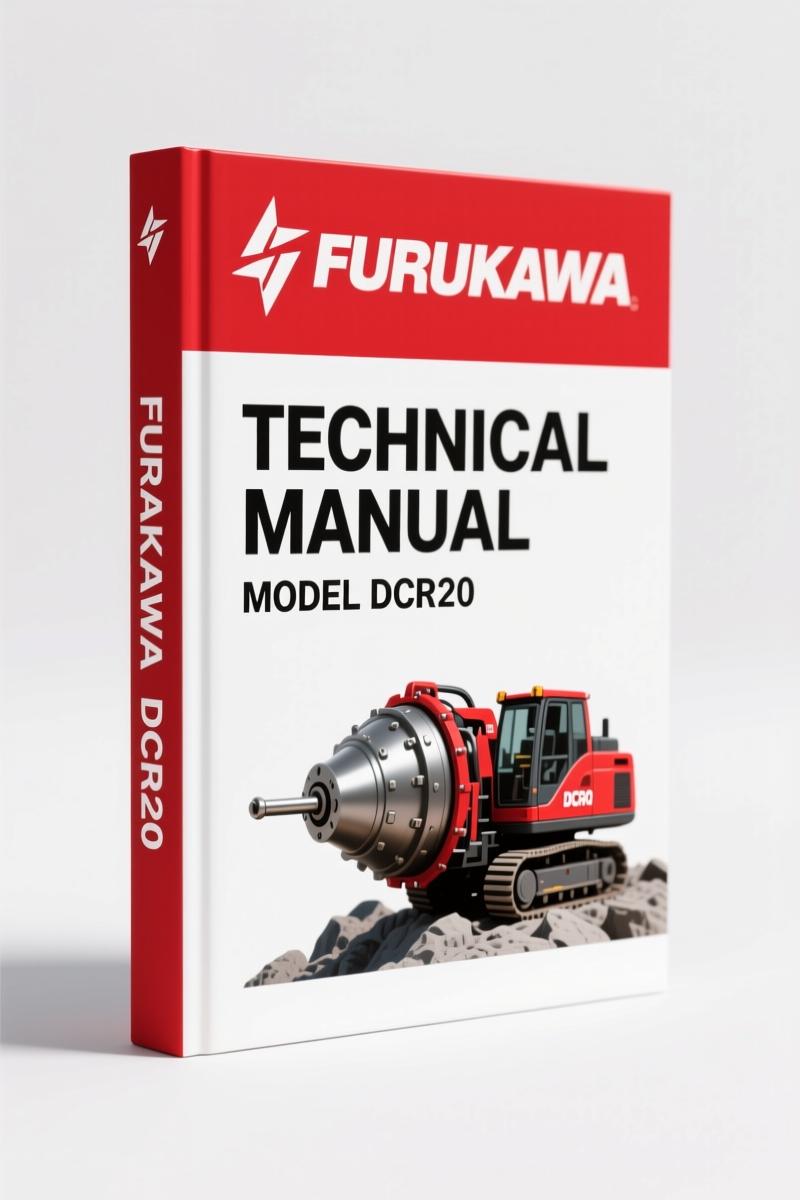
Furukawa Unic DCR20 2012 Technical Manual – Factory Specs
Original price was: $45.90.$30.00Current price is: $30.00.
339-page OEM technical manual for DCR20 drill rig with hydraulic circuit adjustments, pneumatic diagrams, and maintenance schedules.
Description
Furukawa Unic DCR20 2012 Technical Manual – Factory Specs for the Workbench
I’ve been turning wrenches for 28 years. ASE Master, six bays in San Antonio. I’ve seen more than a few DCR20s come through with blown seals, misadjusted anti-jamming circuits, and compressors that got run 500 hours on a filthy separator because someone chased a third‑party manual that skipped the 300‑hour initial service. The Furukawa Unic DCR20 2012 Technical Manual is what you need if you actually want to keep these machines running without making costly mistakes. It’s 339 pages of factory‑sourced data—not a reprint, not a condensed “overview.” You get the full hydraulic and pneumatic circuit diagrams, the compressor maintenance schedule, the screen diagnostics, and the electrical schematics that tell you exactly where each wire goes.
Hydraulic Circuit Adjustments and Schematics
This manual doesn’t hand‑wave at the hydraulic system. It breaks down every loop: main distributor valves, modular pilot valves for the rod changer, the dust collector, and the P5 valve. Page 209 covers the adjustment procedure for the whole hydraulic circuit—something aftermarket “summary” manuals won’t give you. You’ll find the manometer calibration for receiver tank pressure (4 MPa scale), feed pressure (25 MPa), normal rotation pressure, and blow‑off pressure. If you’re setting the anti‑jamming or the rod changer clamp controls, you need the factory numbers. I’ve had to fix machines where someone guessed the pilot pressure on the rod changer—guaranteed that costs you a bent pin or a snapped rod.
Compressor Air/Oil Flow: What the Manual Details
The screw compressor section (section 11 in the TOC) is worth the price alone. It walks you through the air/oil flow path: intake control group, discharge valve, regulator, auto purge valve, de‑aeration valve, bypass valve, oil cooler, check valves, separator, and oil filter. Section 11.2.1.1 shows the displacement mechanism—not theory, actual valve timing. Section 11.3 covers the gear‑multiplier chamber. If you’re doing a full compressor rebuild, you’ll need the torque specs for the oil filter housing and the regulator diaphragm replacement. The manual even gives you the cleaning intervals for the oil line strainers (two elements). Don’t skip those; I’ve seen clogged strainers take out an oil cooler.
Maintenance Schedule: 300, 500, 1000, 2000, 3000 Hours
Section 11.4 lays out the periodic maintenance in plain hours. First oil and filter change at 300 hours, then every 500 after that. Clean the air filter element at 500 hours. Replace the speed regulator diaphragm at 1000. Replace the oil separator at 2000. At 3000 hours, you’re checking hoses, replacing the O‑ring on the pressure regulator, cleaning the butterfly valve (discharge device), replacing the auto purge valve diaphragm, and more. I keep a printed copy of this schedule in my toolbox. You don’t want to guess when to swap that separator—a ruptured separator dumps oil into the downstream air line, and that’s a $2,000 cleanup.
Control Screen Diagnostics: Troubleshooting from the Cab
Section 08 is the operator screen manual—home screen, main screen, menu, troubleshooting, input confirmation screens for cab, engine compartment, rod changer, and control boxes. There’s a blinking‑code history for the engine, an FMMS history log, and parameter adjustment screens for the automatic greaser and options. If the machine throws a code and you don’t have this manual, you’re guessing which solenoid valve or sensor is faulting. The manual includes the DCR20 circuit diagrams for the electrical system (page 290 onward) plus the pneumatic schematics (page 301). I’ve used those to trace a sticky anti‑jamming relay that three other techs misdiagnosed as a bad pump. Wiring colors, connector pinouts, everything.
Source Authenticity: OEM vs Aftermarket Schematics
This is an original factory technical manual printed in 2012 by Furukawa Unic. The PDF comes from the same binder that the factory engineers used at the Loesche plant. I’ve compared an aftermarket “compatible” schematic for the DCR20 hydraulic circuit—they swapped two port designations and used the wrong pilot line for the rod changer. That kind of error on a 25u202fMPa circuit will blow a seal or crack a valve body. You don’t want that. The OEM manual has the Loesche stamp on page 2, the teddy sign-off from the technician who finalized the annexes. That’s the document you trust when a customer’s machine is down and you’ve got three hours to fix it.
- Does this manual cover the electrical schematics?
- Yes, pages 290‑301.
- What are the maintenance intervals for the compressor?
- The manual specifies initial oil/filter change at 300 hours, then every 500 hours. At 500 hours clean the air filter and oil strainer. At 1000 hours replace the speed regulator diaphragm and clean radiator/oil cooler. At 2000 hours replace the oil separator. At 3000 hours inspect hoses, replace pressure regulator O‑ring, clean discharge butterfly valve, replace auto purge valve diaphragm, and check the speed regulator diaphragm again. Each interval includes step‑by‑step procedures with torque specs and fluid capacities—no guesswork.
You can browse related manuals for other Furukawa Unic models if the DCR20 isn’t the only machine in your shop. Check the Furukawa Unic UBA260 UBA340 UBA500 UBA263 UBA264 Manual for rotary‑blasthole drill specs, or the Furukawa Unic URW295C1UR Operators Manual – Factory Specs for the crawler‑mounted rigs. There’s also the Furukawa Unic URA343 URA344 URA345 Operators Manual – OEM Specs for the top‑drive models. If you need more context on Manual Transmission theory, Wikipedia has a decent baseline, but for the DCR20 you want the factory document. The same goes for general Manual Transmission repair—stick with the OEM source.
Don’t waste time chasing specs that don’t match the machine on your lift. Access the Factory Manual and put the DCR20 hydraulic and pneumatic data where you can flip to it fast. That’s how you keep the customer happy and the bays turning.
Additional information
| Brand | Furukawa Unic |
|---|---|
| Language | English |
4 reviews for Furukawa Unic DCR20 2012 Technical Manual – Factory Specs
You may also like…
-
Sale!
Furukawa Unic URW370C2UR Parts Catalog – 292 Pages OEM Data
Original price was: $56.16.$36.00Current price is: $36.00. -
Sale!
Furukawa Unic UR1500 Parts Catalog – 244 Pages OEM Data
Original price was: $39.00.$30.00Current price is: $30.00. -
Sale!
Furukawa Unic URW376C1U, URW546C1U Workshop Manual – 165 Pages
Original price was: $59.63.$37.50Current price is: $37.50. -
Sale!
Furukawa Unic URV500 Parts Catalog – 471 Pages OEM Data
Original price was: $40.20.$30.00Current price is: $30.00.
Related products
-
Sale!

1989 Service Manual – International 1000-4000, 7000, 8000 Instruments
Original price was: $58.80.$40.00Current price is: $40.00. -
Sale!

2006 Service Manual – International DT 466E, 530E Diesel Engine
Original price was: $67.50.$50.00Current price is: $50.00. -
Sale!
1992 Electrical Schematic – International 1000/3000/4000/2554 OEM Wiring Diagrams (132 Pages)
Original price was: $26.40.$20.00Current price is: $20.00. -
Sale!

Technical Manual – International 6.0L Power Stroke FICM Diagnostics
Original price was: $29.80.$20.00Current price is: $20.00.
diy_master –
I am so happy with this manual. The text is searchable and easy to navigate. Every torque spec is provided for Furukawa Unic Unic. Saves me a lot of dollars.
Michael T. –
I am extremely satisfied with this manual. The pages are clean and well indexed. Every spec sheet is provided for Furukawa Unic Unic. Saved my repair job! Thanks.
pro_mechanic –
I am so happy with this transaction. The PDF is very clear. A must-have for any Furukawa Unic Unic mechanic doing repairs. I will definitely buy again.
Charles W. –
This is just what I was looking for. Quick access after checkout process. Contains precise schematics for Furukawa Unic. I will recommend this shop to others.