
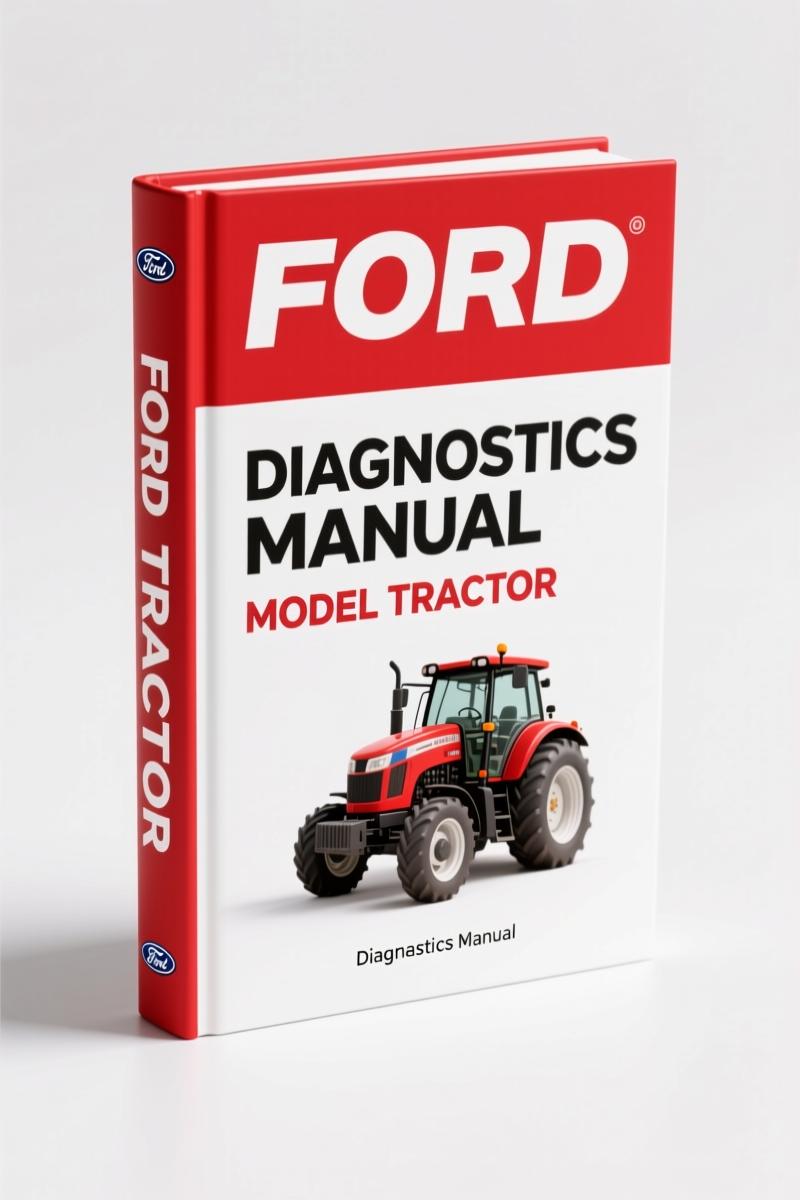
Ford Tractor Diagnostics Manual – Factory Electrical Specs
Original price was: $43.80.$30.00Current price is: $30.00.
Factory diagnostics manual for Ford tractors covering battery, generator, starter, and circuit resistance tests with OEM specs.
Description
Ford Tractor Diagnostics Manual
You got a tractor that won’t start, battery’s dead, generator not charging? I’ve seen too many guys throw parts at a Ford Tractor electrical problem and still have the same issue an hour later. This Diagnostics Manual is the one you need – 60 pages of factory test procedures, not some generic rewrite from a third-party publisher. The Ford engineers wrote this for their own service network, and it shows in every step. If you want to fix the Electrical system on a Ford tractor without guessing, this is the file to have on your bench.
Checking the Battery – Capacity Test First
Page 4 walks you through the battery capacity test. You don’t just check voltage and call it good. The manual tells you load test procedure with specific amperage draw for 6- and 12-volt systems. Skip this step and you’ll be chasing a generator problem that’s actually a weak cell. I’ve seen it happen on a 6000 series – the owner replaced the regulator twice before someone finally load-tested the battery. Don’t be that guy.
Generator Output Test: Negative vs. Positive Ground
The generator section alone is worth the access. There are three output test methods depending on your tractor’s ground polarity. Pages 5-7 give you the exact hookup for each one. If you’ve ever tried to test a positive-ground system with a modern multimeter and got weird readings, you’ll appreciate the step-by-step. The Generator Output Test (negative ground) procedure on page 5 is the one I use most. It calls for a carbon-pile load tester – don’t substitute with a headlight bulb and call it good.
Starter No-Load vs. Cranking Test – Know the Difference
Page 18 covers the no-load current test for the starting motor. That tells you if the armature or field coils are shorted. Page 20 is the cranking current test – that tells you if the engine is dragging or the starter is weak. Two different tests, two different results. I’ve had guys run a cranking test when they should have run a no-load, and they condemned a good starter. The manual keeps you straight.
Circuit Resistance – Measuring Voltage Drop the Right Way
Section starts on page 24. It breaks down generating system resistance, starting motor circuit resistance for 4-cylinder engines and Series 6000 Diesel. If you’re not using a voltmeter to measure voltage drop, you’re guessing. Page 26 gives the max resistance for the starting motor circuit on 4-cylinder Ford tractors. Exceed that spec and you’ve got a corroded cable or a bad connection. You’ll also find the primary ignition circuit resistance on page 30 – critical for proper spark timing.
Trouble Shooting the Ignition System – Page 48 Procedure
This is not a generic timing light guide. The factory trouble‑shooting chart on page 48 walks you through ignition system faults step by step: coil primary resistance, secondary voltage, point condition. If you’re working on a 6‑volt positive‑ground tractor that has erratic spark, follow the chart and you’ll find the problem in under 20 minutes. The manual also covers trouble‑shooting for the generating system (page 32) and different starting system variants for 4‑cylinder, Series 6000 Gas, and Series 6000 Diesel (pages 36–42).
Electrical Specs on Page 58-59 – Why OEM Data Matters
Back page of the manual lists all the critical electrical specifications: generator output current, regulator set points, starter draw, battery capacity. These numbers came from Ford’s engineering division, not from a parts catalog website. When I train new hires, I tell them: aftermarket manuals sometimes copy old specs or round them off. This Ford Tractor Diagnostics Manual gives you the exact values Ford used on the assembly line. If you’re rebuilding a generator or setting a regulator, you need those numbers right. One wrong regulator setting can cook a battery in a week.
Audience Fit – Home Garage or Professional Shop
If you’re a DIY owner who wants to keep a vintage Ford tractor running, this manual is for you. The instructions assume you have a voltmeter, a carbon‑pile load tester, and basic wiring knowledge – but they don’t assume you’re a factory tech. Every test is described in plain language with the schematic chart to guide you. For a shop like mine, it’s a quick reference when a farmer brings in a 1965 Ford 4000 and says “the dash light flickers.” I flip to the regulator test curve on page 9, run the test, and tell him if it’s the regulator or the generator. Saves billable hours.
Source Validity – Why OEM Trumps Aftermarket Copies
This is an original Ford publication, part of the factory service training program. The introduction (page 2) states the specs are correct at time of printing and encourages technicians to record updates. That tells you the manual was a living document in Ford’s hands – not a photocopy of a photocopy. I’ve seen aftermarket “compilations” that mix up positive‑ground and negative‑ground procedures. This manual keeps them separate and labels each page. You can trace every test back to Ford’s own engineering bulletins. That’s why we carry it.
Related Manuals You Might Need
- Ford Integrated Diagnostic System (IDS) Training Manual
- Ford Chassis Application Manual 1986-2004
- Automatic Transmission CVT Diagnosis and Service
For broader context on tractor electrical theory, check the Automotive Industry Overview and the history of On-board Diagnostics (OBD) – not directly Ford tractor, but helps understand the evolution.
Frequently Asked Questions
- Does this manual cover Ford tractors with alternators instead of generators?
- No. This edition covers only DC generator systems with external regulators. Ford switched to alternators in the early 1970s on some models. If your tractor has an alternator, you need the later Ford electrical service manual.
- What test equipment do I need to follow the procedures?
- A voltmeter, ammeter (0-50 amp DC), carbon-pile load tester, and a tachometer for generator RPM tests. The manual assumes you have those.
- Can I use this manual for a Ferguson or Massey Ferguson tractor?
- Not directly. The electrical components are Ford-specific part numbers and test specs. However, if the Ferguson uses a Ford-sourced generator or starter, the test procedures may transfer. Verify your component part number first.
- How do I know if my tractor has a positive-ground electrical system?
- Look at the battery terminal connected to the frame. On positive-ground Ford tractors, the positive terminal (usually marked with a + or red) is grounded. The manual provides separate test procedures for positive and negative ground on pages 5-10.
You don’t need to reread the whole thing to get value – just pull the test you need, grab your multimeter, and run it. Access the Factory Manual now and keep it on your tablet or print it out for the toolbox. That 60‑page PDF is the difference between guessing and knowing.
Additional information
| Brand | Ford |
|---|---|
| Language | English |
2 reviews for Ford Tractor Diagnostics Manual – Factory Electrical Specs
You may also like…
-
Sale!

Ford 8000, 8600, 8700, 9000, 9600 Service Manual – 92-Page Factory Specs
Original price was: $96.20.$65.00Current price is: $65.00. -
Sale!

Ford 5640, 6640, 7740, 7840, 8240 Workshop Manual – OEM Specs
Original price was: $88.40.$65.00Current price is: $65.00. -
Sale!

Ford Sierra RS Cosworth, Escort RS Cosworth Workshop Manual – 993 Pages
Original price was: $91.00.$65.00Current price is: $65.00. -
Sale!

Ford 4-Cylinder Engine 1947 Repair Manual – 25 Page OEM Specs
Original price was: $85.15.$65.00Current price is: $65.00.
Related products
-
Sale!

International 1000-3000 Series Operators Manual – 132 Pages of OEM Specs
Original price was: $14.40.$10.99Current price is: $10.99. -
Sale!
1995 Operators Manual – International 1000-4000 Series | OEM Documentation
Original price was: $12.49.$9.99Current price is: $9.99. -
Sale!
1994 Troubleshooting Manual – International 1000-4000 FBC
Original price was: $60.00.$50.00Current price is: $50.00. -
Sale!
1991 Electrical Schematic – 112-Page OEM Wiring Diagram for International 1000-3000 Series
Original price was: $22.75.$17.50Current price is: $17.50.
pro_mechanic –
Highly recommended! It is very easy to read on my phone without blur. A must-have for any Ford Tractor mechanic doing repairs. Saved my repair job! Thanks.
diy_master –
Outstanding! The pages are clean and easy to navigate. Contains detailed schematics for Ford. Saved my weekend project! Thank you.