
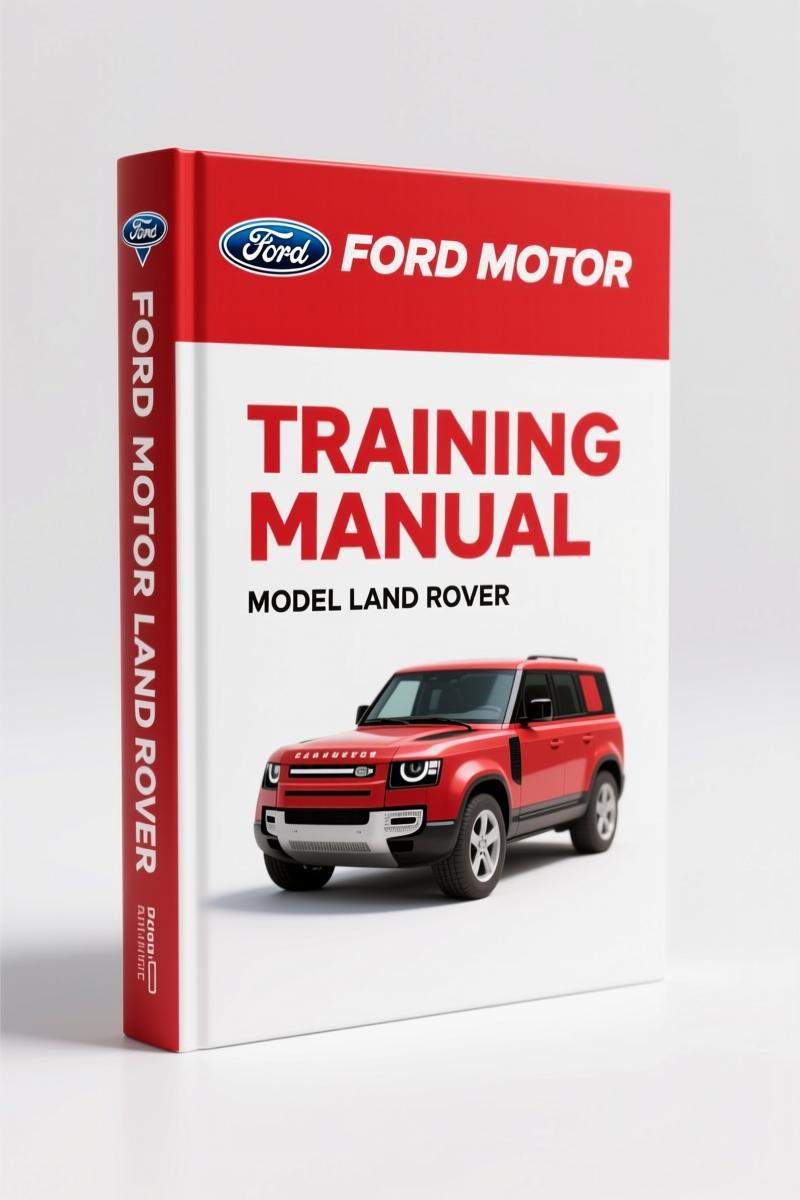
FORD Motor Land Rover, Volvo, Mazda, Lincoln, Ford 2001 Training Manual – Brake Systems
Original price was: $22.93.$14.99Current price is: $14.99.
OEM 2001 training manual: brake theory, drum/disc, master cylinder, ABS, diagnostic process. 54 pages. For Land Rover, Volvo, Mazda, Lincoln, Ford.
Description
FORD 2001 Training Manual: Land Rover, Volvo, Mazda, Lincoln – Brake Systems
If you are tearing into a brake job on a Land Rover or a Lincoln and half the parts look the same but you aren’t sure about the FORD Motor Land Rover, Volvo, Mazda, Lincoln, Ford 2001 Training Manual, you are missing the foundation. This is not a repair manual for one vehicle. It is the factory training document that teaches how every brake system on these brands works. Without that, you are guessing. And guessing on brakes gets people hurt.
I have been turning wrenches since before some of you were born. I have seen guys pull a master cylinder off a Volvo and put it on a Mazda because “they looked the same.” That is how you get a pedal to the floor. This manual, published in 2001 by FORD Motor for their Global Fundamentals Curriculum, is the real thing. 54 pages of pure brake knowledge, from friction theory to ABS modulation. No fluff. No pretty pictures of guys smiling. Just diagrams, torque tables, and the why behind each component.
That matters. Understanding the theory behind hydraulic principles and mechanical leverage lets you diagnose a spongy pedal on any Ford group vehicle without swapping parts blindly.
Brake Systems Covered: From Drum to ABS
The table of contents breaks your learning into seven lessons. Lesson 1 covers the braking system fundamentals: energy, power, friction, traction, weight and balance, mechanical leverage, and hydraulic principles. That is the bedrock. Lesson 2 dives into drum brakes and parking brakes. Lesson 3 handles disc brakes and their components. Lesson 4 explains master cylinders, split front/rear and diagonally split systems, brake lines, fluid, and braking force control valves. Lesson 5 covers power-assisted brakes, including single and dual diaphragm boosters and Hydroboost. Lesson 6 is the anti-lock brake system (ABS) with the control module, wheel speed sensors, and hydraulic control unit (HCU) operation. Lesson 7 gives you the diagnostic process: symptom-to-system-to-component-to-cause. Every section has clear objectives and an “At a glance” summary so you know exactly what you should take away.
Why a Training Manual Instead of a Repair Manual?
Because if you do not understand why an ABS wheel speed sensor needs to be a specific distance from the tone ring, you will spend hours chasing a code that never clears. Ford Motor Company designed this Training Manual to be the prerequisite for any brand-specific workshop manual. It teaches you the physics and the common components across Land Rover, Volvo, Mazda, Lincoln, and Ford. After you work through this, picking up a vehicle-specific manual for a Ford Transit Connect or a Ranger will make ten times more sense. Check the FORD Motor Transit Connect 2009 User Manual – Factory OEM Guide if you need actual torque specs for that van. But first, learn the fundamentals here.
3 Critical Lessons for the DIY Mechanic
First, the manual explains hydraulic principles with actual numbers. Pedal ratio, piston area, fluid displacement – you will see how a 1-inch master cylinder bore behaves differently from a 1.125-inch bore. Second, the diagnostic process in Lesson 7 is the same method I teach my junior techs. You start with the symptom (pedal sinks), map it to the system (hydraulic), then the component (master cylinder seals), then the cause (internal bypass). Third, the brake fluid section tells you the DOT ratings and what happens when moisture lowers the boiling point. That is the kind of knowledge that keeps your Volvo stopping at the bottom of a long grade.
The manual also references other courses in the Global Fundamentals series, such as Manual Transmission and engine performance. If you want to know why your brake fluid needs to meet a specific viscosity, check Motor Oil Specifications for context on fluid properties across systems.
Torque Specs and Fluid Capacities – Where to Find Them
Do not expect a list of every bolt torque in this training manual. That is not its job. What you get on page 3 is the curriculum overview that shows how this brake book fits with the other eight books. The actual torque values for a specific Ford, Lincoln, or Mazda model come from the vehicle-specific workshop manual. But this book gives you the engineering rationale. For example, the section on brake lines explains how flare nut torque relates to tube wall thickness and seat design. That lets you judge if a generic aftermarket spec is safe. I have seen aftermarket manuals list 15 ft-lbs for a brake line fitting that Ford calls for 18 ft-lbs. That difference causes leaks. This training manual stops you from trusting bad data.
Source Authenticity: OEM Factory Document vs Aftermarket
This is a genuine FORD Motor Company publication (FCS-13201-REF). It came from the same training center that taught dealership technicians in 2001. Aftermarket manuals often copy and paste generic diagrams, mix up part names, or miss important warnings. This training manual has the original Ford part number, the copyright notice, and the curriculum reference. I do not trust aftermarket brake documentation on principle because one wrong torque spec can cost a rotor or worse. With this OEM document, you know the information matches what FORD Motor taught their own people. If you need a companion repair manual for a specific vehicle, look at FORD Motor Ranger User Manual – 272-Page OEM Factory Guide or FORD Motor Escape 2001 User Manual – OEM Factory Documentation.
- Does this manual include wiring diagrams for the ABS system?
- No. This is a theory and components training manual, not a vehicle-specific wiring diagram.
- What torque values are listed for brake caliper bolts?
- The manual covers theoretical concepts and component operation. It does not list specific torque specs for every bolt. For that, you need the vehicle-specific workshop manual. However, it explains the principles of hydraulic pressure, friction, and mechanical leverage that determine those values. If you understand those, you will know why a caliper bolt needs 45 ft-lbs and not 30. This manual builds that understanding so you can apply it across multiple Ford group vehicles. Once you have that foundation, you can work on any Land Rover, Volvo, Mazda, Lincoln, or Ford with confidence.
Bottom line: if you plan to work on brakes for any vehicle in the Ford family, start with this 2001 Training Manual. It saves you from hunting through internet threads and trusting forum advice. Access the Factory Manual now from AutoRepairManuals and put real OEM knowledge under your toolbox lid.
Additional information
| Brand | FORD Motor |
|---|---|
| Language | English |
3 reviews for FORD Motor Land Rover, Volvo, Mazda, Lincoln, Ford 2001 Training Manual – Brake Systems
You may also like…
-
Sale!
FORD Motor Focus 2010 Workshop Manual – 1012 Pages of Factory Specs
Original price was: $31.75.$25.00Current price is: $25.00. -
Sale!
FORD Motor B2e 2010 Wiring Diagram – OEM Electrical Schematics
Original price was: $21.00.$15.00Current price is: $15.00. -
Sale!
FORD Motor 6.0L Diesel 2008 Diagnostics Manual – OEM OBD Summary
Original price was: $39.75.$25.00Current price is: $25.00. -
Sale!
FORD Motor Ranger 2002 Wiring Diagram – Factory OEM Schematics for European LHD Models
Original price was: $29.20.$20.00Current price is: $20.00.
Related products
-
Sale!

1992 Electrical Schematic – OEM Wiring Diagrams for International 1000-3800
Original price was: $24.48.$18.00Current price is: $18.00. -
Sale!
2004 Acura TSX Wiring Diagram – 73-Page Factory Electrical Schematics
Original price was: $15.88.$9.99Current price is: $9.99. -
Sale!

2011 Parts Catalog – International Truck OE Parts Documentation (1786 Pages)
Original price was: $34.50.$25.00Current price is: $25.00. -
Sale!
International 1000-3000 Series Operators Manual – 132 Pages of OEM Specs
Original price was: $14.40.$10.99Current price is: $10.99.
pro_mechanic –
Five stars! The PDF is very clear. Every spec sheet is provided for FORD Motor Motor. Saved my repair job! Thank you.
Richard G. –
Five stars! It is easily zoomable on my phone without losing quality. It helped me to rebuild my FORD Motor Motor transmission. Saved my repair job! Thanks.
William H. –
Perfect OEM spec sheet. It is very easy to read on my tablet without losing quality. Contains detailed schematics for FORD Motor. Saved my repair job! Thank you.