
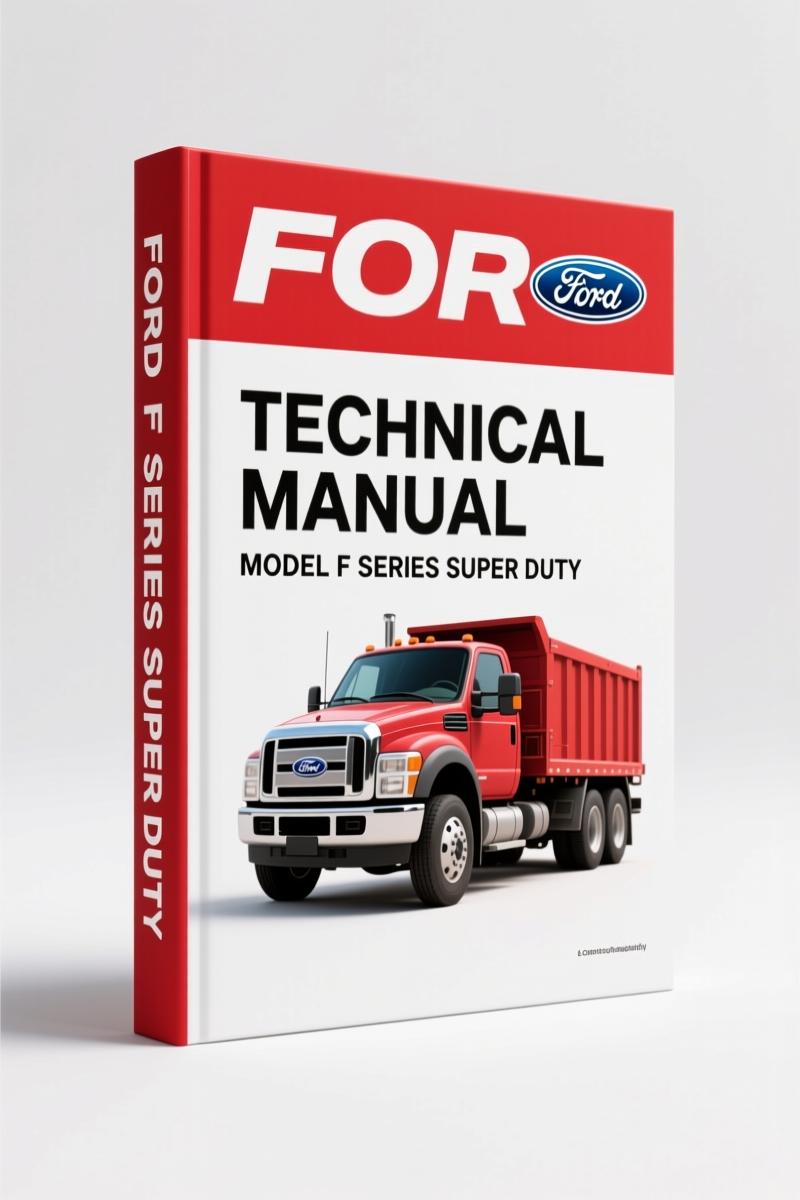
Ford F Series Super Duty Technical Manual – 7.3L DIT Diesel
Original price was: $34.43.$22.50Current price is: $22.50.
Ford factory manual for 1998-1999 F Series Super Duty 7.3L DIT diesel. 78 pages of specs, torque data, and diagnostic guides.
Description
Ford F Series Super Duty Technical Manual – 78 Pages of Factory Diesel Knowledge
You’ve got a 7.3L Power Stroke sitting in your bay, and the customer is watching the clock. The aftermarket data says “tighten to spec” but doesn’t tell you which spec. That’s where this Ford F Series Super Duty Technical Manual comes in. 78 pages of factory-verified procedures, torque tables, and diagnostic flows that Ford sent to their own dealership techs. I’ve been turning wrenches since before the 7.3L came out, and I can tell you: if you skip the OEM documentation on these diesel engines, you’re gambling with head gaskets and high-pressure oil leaks.
This manual covers the 1998–1999 model years of the Ford F Series Super Duty equipped with the 7.3L Direct Injection Turbocharged Diesel. It’s not a reprint or a third-party compilation. It’s the original technical manual with the Ford logo on it, and it treats the engine as a system—air charging, fuel charging, sensors, and the special torque data that aftermarket books get wrong. Page 33 lists the critical torque values for the cylinder head, main bearings, and turbocharger mounting. You need those numbers when you’re torquing head bolts, and this manual gives them straight from the engineering team.
7.3L DIT Diesel Engine Specifications and New Features
The first section of the manual (page 4–5) covers engine specs, serial number locations, and emission label info. It also includes a horsepower and torque comparison between the 1998 and 1999 calibration revisions. If you’ve ever replaced a high-pressure oil pump and wondered whether the calibration changed the injection timing, this section answers that. The “New Features” list on page 4 calls out the revised wastegate actuator and the updated fuel filter housing with a water-in-fuel sensor. Knowing these changes saves you from ordering the wrong parts.
Air Charging System: Wastegate Control and Turbo Removal
Turbocharger problems on the 7.3L are common—sticking wastegates, cracked pedestals, oil leaks. Pages 13–17 walk through the turbo identification, wastegate control rod adjustment, and the factory procedure for diagnosing overboost conditions. Then page 18 gives the turbo removal and installation sequence, including the torque for the exhaust manifold bolts and the oil return line fitting. Aftermarket manuals tell you to “remove the turbo” but never warn you about the two hidden bolts on the back of the bracket. This manual shows you the exact orientation.
Fuel Charging System: Injectors, Fuel Filter, and High Pressure Oil
Pages 21–29 cover the injectors, fuel filter service, and the high-pressure oil system. The injector removal procedure on page 21 includes the special tool part numbers you’ll need to pull the injector without breaking the connector. Page 24 gives the fuel filter replacement interval and the proper bleed procedure—critical because air in the high-pressure oil rail will cost you a no-start. The high-pressure oil system section (page 29) explains the operation of the ICP sensor and IPR valve, plus the test procedure for measuring oil pressure at the standpipe. If you’ve ever chased a stalling issue that only happens when the oil is hot, this is the chapter you need.
Special Torque Data – Get It From The Factory
Torque specifications are the single most faked-up numbers in aftermarket literature. Page 33 in this manual lists the exact torque for the cylinder head bolts (first pass, second pass, final angle), the main bearing cap bolts, the connecting rod nuts, and the vibration damper. Use those numbers with a calibrated torque wrench—not a clicker that hasn’t been tested in three years. The manual also includes the tightening sequence for the intake manifold and the front cover. I’ve seen too many oil leaks caused by someone using an aftermarket torque chart that was off by 10 ft-lbs. Don’t be that guy.
Who Should Use This Manual
This manual is written for the technician or advanced DIYer who has already done a few diesel jobs and knows how to work safely around high-pressure fuel systems. It’s not a “how to change oil” pamphlet. If you’re swapping a turbo, rebuilding a fuel system, or diagnosing a no-start, this is the reference you keep on the fender. The diagnostic guides and forms starting on page 50 give you a structured approach to trouble codes and intermittent failures—stuff the chilton manuals gloss over.
Why OEM Documentation Matters More Than Aftermarket
Aftermarket publishers copy data from a 1994 shop manual and call it “universal.” This manual came directly from Ford’s powertrain engineering group. It has the official Ford part numbers, the real calibration strategies, and the safety warnings that aftermarket books omit. The foreword on page 2 includes a caution about using a turbocharger compressor inlet shield when running the engine with the air cleaner removed. That’s not generic filler—it’s a reminder that a loose rag can get sucked into the compressor wheel and destroy the turbo in half a second. You don’t get that kind of detail from a third-party PDF.
If you’re working on a 1998–1999 Ford F Series Super Duty with the 7.3L Power Stroke, you need the real torque specs, the correct turbo removal sequence, and the fuel system diagnostic procedures. This 78-page technical manual gives you all of that in a single, searchable file. Pair it with the Ford Mondeo 2003 Technical Manual – OEM Factory Data if you also work on passenger cars, or grab the Ford FALCON Technical Manual – Multibody Vehicle Dynamics for chassis systems. For a broader look at diesel engine data, check the Automotive Industry Overview on Wikipedia. And if you’re rebuilding a manual transmission on a Super Duty, the Manual Transmission page has helpful background. For Ford SUVs, the Ford Ranger Technical Manual: 630 Pages of Factory Specs covers the smaller platforms.
Access the Factory Manual and keep it on your tablet or print the pages you need. Your engine will thank you.
Frequently Asked Questions
- Does this manual cover the 7.3L Power Stroke engine only, or does it include transmission and chassis info?
- It covers the 7.3L DIT diesel engine in detail—specs, air charging, fuel charging, sensors, torque data, and diagnostic guides. Transmission and chassis are not included. You’ll need separate service manuals for those systems.
- Is the torque data on page 33 for the cylinder head bolts given in ft-lb or Nm?
- Both. The table lists the values in both foot-pounds and Newton-meters, along with the tightening angle for the final pass.
- Can a beginner with no diesel experience use this manual to rebuild the fuel system?
- No. This manual assumes you know how to work on a high-pressure diesel fuel system safely. Beginners should first complete a basic safety course and get hands-on experience with a mentor before attempting fuel system work.
- What is the publication year of this technical manual?
- 1998. It was released shortly after the 1999 model year Super Duty trucks entered production, and it covers both the 1998 and 1999 model years.
Additional information
| Brand | Ford |
|---|---|
| Language | English |
4 reviews for Ford F Series Super Duty Technical Manual – 7.3L DIT Diesel
You may also like…
-
Sale!

Ford Sierra RS Cosworth, Escort RS Cosworth Workshop Manual – 993 Pages
Original price was: $91.00.$65.00Current price is: $65.00. -
Sale!

Ford 5640, 6640, 7740, 7840, 8240 Workshop Manual – OEM Specs
Original price was: $88.40.$65.00Current price is: $65.00. -
Sale!

Ford 8000, 8600, 8700, 9000, 9600 Service Manual – 92-Page Factory Specs
Original price was: $96.20.$65.00Current price is: $65.00. -
Sale!

Ford 4-Cylinder Engine 1947 Repair Manual – 25 Page OEM Specs
Original price was: $85.15.$65.00Current price is: $65.00.
Related products
-
Sale!

1991 Electrical Schematic – 112-Page OEM Wiring Diagram for International 1000-3000 Series
Original price was: $22.75.$17.50Current price is: $17.50. -
Sale!

Acura Integra 1998 Service Manual – 1891 Pages Factory OEM Documentation
Original price was: $31.75.$25.00Current price is: $25.00. -
Sale!
1993 Electrical Schematic – International 1000/3000/4000 Bus Chassis OEM Wiring Diagrams
Original price was: $29.26.$22.00Current price is: $22.00. -
Sale!
1989 Service Manual – International 1000-4000, 7000, 8000 Instruments
Original price was: $58.80.$40.00Current price is: $40.00.
Richard G. –
This is exactly what I was looking for. Quick access after checkout process. A must-have for any Ford F owner doing maintenance. Saves me a lot of dollars.
gearhead88 –
Superb resource! The pages are clean and well indexed. It helped me to troubleshoot my Ford F electrical system. Saved my weekend project! Thanks.
James L. –
This is exactly what I needed. Instant access after checkout. Every wiring layout is provided for Ford F. Saves me a lot of money.
Thomas B. –
Perfect factory service manual. The document is very clear. Every spec sheet is included for Ford F. Worth every penny.