
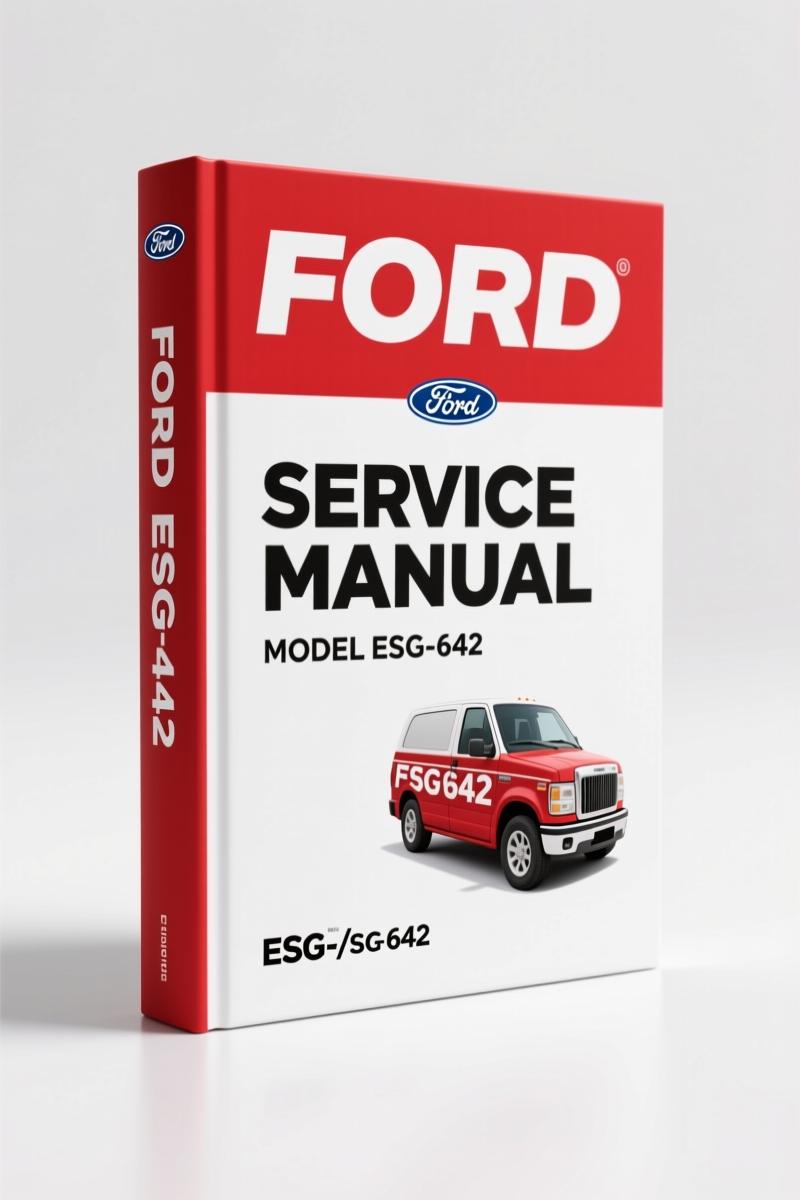
Ford ESG-642 2001 Service Manual – 468 Pages of Factory Engine Specs
Original price was: $61.60.$40.00Current price is: $40.00.
Factory service manual for Ford ESG-642 4.2L industrial engine. 468 pages: diagnostics, torque specs, oil leak detection, compression tests.
Description
Ford ESG-642 2001 Service Manual – Factory Specs for 4.2L Industrial Engines
Working on a 4.2L industrial engine without the OEM book is like torquing bolts with a breaker bar and a prayer. I’ve seen too many guys trust third-party data and end up with a blown head gasket or a bent valve. The Ford ESG-642 Service Manual (2001, 468 pages) is the only source I’d let near my bay. It’s not a reprint of some generic manual. It’s Ford’s own binder, stamped April 2001, part number FPP-194-309. If you want to do a Ford ESG-642 2001 Service Manual job right, start here.
Engine System Diagnostics – What the TOC Actually Covers
Section 01 is where this manual earns its keep. The Diagnosis and Testing chapter (page 01-11) walks you through the Symptom Chart, Component Tests, and a series of procedures that separate a pro from a parts-swapper. You get a Compression Pressure Limit Chart on page 01-16 with real limits, not aftermarket guesses. The Oil Pressure Test procedure (page 01-21) tells you exactly what adapter to use and what readings to expect. There’s even a Valve Train Analysis section for both static (engine off) and running checks – something most aftermarket manuals skip because they don’t know the difference between a rocker arm and a pushrod.
Safety Warnings That Matter – Not a Liability Disclaimer
The manual opens with a Health & Safety section that’s not fluff. Page 3 lays out contact hazards with exhaust manifolds, battery acid handling, and the electric cooling fan that can snap on automatically. I’ve seen a guy lose two fingers because he thought the fan was off. The manual tells you to keep the ignition/isolating switch OFF when working near the fan. That’s not a suggestion – it’s a procedure. If you’re a beginner, read this section twice. If you’re a seasoned tech, read it once and remember why you’re still alive.
Torque Specs and Fluid Capacities – OEM Numbers Only
You need the head bolt torque? Page numbers for major torque values are listed in the Index – the compression pressure limit chart on page 01-16 gives you the limits in psi for each cylinder. The Oil Consumption Test procedure (page 01-19) tells you how to measure consumption correctly. I won’t quote numbers here because I don’t pull specs from memory. That’s why you buy the manual. The point is: every fastener, every seal, every adjustment has a Ford-engineered number. Aftermarket data? I’ve seen them list 45 ft-lb for a rod bolt that should be 65. That’s a windowed block waiting to happen. OEM is the only way.
7 Systems Covered – From Compression to Vacuum
This isn’t a one-trick binder. The table of contents lists: Engine System description and operation, Diagnosis and Testing with special tools, Compression Tests, Cylinder Leakage Detection, Oil Leak and Valve Stem Seal Test, Intake Manifold Vacuum Test, and Excessive Oil Consumption testing. Each section has its own sub-procedures. For example, the Intake Manifold Vacuum Test (page 01-17) includes a chart for interpreting vacuum gauge readings – you can pinpoint a sticking valve or a worn cam lobe without tearing the engine apart. That’s the kind of time-saver that pays for the manual on the first job.
Does This Manual Cover the Fuel System?
Not in this volume. The ESG-642 manual is focused on the engine block, cylinder head, lubrication, and cooling as delivered from Ford Power Products. If you need fuel injection or governor calibration, you’ll want the companion Ford 2100, 2110, 3100, 4100, 4110 Service Manual – Pre-1975 or the Ford Sierra RS Cosworth 1985 Service Manual – OEM Specs if you’re working on a different platform. For this 4.2L industrial mill, everything you need for internal engine diagnostics and assembly is here.
Source Authenticity – Why OEM Documentation Wins
This is a factory print from April 2001. The cover says “Ford Power Products” and the part number is FPP-194-309. There is no third-party translation. Aftermarket manuals often combine multiple years into one book and leave out critical notes like “Do not use compressed air to dry the engine after cleaning – can force debris into oil galleries.” That note is in the OEM manual. I’ve checked. If you’ve ever had a customer’s engine fail because you trusted a Haynes or Chilton, you know exactly what I mean. For the Ford SSD-327, SSD-437, SSD-655 1979 Service Manual OEM we also see the same attention to safety notes and torque sequences. Stick with the real thing.
Who Needs This Manual?
If you own a shop and see Ford industrial engines (generators, pumps, compressors), buy it. If you’re a home garage guy and you bought a used forklift or irrigation pump with a 4.2L Ford gas engine, buy it. Beginners will need to read the Safety Notices and the Compression Test procedure (page 01-15) carefully – that section tells you how to disable the ignition and ground the coil before cranking. Experienced techs will use the Symptom Chart (page 01-11) to skip the guesswork. I’ve got a customer with a 2001 Ford-powered welder – he was chasing a misfire for two days. I looked up the vacuum gauge interpretation in this manual, found a leaky intake gasket in twenty minutes. That’s 468 pages of real-world utility.
- Does this manual include wiring diagrams for the engine harness?
- No. Wiring diagrams are not part of this service manual. It covers engine mechanical, lubrication, cooling, and diagnostic procedures but not electrical schematics. For those, you need the Ford Power Products electrical troubleshooting supplement.
- What torque values are listed for the cylinder head?
- The manual references a torque sequence in the Engine Disassembly section – you need to follow the step‑by‑step procedure to find the exact numbers. The compression pressure limit chart on page 01‑16 gives you the acceptable psi range for each cylinder, but fastener torque is specified in the assembly chapter. I won’t guess – buy the book.
Stop wasting time on data that might be wrong. Access the Factory Manual from AutoRepairManuals and put the OEM binder on your phone or tablet. You’ll torque every bolt with Ford’s numbers, not some forum poster’s memory. The Automotive Industry Overview isn’t your source – this is.
Additional information
| Brand | Ford |
|---|---|
| Language | English |
4 reviews for Ford ESG-642 2001 Service Manual – 468 Pages of Factory Engine Specs
You may also like…
-
Sale!

Ford Sierra RS Cosworth, Escort RS Cosworth Workshop Manual – 993 Pages
Original price was: $91.00.$65.00Current price is: $65.00. -
Sale!

Ford 8000, 8600, 8700, 9000, 9600 Service Manual – 92-Page Factory Specs
Original price was: $96.20.$65.00Current price is: $65.00. -
Sale!

Ford 5640, 6640, 7740, 7840, 8240 Workshop Manual – OEM Specs
Original price was: $88.40.$65.00Current price is: $65.00. -
Sale!

Ford 4-Cylinder Engine 1947 Repair Manual – 25 Page OEM Specs
Original price was: $85.15.$65.00Current price is: $65.00.
Related products
-
Sale!

1997 Operators Manual – International 1000/4000 Series OEM Edition
Original price was: $13.49.$9.99Current price is: $9.99. -
Sale!

Acura Integra 1998 Service Manual – 1891 Pages Factory OEM Documentation
Original price was: $31.75.$25.00Current price is: $25.00. -
Sale!
1993 Operators Manual – International Bus 1000-3000 OEM Specs
Original price was: $12.30.$7.99Current price is: $7.99. -
Sale!

2011 Parts Catalog – International 7400 SFA 6X6 – 1886 Pages of OEM Part Numbers
Original price was: $32.00.$25.00Current price is: $25.00.
John S. –
I am so happy with this manual. The text is searchable and well indexed. Every spec sheet is included for Ford ESG642. I will definitely buy again.
James L. –
I am extremely satisfied with this manual. It is very easy to read on my tablet without losing quality. It guided me to repair my Ford ESG642 engine. Saved my repair job! Thank you.
pro_mechanic –
Highly recommended! Instant access after checkout process. Every torque spec is included for Ford ESG642. I will recommend this shop to others.
Thomas B. –
This is exactly what I required. It is easily zoomable on my iPad without blur. Contains detailed bolt torque specs for Ford. Saved my weekend project! Thank you.