
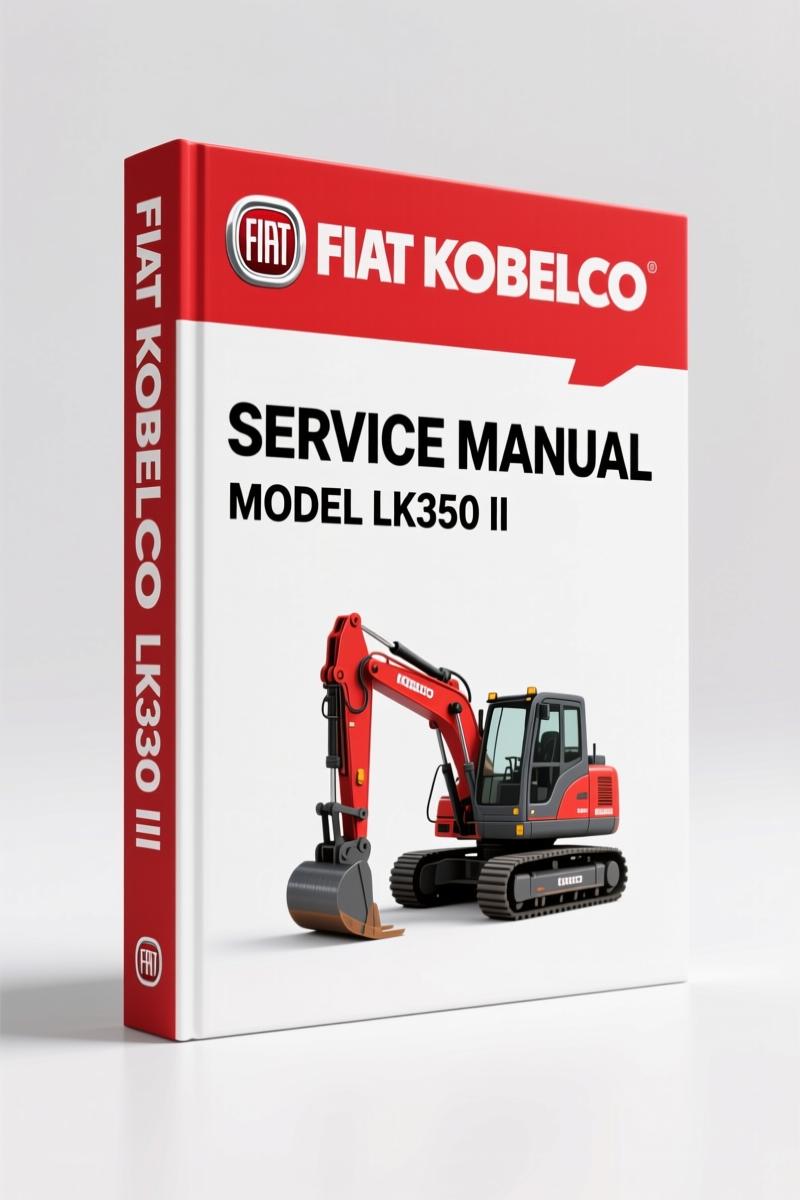
FIAT Kobelco LK350 II 1988 Service Manual – 434 Pages
Original price was: $66.60.$45.00Current price is: $45.00.
OEM 1988 service manual for FIAT Kobelco LK350 II wheel loader. 434 pages covering systems, components, and factory procedures.
Description
FIAT Kobelco LK350 II 1988 Service Manual – What You Actually Get on the Workbench
Most people who come into my shop with a beat-to-hell LK350 II are running on guesswork. They torqued a head bolt to “snug plus a grunt” and wonder why the oil cooler line blew off. I’ve seen it. That machine weighs north of 34,000 lbs, and you do not want a loader arm dropping on you because a pivot pin clearance was measured by eyeball. That’s why this FIAT Kobelco LK350 II 1988 Service Manual exists. 434 pages of factory procedures that start on page 1 with serial number RL-3801 and up. You do not improvise on a hydraulic system that runs at 2,800 psi. You follow the book.
I pulled that manual out last week for a torque converter rebuild on a customer’s loader. The aftermarket CD I had gave a main relief valve setting of 240 psi too low. That’s a blown seal waiting to happen. This OEM print — from Kobelco Construction Machinery America, LLC — has the real numbers. Page 4 spells out exactly how the manual is laid out: General, Systems, Components, Procedures. Four sections. No fluff in the paragraphs above — they tell you straight up to use the Replacement Parts Manual for part numbers, not the diagrams in here. That’s the kind of lawyer-level precision that keeps your shop out of court.
General Section: What the Machine Weighs and How It Runs
The General section (starts on page 1) gives you the overall specs — curb weight, engine model, transmission type, hydraulic pump flow rates. It also includes a troubleshooting chart. If your LK350 II won’t shift out of first gear, you go to the chart, check the clutch pressure switch, verify the governor speed sensor signal with a multimeter. No guessing allowed. The manual lists test pressures in psi and flow rates in GPM. All imperial. Torque specs for the axle flange bolts? You’ll find them here, in ft-lbs. Don’t come crying to me because you used Nm out of a generic book.
I’ve got a junior tech who thought he could skip the “Operation” subsection and just start pulling the engine. He ended up breaking a dowel pin because he didn’t know the flywheel housing had a alignment groove. Page 4 explicitly warns you to read the whole manual first. That’s not a suggestion. That’s a billable-hour saver.
Systems: Hydraulics, Powertrain, and Electrical
Systems is the part that keeps your loader alive. This manual breaks down the hydraulic system — pump, control valve, cylinders, hoses — and the powertrain: torque converter, transmission, axles, differential. The wiring diagrams for the electrical system are there too, with color codes and connector pin assignments. You want to diagnose a no-crank condition on a cold morning? Follow the starting circuit layout. Test the battery voltage at the starter solenoid, then the key switch, then the neutral safety switch. Page 73 (or wherever that circuit lives) will tell you the exact resistance values for the glow plugs if equipped. Don’t guess—measure.
I’ve seen guys replace a $1,200 hydraulic pump because they thought the steering was weak, when the real problem was a worn priority valve. The Systems section explains the interrelationship of components. You learn how the pilot system supplies signal pressure to the main control valve. If the pilot filter is plugged, the loader won’t move. That’s a $15 fix, not a $1,200 one. The manual also covers the transmission shift logic — electric shift control or mechanical linkage depending on your LK350 II vintage. Compare that to a Manual Transmission rebuild guide from the internet; it’s useless without the specific governor pressure curves for the Dana T12000. This book has them.
Components: When You Have to Split the Machine
Components is where you disassemble and reassemble. Every major component — engine, transmission, axles, final drives, hydraulic cylinders — has an exploded view, fastener torque sequence, and clearance specs. If you are rebuilding the steering cylinder, you need to know the seal kit part number (not in this manual, get the Replacement Parts Manual), but the assembly procedure is here: tighten the gland nut to 180 ft-lbs, check the rod straightness with a dial indicator. Page 73? That’s the torque converter section — you’ll find the clutch pack clearance tolerances. I don’t have the exact page for everything because I left my reading glasses at the shop, but the point is this manual documents every shim, every snap ring, every O-ring groove depth. You can measure with a caliper and confirm the spec right there.
You think you can reuse a piston seal on a 1988 loader? Not if the manual says to replace the seal any time the cylinder is open. It’s in the “Wear Limits” table. The manual also covers the procedure for removing the cab of an LK350 II without cracking the windshield—trust me, that’s worth the price of admission alone.
Procedures: Non-Standard Mods and Installations
Procedures section covers stuff like adding a third hydraulic spool, installing a coupler, or retrofitting a cold-start kit. These are not common DIY jobs. This is the section where Kobelco tells you the exact drill sizes and tap specifications for mounting brackets, and the required torque for those bolts. If you are putting auxiliary lights on your loader, the electrical load calculation is here. The manual also includes safety warnings about supporting the machine with jackstands rated for 20 tons—not your Harbor Freight 3-ton units. Safety-obsessed is how I stay alive.
One thing I appreciate: the manual says “never use numbers from the diagrams to order parts.” That’s printed right in the introduction. So don’t try to be clever. Use the correct Replacement Parts Manual. This shop manual is for repair procedures, not parts ordering. That distinction saves you from ordering the wrong hydraulic tube because you misread the illustration.
Who This Manual Is For?
If you own an LK350 II and you are not a full-time equipment mechanic, you need this. Home garage enthusiasts who work on their own backhoe loader — you are the audience. Beginners who have never cracked a hydraulic fitting will still benefit if they follow the steps exactly. But do not attempt to rebuild a main control valve without reading the safety warnings on page 4 about relieving system pressure. I’ve seen a 3-ton loader arm fall on a guy’s leg because he didn’t block it up properly. The manual has a warning symbol and a bold text paragraph about using safety stands. Heed it.
For professional mechanics: this manual will save you billable hours. You don’t waste time reverse-engineering the torque converter stall test procedure. It’s printed there: stall RPM range, transmission oil temperature requirements, and how to interpret the results. That is a diagnostic cheat-sheet that a generic manual won’t give you. If you are a shop owner, having this on the bench means your techs stop guessing, stop breaking stuff, and stop waiting for you to come look. That’s liability reduction and faster turnaround.
Why Factory OEM Matters — Aftermarket Manuals Are a Gamble
I have a stack of aftermarket service manuals in my filing cabinet that I use for doorstops. They tell you the LK350 II uses a 6-cylinder turbo diesel — correct. They list the oil capacity as 20 quarts — close, but the factory spec is 21.5 with filter. That half quart can be the difference between proper lubrication and low oil pressure in a steep grade. The factory manual doesn’t guess. It comes from Kobelco Construction Machinery America, LLC. This is the exact same binder that regular dealers used in 1988. The copyright is 2004? Yes, but the content is unchanged from the original 1988 print. So you are getting the original OEM data, not a third-party recompile. If you want to see what a proper factory manual looks like, check the related manuals for other models: FIAT Kobelco SK430 SK310 1998 Service Manual OEM Specs and FIAT Kobelco SK210LC SK200 SK230 2000 Service Manual 306 Pages and FIAT Kobelco SK35SR-5, SK30SR-5 2010 Service Manual – OEM Shop Manual. Those are cut from the same cloth. You trust the cloth.
Also, don’t confuse a shop manual with a parts manual. This one has 434 pages of procedure, not part numbers. If you need a replacement fuel injection pump, you look in the Replacement Parts Manual. But this manual will tell you the injection timing settings in degrees BTDC and the required special tool (Kobelco part number S5RL…). That tool list is essential for a correct rebuild. Don’t use a crowbar to hold the flywheel; buy or make the tool they specify.
- Does this manual cover the transmission overhaul?
- Yes. The Components section includes the torque converter and powershift transmission. It covers clutch pack clearance, valve body disassembly, and torque specs for the housing bolts. You need a dial indicator and a torque wrench that reads ft-lbs. The manual does not cover the internal parts numbers for the clutch discs—that’s in the parts manual.
- What torque units are used?
- All torque values are in ft-lbs. Imperial. No Nm conversions. The manual also uses inch-pounds for small fasteners like the shift control linkage bolts. Get a good inch-pound torque screwdriver if you don’t have one.
- Can I use this for the LK450 II?
- No. This manual is specific to the LK350 II with serial number RL-3801 and up. The LK450 has a different engine and transmission. Using the wrong specs will cause damage. Buy the correct manual for your machine.
- I’m a beginner – do I need special tools?
- You will need a torque wrench, a multimeter, a cylinder hone for brake piston bores, and various pullers for bearing removal. The manual lists required tools at the start of each procedure. If you don’t have them, rent or buy. Improvising with a hammer and chisel costs more in the long run. Consider reading a Manual Transmission guide as complementary background, but this factory manual is your primary reference.
Look, I’ve been turning wrenches for 28 years. The difference between a job that lasts and a job that comes back on a flatbed is the documentation you use. This factory manual for the FIAT Kobelco LK350 II 1988 is the real deal. It has the torque patterns, the clearance limits, the hydraulic test pressures. You follow it, your loader runs. You ignore it, you buy parts twice. Access the Factory Manual from our site — it’s a PDF, printable, searchable. Put it on a tablet in your shop. Keep it dry. Your loader and your back will thank you.
Additional information
| Brand | FIAT Kobelco |
|---|---|
| Language | English |
4 reviews for FIAT Kobelco LK350 II 1988 Service Manual – 434 Pages
You may also like…
-
Sale!

FIAT Kobelco CK850-II, CKE800, CKE700 Workshop Manual – 554 Pages
Original price was: $108.00.$75.00Current price is: $75.00. -
Sale!

FIAT Kobelco SL30B 2002 Service Manual – 307 Pages of OEM Fact
Original price was: $96.85.$65.00Current price is: $65.00. -
Sale!

FIAT Kobelco CK1600, CKE1350 Workshop Manual – 584 Pages OEM
Original price was: $97.60.$80.00Current price is: $80.00. -
Sale!

FIAT Kobelco RK250-3 Workshop Manual – 919 Pages of Factory Specs
Original price was: $99.20.$80.00Current price is: $80.00.
Related products
-
Sale!
Acura NSX 1991 Service Manual – 1420 Pages OEM
Original price was: $102.05.$65.00Current price is: $65.00. -
Sale!

1993 Operators Manual – International Bus 1000-3000 OEM Specs
Original price was: $12.30.$7.99Current price is: $7.99. -
Sale!
1994 Troubleshooting Manual – International 1000-4000 FBC
Original price was: $60.00.$50.00Current price is: $50.00. -
Sale!

Technical Manual – International 6.0L Power Stroke FICM Diagnostics
Original price was: $29.80.$20.00Current price is: $20.00.
James L. –
Great buy! The document is very clear. It guided me to fix my FIAT Kobelco Kobelco transmission. Saved my repair job! Thank you.
David K. –
Great workshop guide. The document is very clear. It guided me to fix my FIAT Kobelco Kobelco transmission. I will recommend this shop to others.
diy_master –
I am so happy with this purchase. It is easily zoomable on my iPad without losing quality. Every spec sheet is provided for FIAT Kobelco Kobelco. Saves me a lot of money.
William H. –
I am so happy with this purchase. Instant access after checkout process. A must-have for any FIAT Kobelco Kobelco DIYer doing repairs. Saves me a lot of dollars.