
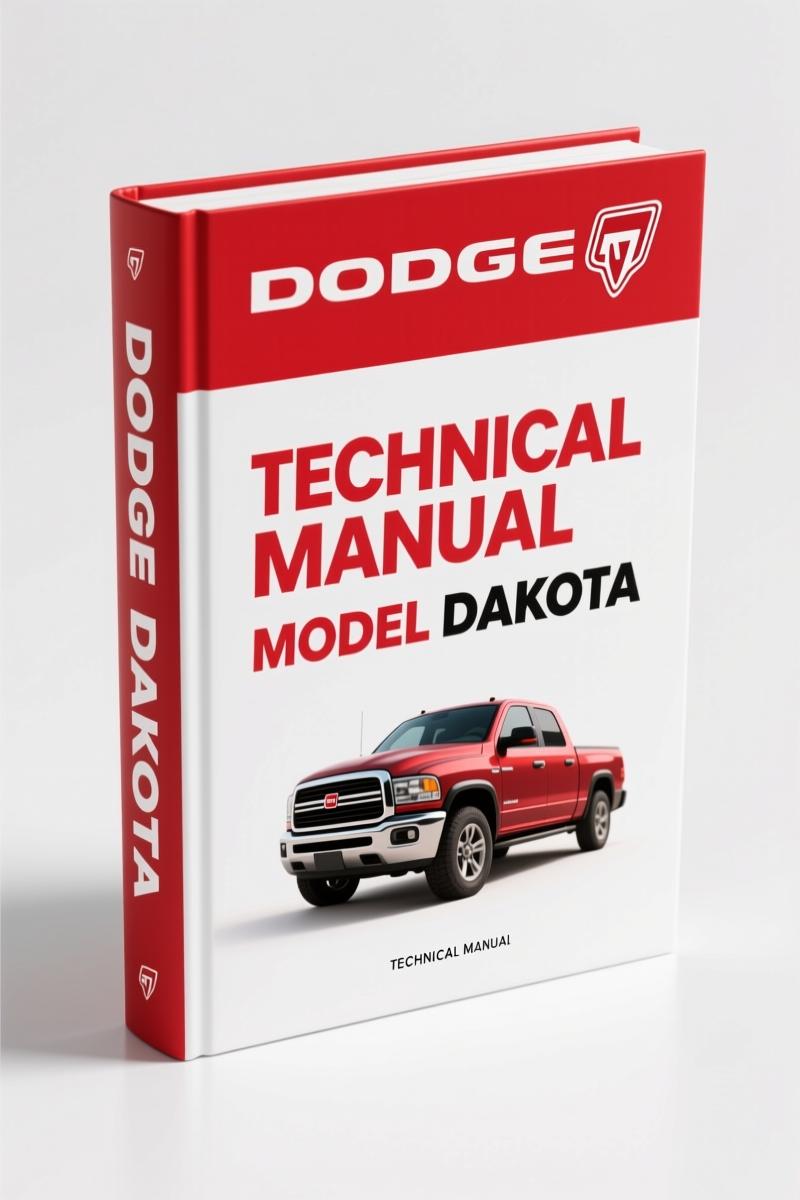
Dodge Dakota Technical Manual – 1997-1998 OEM Parts Catalog
Original price was: $7.40.$5.00Current price is: $5.00.
OEM factory parts catalog for 1997-1998 Dodge Dakota with 521 pages of part numbers, VIN decoding, and exploded diagrams.
Description
Dodge Dakota Technical Manual – 1997-1998 Factory OEM Specs
You’ve got a Dakota on the lift with clunks in the front end, or maybe the rear axle is leaking. If you reach for a third-party manual, you might get a torque spec that’s off by 20 ft-lbs – and I’ve seen stripped torsion bar crossmember bolts because of that. The Dodge Dakota Technical Manual straight from the factory floor is 521 pages of the exact same documents the dealer techs used. No reprints, no aftermarket interpretation. This is the real deal.
Before you drop the cradle or pull an axle shaft, you need the right sequence and the right numbers. This manual gives you both. I’ve been turning wrenches for 28 years, and I’ll tell you right now: if you skip the factory spec sheet because you think it’s faster, you’re going to waste a Saturday afternoon fixing your own mistake. That’s why I keep a copy of this on my tablet in bay 3.
Front Suspension and Torsion Bar Specs – Group 2
Group 2 covers the entire front suspension and drive. You get exploded diagrams for every component: control arms, springs, shocks, knuckles, stabilizer bar, and the torsion bar. Fig. 2-110 through Fig. 2-140 break it down by AN-1 and AN-5 variants. If you’re replacing the torsion bar, the manual shows you the exact seating procedure and the preload adjustment – not the vague “tighten until it feels right” you get from Haynes. The front axle drive shafts, housing, assembly, differential, and skid plate are all in Group 2 as well. This is the section that saves you buying extra bushings because the bolt pattern is clearly dimensioned.
Brakes, Clutch, and Cooling – Factory Procedures for 9-Inch and 10-Inch Rear Drums
Group 5 covers service brakes with specific diagrams for the 9-inch x 2.5-inch and 10-inch x 2.5-inch rear brakes (Fig. 5-210 and Fig. 5-220). The power brake booster, master cylinder, lines, and pedals are all there. I’ve had guys slap on aftermarket shoes without measuring the drum ID because they trusted a generic chart. This manual gives you the factory wear limits and the correct brake bleed sequence for the RWAL II system. Group 6 covers the clutch assembly and hydraulic controls if you’re working a manual trans truck. Group 7 – cooling – includes radiator diagrams for every engine: 2.5L, 3.9L, 5.2L, and 5.9L. You won’t guess which water pump gasket to use.
Dodge Dakota Technical Manual: What’s Inside the 521 Pages
Let’s run through the major groups: VIN plate decoding on page 1 (yes, you can decode your Dakota’s build specs – position 6 tells you the series, position 8 gives the engine code). Then Group 2 (front suspension & drive), Group 3 (rear axle – Corporate 8.25 and 9.25), Group 4 (parking brake), Group 5 (service brakes), Group 6 (clutch), Group 7 (cooling), and Group 8 (electrical – starters, alternators, distributors, modules, relays, sensors, JTEC single board engine controllers, switches, horns, battery tray, lamps). That’s 521 pages of factory data, not 200 pages of condensed fluff. Need to trace a wiring diagram for the dome lamp? Fig. 8-1150. Need the charge pressure spec for the 5.2L? It’s in the engine section. This manual is organized by group and figure number – you learn the system quickly.
Verify Your Build: VIN Plate Decoding on Page 1
The very first page of this manual shows you how to read the VIN plate. Position 1: country (1 = US). Position 2: assembler (B = Dodge). Position 3: vehicle type (7 = truck). Positions 4-5: GVWR and passenger safety codes. Position 6: vehicle line – G for Dakota 4×4, L for Dakota 4×2. Position 7: body style (2 = Dakota/Sport/SLT, 3 = Club Cab 4WD, 6 = Regular Cab 2WD). Position 8: engine – P for 2.5L, X for 3.9L, Y for 5.2L, Z for 5.9L. Position 10: model year – W for 1998, V for 1997. Position 11: assembly plant – S for Dodge City. This is gold when you’re ordering parts from a dealer and the parts guy asks for the build code. I’ve got this page memorized for my own Dakota.
Why Aftermarket Manuals Fall Short – Stick with OEM
I’ve seen aftermarket manuals that list the wrong oil capacity for a 3.9L because they copied from a Ford manual. I’ve seen torque specs for suspension bolts that are 10 ft-lbs low. The Dodge Dakota Technical Manual is the original factory document. The paper copy I own has held up to grease and coffee spills because it was printed on heavy stock. The PDF version from AutoRepairManuals is scanned from the same binder. No third-party rewriting, no missing pages. When you access it, you get exactly what the dealer paid for. If you’re doing a full suspension overhaul on a 1997 Dakota or chasing a parasitic drain on a 1998, this is your wiring diagram source. Pair it with the Dodge Dakota 1997 Technical Manual for cross-referencing older model years. For VIN-specific decoding, grab the Dodge Dakota VIN Plate Decoding Technical Manual. And if you work on multiple Dodge trucks, the Dodge Truck Technical Manual – OEM Factory Specs, 1458 Pages covers a wider range.
For broader context on how OEM manuals differ from aftermarket, see the Automotive Industry Overview and Automotive Industry Overview.
Stop guessing, start using the factory data. Access the Factory Manual.
- Does this manual cover the 2.5L four-cylinder engine?
- Yes. Group 7 cooling and Group 8 electrical both include 2.5L-specific diagrams and parts.
- What torque values are given for suspension components?
- The manual provides factory torque specs for every bolt in Group 2 – from the control arm pivot bolts to the torsion bar adjuster. For example, the stabilizer bar link nut torque is listed in Fig. 2-120 with the exact ft-lbs for the AN-1 and AN-5 chassis. You won’t find a generic “tighten to specification” line. Every spec is printed next to the illustration. I’ve used these numbers on dozens of Dakota front ends and never had a come-back. If you’re tightening the upper control arm pivot bolt, the manual tells you the sequence and the final angle if it’s torque-to-yield. That level of detail is missing from 90% of aftermarket manuals.
- Is this the same as a Chilton manual?
- No. This is the original Dodge factory document – not a condensed rewrite.
- Can I use this for a 1999 Dakota?
- It covers 1997 and 1998 production. The 1999 model year has differences in the electrical system and some suspension revisions. You need the 1999-specific manual for accuracy.
Additional information
| Brand | Dodge |
|---|---|
| Language | English |
4 reviews for Dodge Dakota Technical Manual – 1997-1998 OEM Parts Catalog
You may also like…
-
Sale!

Dodge Voyager, Caravan Service Manual – Differential & Driveline OEM Specs
Original price was: $44.10.$30.00Current price is: $30.00. -
Sale!

Dodge Caliber Repair Manual – 332-Page OEM Body Repair Guide
Original price was: $64.00.$40.00Current price is: $40.00. -
Sale!

Dodge Durango ST, SLT, LIMITED 2005 Service Manual – 6341 Pages
Original price was: $43.50.$30.00Current price is: $30.00. -
Sale!

Dodge Sprinter Diagnostics Manual – 292 Pages of Factory ECM & Transmission Data
Original price was: $48.00.$30.00Current price is: $30.00.
Related products
-
Sale!

2012 Service Manual – Body Builder Electrical Systems 480 Pages
Original price was: $48.28.$34.00Current price is: $34.00. -
Sale!

1989 Service Manual – International 1000-4000, 7000, 8000 Instruments
Original price was: $58.80.$40.00Current price is: $40.00. -
Sale!
1994 Troubleshooting Manual – International 1000-4000 FBC
Original price was: $60.00.$50.00Current price is: $50.00. -
Sale!

1989 Service Manual – International 2000-8000 Electrical Systems
Original price was: $72.00.$50.00Current price is: $50.00.
Richard G. –
This is exactly what I needed. The pages are clean and well indexed. Every spec sheet is included for Dodge Dakota. I will recommend this shop to others.
Michael T. –
Excellent factory service manual. It is very easy to read on my phone without losing quality. Every spec sheet is provided for Dodge Dakota. I will recommend this shop to others.
pro_mechanic –
I am very pleased with this manual. Instant access after checkout. Contains detailed schematics for Dodge. Great value for money.
David K. –
Great factory service manual. The scan is high-quality and well indexed. Every torque spec is provided for Dodge Dakota. Saves me so much time.