
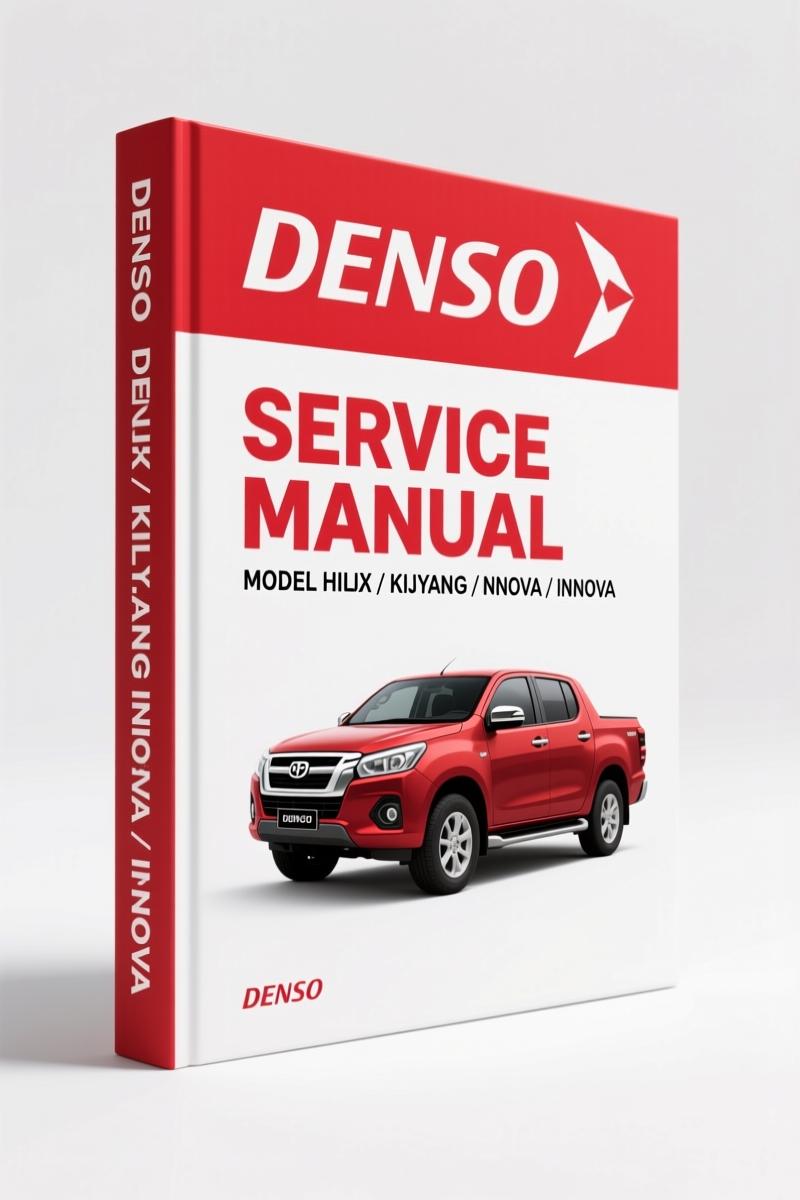
Denso HILUX, KIJYANG INNOVA, INNOVA 2004 Service Manual – Factory Specs
Original price was: $36.90.$30.00Current price is: $30.00.
68-page Denso factory service manual for Toyota HILUX, KIJYANG INNOVA, INNOVA 1KD/2KD common rail diesel injection systems. Published 2004.
Description
Denso HILUX, KIJYANG INNOVA, INNOVA 2004 Service Manual
You have a truck or SUV with a 1KD or 2KD common rail diesel, and the MIL is on. Or maybe the rail pressure is dropping and you don’t have a clue where to start. You grab a generic aftermarket book and the wiring diagram doesn’t match, the torque specs are missing, and the troubleshooting steps skip half the checks. That’s the kind of waste that pulls you off the job and costs you billable hours. This is the official Denso publication from July 2004 — the same one the factory technicians used when these vehicles were new. It runs 68 pages and it does not waste a single one.
Fuel System and Control System Breakdown
Section 2-2 (System Configuration) lays out the fuel system and control system architecture. You get a diagram of main components — supply pump, rail, injectors, ECU, EDU — and a description of how they talk to each other. The fuel system section alone keeps you from misrouting high-pressure lines or misidentifying the return circuit. If you’ve ever swapped a feed line with a return on a common rail, you know the mess that makes.
Need the construction details on the supply pump (HP3)? Section 3-1 A. covers the plunger, SCV, and delivery valve. The manual explains the X2 revised injector design, which is different from earlier versions. Don’t trust a third-party cross-reference; the ECU connector pinout on page 4-6 is what you need to verify before you probe anything.
What Does the DTC Check Cover?
Chapter 4 is the diagnosis system. It starts with normal mode vs check mode, explains 2 Trip Detection Logic, and shows how to read freeze frame data. The DTC chart (Section 4-4) lists codes for the common rail system specific to these engines. You get the fail-safe chart too — what happens when the ECU detects a fault and how it limits engine output. That’s the difference between a limp-home condition and a dead stop on the highway.
Clearing DTCs: the manual covers both methods — with the DST-2 and without. That second method is gold when you’re on the side of a job and the scan tool battery is dead. Page 45 shows the exact procedure for clearing codes from the ECU without any special tool. Write down the sequence; it’s not intuitive.
Fuel Filter Warning: What You Need to Know
Section 3-5 is a whole page dedicated to the fuel filter warning system. The common rail system is sensitive to water and debris. The manual tells you where the warning sensor sits, how the system detects a clogged filter, and the replacement interval. Ignoring this leads to injector damage that costs more than the filter itself. The installation position diagram on page 40 makes sure you don’t install the sensor upside down — yes, people do that.
3 Systems Detailed in This Manual
Three control subsystems are covered in depth: fuel injection quantity control, fuel injection timing control, and fuel injection rate control (Section 3-2 D through F). Each one includes a block diagram and a written description of how the ECU adjusts parameters. The EGR control system and the electronically controlled intake air throttle (diesel throttle) are also explained in separate sections. If you’re chasing a surging idle or a smoking exhaust, start here. You’ll find the logic the ECU uses to modulate EGR percentage and throttle position under different loads.
Understand the Supply Pump (HP3) Construction
Section 3-1 A goes through the supply pump component by component. The manual describes the feed pump, regulator, and the spill control valve (SCV). The SCV is a common failure point on high-mileage vehicles — the manual shows the test procedure using resistance checks at the ECU harness. You need a multimeter and the wiring diagram from Section 4-6 A. The EDU external wiring diagram is separate, so you don’t confuse the driver unit with the main ECU.
Source Validity: OEM Denso vs Aftermarket Reprints
This is a genuine Denso publication, not a photocopy of a photocopy. Denso printed it in July 2004 for the Toyota HILUX, KIJANG INNOVA, and INNOVA models with the 1KD/2KD engine. Every wiring diagram, torque spec, and component description came from Denso’s engineering group. Aftermarket manuals often cut the wiring section or replace it with a generic schematic that doesn’t match the pin colors. You don’t want that when you’re diagnosing an injector circuit. This manual has the exact connector views, pin numbers, and wire colors as they left the factory.
Does This Manual Cover the Manual Transmission?
The manual is about the common rail fuel system only. It does not cover transmission removal, clutch replacement, or anything driveline-related. The Manual Transmission itself is outside the scope. However, the ECU interfaces with the transmission control module in automatic-equipped vehicles, and the wiring diagram includes those communication lines. If you need transmission overhaul specs, look for a separate Toyota body and chassis manual.
FAQ
- Is this manual for gasoline engines?
- No. It covers only the Denso common rail diesel system on the 1KD/2KD engines.
- What is the supply pump type?
- HP3. The manual dedicates over five pages to its construction, including the SCV and delivery valve.
- How do I clear DTCs without a DST-2?
- Page 45 lists the jumper terminal procedure at the DLC3 connector. You ground specific pins with a fused wire, turn the ignition on, and watch the MIL flash. Follow the exact sequence or you’ll erase freeze frame data.
- Does it cover wiring diagrams?
- Yes. Section 4-6 contains three separate diagrams: External ECU Wiring Diagram, ECU Connector Diagram, and EDU External Wiring Diagram. These are factory-original and include pin numbers, wire colors, and connector shapes. Aftermarket manuals often omit the EDU wiring, which is critical for injector driver circuit diagnosis. The connector diagram shows the orientation of each pin so you can back-probe without damaging the harness.
You know what it’s like to guess. You pull a pin, the multimeter reads funny, and you chase a ghost for an hour. This manual stops that. The Denso engineers wrote it so a technician with basic hand tools and a DST-2 (or a jumper wire) can isolate a fuel system fault in less than two diagnostic cycles. Access the Factory Manual, print the wiring pages, and tape them to your box. You’ll use them.
Additional information
| Brand | Denso |
|---|---|
| Language | English |
2 reviews for Denso HILUX, KIJYANG INNOVA, INNOVA 2004 Service Manual – Factory Specs
You may also like…
-
Sale!
Denso YD1-K2 2003 Service Manual – Factory Common Rail System for NISSAN
Original price was: $57.15.$45.00Current price is: $45.00. -
Sale!
Denso J05D J08E 2010 Service Manual – Factory CRS Operation Guide
Original price was: $46.55.$35.00Current price is: $35.00. -
Sale!
Denso SUPRA Training Manual – 100 Pages of Ignition System & Spark Plug Diagnostics
Original price was: $56.80.$40.00Current price is: $40.00. -
Sale!
Denso 6HK1, 6SD1 2003 Service Manual – Factory Common Rail Specs
Original price was: $64.80.$45.00Current price is: $45.00.
Related products
-
Sale!

1993 Electrical Schematic – International 1000/3000/4000 Bus Chassis OEM Wiring Diagrams
Original price was: $29.26.$22.00Current price is: $22.00. -
Sale!
International 1000-3000 Series Operators Manual – 132 Pages of OEM Specs
Original price was: $14.40.$10.99Current price is: $10.99. -
Sale!
1996 Operators Manual – International 1000-4000 Series (246 pages)
Original price was: $15.28.$9.99Current price is: $9.99. -
Sale!

2011 Parts Catalog – International 7400 SFA 6X6 – 1886 Pages of OEM Part Numbers
Original price was: $32.00.$25.00Current price is: $25.00.
Richard G. –
This is just what I needed. The document quality is excellent. Every spec sheet is provided for Denso HILUX,. Highly recommended for mechanics.
John S. –
I am so happy with this transaction. The PDF quality is excellent. Contains detailed bolt torque specs for Denso. Saved my repair job! Thank you.