
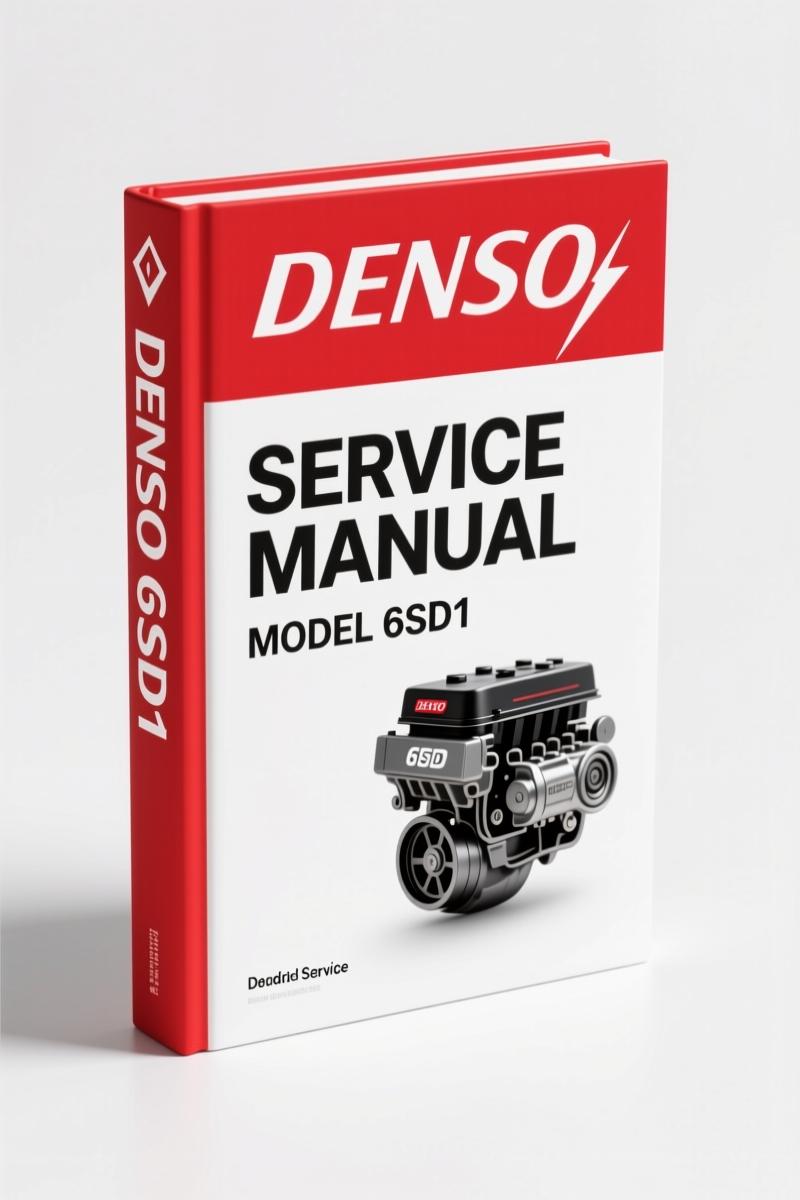
Denso 6HK1, 6SD1 2003 Service Manual – Factory Common Rail Specs
Original price was: $64.80.$45.00Current price is: $45.00.
OEM 23-page service manual for Denso 6HK1/6SD1 common rail systems. Circuit diagrams, diagnosis codes, supply pump specs.
Description
Denso 6HK1, 6SD1 2003 Service Manual – Factory Common Rail Diesel Injection Specs
If you’re staring at a common rail system on an ISUZU 6HK1 or 6SD1 and the ECU is throwing codes you don’t recognize, this Denso 6HK1, 6SD1 2003 Service Manual is the difference between a quick fix and turning a rail into a paperweight. I’ve seen techs guess at supply pump pressure or injector timing and end up with a $3,000 mistake. Denso designed these systems to specific hydraulic and electronic tolerances. Aftermarket summaries skip half the control logic. This is the factory book – 23 pages of what Denso expects an authorized dealer to know before touching the fuel system.
Page 3 lays out the system outline: a self‑diagnosis and alarm function, fail‑safe to stop the engine depending on fault location, and a backup function that changes fuel regulation so the truck can limp home. That’s not theory – that’s what you need to know when the rail pressure sensor drifts.
Common Rail System: Understanding the 1.1 System Outline
The manual walks you through the two subsystems – fuel system and control system. The fuel side: high‑pressure fuel from the supply pump is distributed via the rail; electromagnetic injector valves control the needle lift. The control side: ECU reads sensors (accelerator, NE, TDC, water temp, fuel temp) and modulates injector current timing. Section 1.1 also explains the backup fueling strategy when the ECU detects a sensor failure. That is critical for diag – you don’t replace a rail because the engine runs rough in limp mode.
Fuel Injection Rate Control – Section 3.1
This section covers how the ECU modulates injection rate to reduce noise and emissions while maintaining power. Denso uses a pilot injection strategy that varies with engine speed and load. The manual doesn’t just give you a table – it explains the control logic so you can diagnose why the engine is hammering at idle. If you’re chasing a harsh idle on a 6SD1, start here before pulling injectors.
Does This Manual Cover the Supply Pump and Injector? (Section 2)
Yes, and it does it with factory detail. Section 2 breaks down the supply pump, common rail, injector, and sensors/relays. The supply pump section (2.1) includes the internal fuel metering valve and discharge volume control. The common rail (2.2) covers the pressure limiter and flow damper – two parts that fail when somebody over‑torques the rail. The injector section (2.3) shows the solenoid valve and needle lift control. Aftermarket wiring diagrams never show the charge‑up circuit for the ECU – this manual does (page 4).
3 Key Differences from Conventional Pumps (Section 1.4)
Section 1.4 directly compares the common rail system to a conventional inline pump. Three standouts: injection pressure is independent of engine speed, injection timing is fully variable, and the injector needle is controlled by a solenoid rather than hydraulic pressure. If you’ve only worked on mechanical diesel pumps, this section saves you from treating the rail like a rotary pump. Read it before you crack a line.
Diagnosis Codes and Circuit Diagrams – Section 4
Section 4.1 lists the diagnosis codes. Section 4.2 gives the circuit diagram. The wiring includes the NE sensor (crankshaft position), TDC sensor (cylinder recognition), accelerator position sensor, water temp, fuel temp, and the ECU pin assignments. Having the actual Denso circuit diagram means you can measure resistance at the ECU connector instead of guessing which wire goes where. For reference on manual transmission diagnostics, see Manual Transmission resources. Another external authority on transmission diagnostics can be found at Manual Transmission.
Why OEM Denso Documentation Matters
Aftermarket manuals for common rail systems often omit the self‑diagnosis and fail‑safe logic because they’re too complex to summarize. Denso’s original service manual (June 2003, part no. 00400018) is written for authorized ECD service dealers. The torque values, pressure specs, and electrical tests are Denso‑certified. Using a generic manual means you risk misdiagnosing a fuel pressure fault because the aftermarket didn’t include the charge‑up circuit. This is the real thing – 23 pages of factory procedure.
Related manuals that work with the same fuel system architecture: Denso 4HK1 6HK1 2004 Service Manual covers the later version with minor sensor updates. Denso TGN15, TGN16, TGN26, KUN15, KUN16 2004 Service Manual – OEM A/C Specs is a different system but uses similar Denso electronics. Denso FIGHTER 6M60 2004 Service Manual – Factory Diesel Injection Guide covers another ISUZU variant with the same common rail platform.
Twenty‑three pages of no‑nonsense factory procedure. If you work on ISUZU trucks with Denso common rail injection, this is the only manual that tells you how the ECU thinks and why the rail pressure does what it does.
- Can I use this manual for other Denso engines like the 4HK1?
- The 6HK1 and 6SD1 share the same common rail system layout. For the 4HK1, you’re better off with the 2004 manual linked above – the sensor calibration differs.
- What tools do I need to follow the procedures?
- A multimeter, a scan tool that reads Denso diagnostic codes, and a pressure gauge rated for 30,000 psi. The manual assumes you have a Denso hand‑held tester.
- Does the manual include torque specs for the common rail?
- Torque values are in the construction sections – rail mounting bolts, supply pump flange, injector clamp. You must use a calibrated torque wrench; over‑tightening can crack the rail.
- Is there a wiring diagram with pin numbers?
- Section 4.2 has the circuit diagram showing all ECU pin assignments, sensor connections, and the charge‑up circuit. It also includes the starter signal path.
Access the Factory Manual and get the wiring, diagnosis codes, and fuel control logic that aftermarket books leave out.
Additional information
| Brand | Denso |
|---|---|
| Language | English |
2 reviews for Denso 6HK1, 6SD1 2003 Service Manual – Factory Common Rail Specs
You may also like…
-
Sale!
Denso E13C 2004 Service Manual – Factory Common Rail Diesel Specs
Original price was: $40.20.$30.00Current price is: $30.00. -
Sale!
Denso SUPRA Training Manual – 100 Pages of Ignition System & Spark Plug Diagnostics
Original price was: $56.80.$40.00Current price is: $40.00. -
Sale!
Denso J05D J08E 2010 Service Manual – Factory CRS Operation Guide
Original price was: $46.55.$35.00Current price is: $35.00. -
Sale!
Denso YD1-K2 2003 Service Manual – Factory Common Rail System for NISSAN
Original price was: $57.15.$45.00Current price is: $45.00.
Related products
-
Sale!

1994 Troubleshooting Manual – International 1000-4000 FBC
Original price was: $60.00.$50.00Current price is: $50.00. -
Sale!

Technical Manual – International DT 530 & HT 530 (118 Pages)
Original price was: $37.00.$25.00Current price is: $25.00. -
Sale!
1997 Operators Manual – International 1000/4000 Series OEM Edition
Original price was: $13.49.$9.99Current price is: $9.99. -
Sale!
Acura NSX 1991 Service Manual – 1420 Pages OEM
Original price was: $102.05.$65.00Current price is: $65.00.
Richard G. –
Great OEM spec sheet. It is easily zoomable on my phone without losing quality. Contains clear schematics for Denso. Great value for money.
David K. –
Great buy! It is very easy to read on my phone without losing quality. A must-have for any Denso 6HK1, DIYer doing repairs. Saved my weekend project! Thanks.