
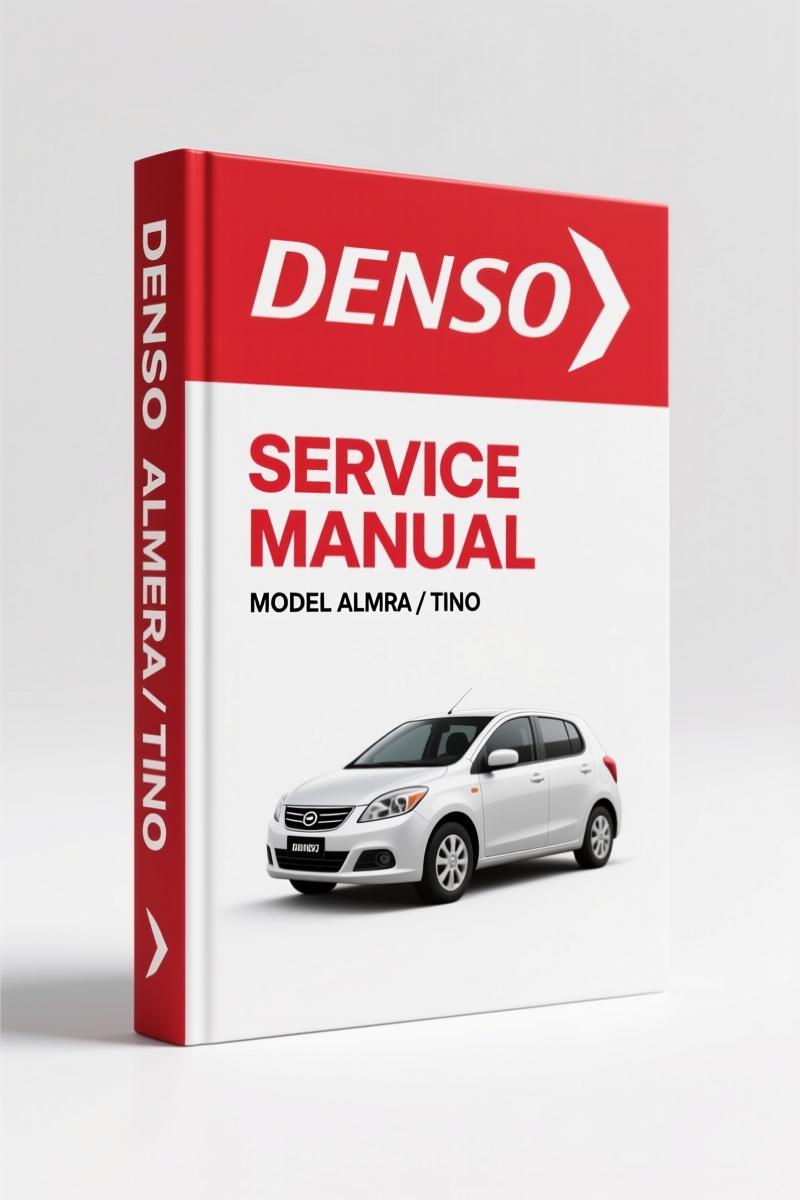
Denso ALMERA, TINO 2003 Service Manual – Factory Common Rail Specs
Original price was: $35.25.$25.00Current price is: $25.00.
41-page factory service manual for Denso common rail injection on NISSAN ALMERA/TINO (2003). Covers DTC codes, system operation, and external connections.
Description
Denso ALMERA, TINO 2003 Service Manual
I’ve been turning wrenches since before OBD-II was a thing, and I’ve seen more aftermarket manuals that were wrong than I’ve seen good ones. This Denso ALMERA, TINO 2003 Service Manual is the real deal – OEM documentation from the company that built the fuel system. If you’re trying to diagnose a no-start on a Nissan YD1-K2 with the HP3 common-rail pump, you don’t want a third-party rewrite. You want the factory sheet that tells you the charge pressure spec and the exact DTC logic. That’s what this 41-page PDF gives you.
Product Application: What This Manual Covers
Chapter 1, “Aplicación del producto,” lists the specific engine – the Nissan YD1-K2 diesel with the Denso HP3 common-rail system. It also includes the part numbers for the injectors, the pump, the ECU, and the rail pressure sensor. Page 1 of the manual shows the title and the engine type. That’s it – no filler, no fluff. If you’re working on a Nissan ALMERA or TINO from 2003 with this engine, you’re in the right place. If you’re working on something else, this manual won’t help you, and I respect that honesty.
System Overview: Common-Rail Basics
Chapter 2, “Descripción general,” walks through the system features and the overall layout. It explains how the high-pressure pump (HP3) feeds the rail, and how the ECU controls injection timing and quantity. The manual is written for DENSO-authorized service dealers, so the language is technical but not cryptic. Page 2 covers the preface, which explains the goal of the manual: to help you understand the structure and function of the DENSO components. You won’t find a description of how to rebuild the engine – this is strictly about the fuel system.
For a DIY mechanic, this section is gold. It tells you what each component does and how they interact. If you’ve ever had a common-rail system that wouldn’t build pressure, you know that guessing leads to replacing parts that weren’t bad. This manual kills that guesswork.
Structure and Function: Inside the HP3 Pump
Chapter 3, “Estructura y funcionamiento,” breaks down the main components – the supply pump, the rail, the injectors, and the control system. It describes the internal construction of the HP3 pump, including the metering unit and the pressure relief valve. Section 3-3 covers the various control modes, like the pilot injection and the post-injection strategies. This is where you’ll understand why the engine runs rough or smokes under certain conditions.
If you’re a shop owner, this chapter saves you from having to explain to a customer why you need to pull the injection pump. The manual gives you the factory reasoning, so you can make decisions based on data, not guesswork.
DTC Table: Diagnosing Fault Codes
Chapter 4, “Tabla de DTC (códigos de diagnóstico),” is the diagnostic heart of this manual. It lists every diagnostic trouble code for the ALMERA/TINO fuel system, along with the likely cause and the recommended action. The DTC table is referenced in the table of contents, and it’s where you’ll go when the check-engine light comes on. Each code is tied to a specific component – injector circuit, rail pressure sensor, supply pump control – so you can pinpoint the failure without swapping parts.
I’ve seen too many techs replace a rail pressure sensor because they got a P0087, only to find out the actual problem was a clogged fuel filter. The DTC table in this manual cross-references the code with the system behavior. It’s the difference between a quick fix and a comeback.
External Connection Diagrams: Wiring That Actually Matches
Chapter 5, “Diagrama de conexiones externas,” gives you the ECU pinout and the connector diagrams. If you’re troubleshooting a no-communication or a short circuit, you need to know which pin does what. The manual shows the external wiring for the ECU, including the power supply, ground, and signal wires. I’ve used aftermarket wiring diagrams that were off by two pins – that’s how you smoke a $1200 ECU. This manual is Denso’s own drawing, so it’s accurate.
For a beginner, this section might look intimidating, but it’s laid out in a logical order. The pin numbers are labeled, and the signal names are consistent with the rest of the manual. If you’re comfortable with a multimeter, you can follow these diagrams.
Source Validity: OEM Denso vs Aftermarket Reprints
This is a factory Denso service manual, not a reprint or a scan from a third-party site. The PDF is 41 pages, originally published in October 2003, and it’s marked “Sólo para concesionarios de servicio ECD autorizados DENSO.” That means it was intended for authorized dealers, not for the general public. The spec data – part numbers, DTC logic, wiring colors – are the same as what Denso puts in their official training materials. If you’ve been burned by aftermarket manuals that copy the table of contents but skip the critical notes, you’ll appreciate the consistency here.
Related manuals for other Denso systems: Denso TGN15, TGN16, TGN26, KUN15, KUN16 2004 Service Manual – OEM A/C Specs, Denso FIGHTER 6M60 2004 Service Manual – Factory Diesel Injection Guide, and Denso Avensis 2005 Service Manual – OEM Diesel Injection Specs. For background on common-rail technology, see Manual Transmission Wikipedia article (though that’s a different system, the principle of hydraulic pressure applies). Also check Manual Transmission for comparison.
FAQ
- Will this manual help me fix a misfire on my ALMERA?
- Yes, if the misfire is caused by a fuel system fault like a bad injector or rail pressure sensor. The DTC table in Chapter 4 will tell you exactly which code to look for. You’ll also need a scan tool that reads Denso-specific codes.
- Does it include torque specs?
- No. This manual focuses on system operation and diagnostics. Torque values for fuel line fittings and injector hold-down bolts are not listed here. You’ll need the engine service manual for those.
If you’re serious about diagnosing a Denso common-rail system on a 2003 ALMERA or TINO, skip the generic PDFs. Access the Factory Manual from AutoRepairManuals and get the actual OEM documentation that Denso wrote for their technicians. No guesswork, no reprints.
Additional information
| Brand | Denso |
|---|---|
| Language | English |
2 reviews for Denso ALMERA, TINO 2003 Service Manual – Factory Common Rail Specs
You may also like…
-
Sale!
Denso SUPRA Training Manual – 100 Pages of Ignition System & Spark Plug Diagnostics
Original price was: $56.80.$40.00Current price is: $40.00. -
Sale!
Denso J05D J08E 2010 Service Manual – Factory CRS Operation Guide
Original price was: $46.55.$35.00Current price is: $35.00. -
Sale!
Denso YD1-K2 2003 Service Manual – Factory Common Rail System for NISSAN
Original price was: $57.15.$45.00Current price is: $45.00. -
Sale!
Denso 6HK1, 6SD1 2003 Service Manual – Factory Common Rail Specs
Original price was: $64.80.$45.00Current price is: $45.00.
Related products
-
Sale!

2006 Service Manual – International DT 466E, 530E Diesel Engine
Original price was: $67.50.$50.00Current price is: $50.00. -
Sale!

Technical Manual – International DT 530 & HT 530 (118 Pages)
Original price was: $37.00.$25.00Current price is: $25.00. -
Sale!

1989 Service Manual – International 2000-8000 Electrical Systems
Original price was: $72.00.$50.00Current price is: $50.00. -
Sale!

1989 Service Manual – International 1000-4000, 7000, 8000 Instruments
Original price was: $58.80.$40.00Current price is: $40.00.
James L. –
Excellent quality! It is easily zoomable on my iPad without blur. Every spec sheet is included for Denso ALMERA,. I will definitely buy again.
pro_mechanic –
Excellent factory service manual. The text is searchable and well indexed. Every torque spec is provided for Denso ALMERA,. I will definitely buy again.