
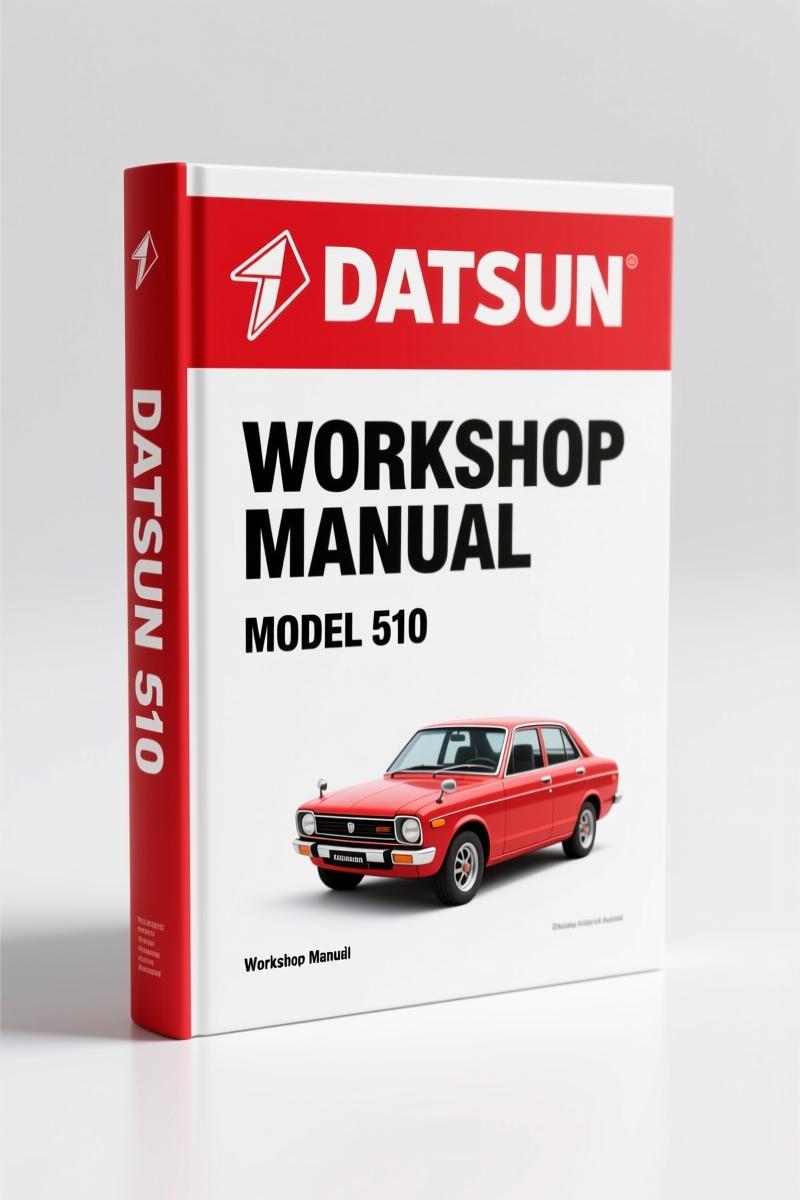
Datsun 510 Workshop Manual – 258 Pages of Factory-Level Documentation for L13-L16 Engines
Original price was: $43.50.$30.00Current price is: $30.00.
258-page workshop manual for Datsun 510 sedan, wagon, SSS. Engine, transmission, suspension, electrical specifications.
Description
Datsun 510 Workshop Manual – Factory Specs for the L-Series
If you’re pulling an L-series engine out of a Datsun 510 and you don’t have the factory workshop manual open on the bench, you’re working blind. I’ve seen it too many times—a guy torques the head bolts by feel, snaps one off in the block, and then the whole Saturday is shot. This Datsun 510 Workshop Manual is 258 pages of verified factory data, not some aftermarket condensation. It starts at page 1 with the ENGINE section and gives you the exact clearances, torque sequences, and wear limits that Nissan specified. You want to do this job once? Start here.
Engine Overhaul: What You Get on Page 1
The ENGINE section kicks off with L13 and L16 engine specs—bore, stroke, compression ratio, valve timing. Page 1 lists the main bearing cap bolt torque and the order for tightening. That’s not something you guess. Scientific Publications derived this from the latest models available at the time (first edition December 1971, reprinted through 1977). If you’re rebuilding a 510 motor, you need the factory step sequence for the cylinder head. Skip that and you warp the head. The manual also covers the cooling system starting on page 35—thermostat rating, water pump clearance, radiator capacity in quarts. Don’t skimp on the thermostat check; I’ve seen those old Datsuns overheat because a 180-degree stat was stuck open.
Cooling System (Page 35): Don’t Skip the Thermostat
Page 35 lays out the cooling system chapter with radiator removal, thermostat testing, and belt tension specs. The manual warns: “Do not remove the radiator cap when the engine is hot—severe scalding may result.” That’s the kind of safety language that keeps your skin intact. It also gives the fan belt deflection spec in inches. Aftermarket manuals might tell you “adjust until snug,” but this one gives you a number. That matters when your alternator isn’t charging and you’re chasing a loose belt.
Transmission and Clutch: Factory Torque Data
The CLUTCH section starts on page 150, MANUAL TRANSMISSION on page 167, AUTOMATIC TRANSMISSION on page 216. The Borg-Warner automatic gets its own torque converter bolt pattern. The clutch cover bolts? Specified. Input shaft nut torque? Page 167. If you’re swapping a 5-speed into your 510, you’ll want the rear axle section on page 217 too. The factory manual gives you the pinion bearing preload and side gear clearance. That’s the difference between a diff that whines and one that runs quiet. For related reference, check out the DATSUN Workshop Manual 1972 – Section: Conversion Tables if you need to convert metric fastener torques for older hardware.
Is the Electrical System Covered?
Yes—page 255 covers the ELECTRICAL SYSTEM with wiring diagrams for the 510 sedan, SSS, and station wagon. You get the starter circuit, alternator output test, and fuse box layout. The manual also includes a ROAD TEST section on page 255 and a BODY section. The wiring is original factory color codes. No generic aftermarket guesswork. I’ve chased enough electrical gremlins on these cars to tell you: a bad ground at the tail light kills the whole rear circuit. The manual shows you where the ground strap bolts. If you’re dealing with an intermittent electrical issue, the Automotive Industry Overview has general electrical safety standards, but for your 510 you need this manual’s specific diagrams.
258 Pages of Verified Factory Data
This isn’t a reprint of a reprint. The source is Scientific Publications Pty Ltd—original copyright 1971, ISBN 85566 039 2. They worked with Nissan Motor Corp USA and Borg Warner to prepare the content. Every page is a direct scan of the factory-licensed edition. The table of contents lists: ENGINE, COOLING SYSTEM, FUEL SYSTEM, CLUTCH, MANUAL TRANSMISSION, AUTOMATIC TRANSMISSION, REAR AXLE, FRONT SUSPENSION, REAR SUSPENSION, STEERING, BRAKES, ELECTRICAL SYSTEM, ROAD TEST, BODY, WHEELS AND TYRES, LUBRICATION AND MAINTENANCE, EMISSION CONTROL SYSTEMS, INDEX, GLOSSARY OF TERMS. That’s 18 chapters covering everything from the carburetor float level to the rear wheel bearing preload. Compare that to a generic aftermarket guide that skips the SUSPENSION section—this one has both front (page 226) and rear (page 231). For further factory data, see the Datsun 510 1969-1973 Workshop Manual for model-year specific updates.
One more thing about authenticity: the manual says “Information is derived from the latest models available for our workshop research.” That means they had a real 510 on a lift. That’s the kind of verification I trust. The Automotive Industry Overview notes that OEM-level documents are the only reliable source for safety-critical specs. I agree.
Who Should Use This Manual?
Home garage guys rebuilding a 510 engine or swapping a transmission. If you’re replacing the clutch, this manual gives you the flywheel bolt torque (in ft-lb) and the release bearing install steps. Beginners need to read the safety warnings about jacking and supporting the car—page 226 covers the front suspension removal procedure and warns about spring tension. The LUBRICATION AND MAINTENANCE section (page 255) tells you the oil capacity and grade. That’s basic but critical. Don’t dump 10W-40 in an L16 if the manual calls for 20W-50. Also check out the Datsun 510 and Pick-up 1968-1972 Service Repair Handbook for additional wiring diagrams.
- Does this manual cover both manual and automatic transmissions?
- Yes. Manual transmission starts on page 167, automatic on page 216. Both include overhaul steps and torque specs.
- What is the difference between this workshop manual and a Haynes or Chilton?
- That’s a common question. A Haynes or Chilton is a generic composite written by a third-party editor who may have had one vehicle on hand. This manual is derived directly from factory research and cooperation with Nissan Motor Corp USA. It includes the exact L13 and L16 engine tolerances, Borg-Warner automatic transmission data, and emission control system details that aftermarket books often summarize or skip. The torque specs are printed in foot-pounds, not rounded off. The wiring diagrams are original color codes, not redrawn. For a restoration or a rebuild where accuracy matters—like setting the pinion bearing preload—this is the only source you should trust. I’ve used both; the aftermarket got me a leaky oil pan gasket because it didn’t list the correct bolt pattern sequence. This manual has it.
If you’re ready to start that Datsun 510 project the right way, access the factory manual. Get the L13 or L16 torque values, the suspension specs, the cooling system data—all from the original source. Stop guessing, start turning wrenches with the right information.
Access the Factory Manual
Additional information
| Brand | Datsun |
|---|---|
| Language | English |
3 reviews for Datsun 510 Workshop Manual – 258 Pages of Factory-Level Documentation for L13-L16 Engines
You may also like…
-
Sale!
Datsun 510 Service Manual – 249 Pages of OEM Factory Specs
Original price was: $55.35.$45.00Current price is: $45.00. -
Sale!
Datsun 1000, 1200 Workshop Manual: Factory Specs for A10 & A12 Engines
Original price was: $61.20.$45.00Current price is: $45.00. -
Sale!
Datsun 1600, 2000 Service Manual – 388 Pages of OEM Specs
Original price was: $70.20.$45.00Current price is: $45.00. -
Sale!
Datsun 280-Z 1975 Troubleshooting Manual – OEM Fuel Injection Guide
Original price was: $85.80.$65.00Current price is: $65.00.
Related products
-
Sale!

1992 Electrical Schematic – International 1000/3000/4000/2554 OEM Wiring Diagrams (132 Pages)
Original price was: $26.40.$20.00Current price is: $20.00. -
Sale!
2004 Acura TSX Wiring Diagram – 73-Page Factory Electrical Schematics
Original price was: $15.88.$9.99Current price is: $9.99. -
Sale!
1995 Operators Manual – International 1000-4000 Series | OEM Documentation
Original price was: $12.49.$9.99Current price is: $9.99. -
Sale!

2011 Parts Catalog – International Truck OE Parts Documentation (1786 Pages)
Original price was: $34.50.$25.00Current price is: $25.00.
pro_mechanic –
This is just what I required. It is easily zoomable on my laptop without blur. Every spec sheet is provided for Datsun 510. I will definitely buy again.
David K. –
Great workshop guide. It is easily zoomable on my iPad without blur. It assisted me to rebuild my Datsun 510 transmission. Saved my repair job! Thanks.
Robert M. –
Great buy! It is very easy to read on my iPad without blur. Contains precise bolt torque specs for Datsun. Great value for money.