
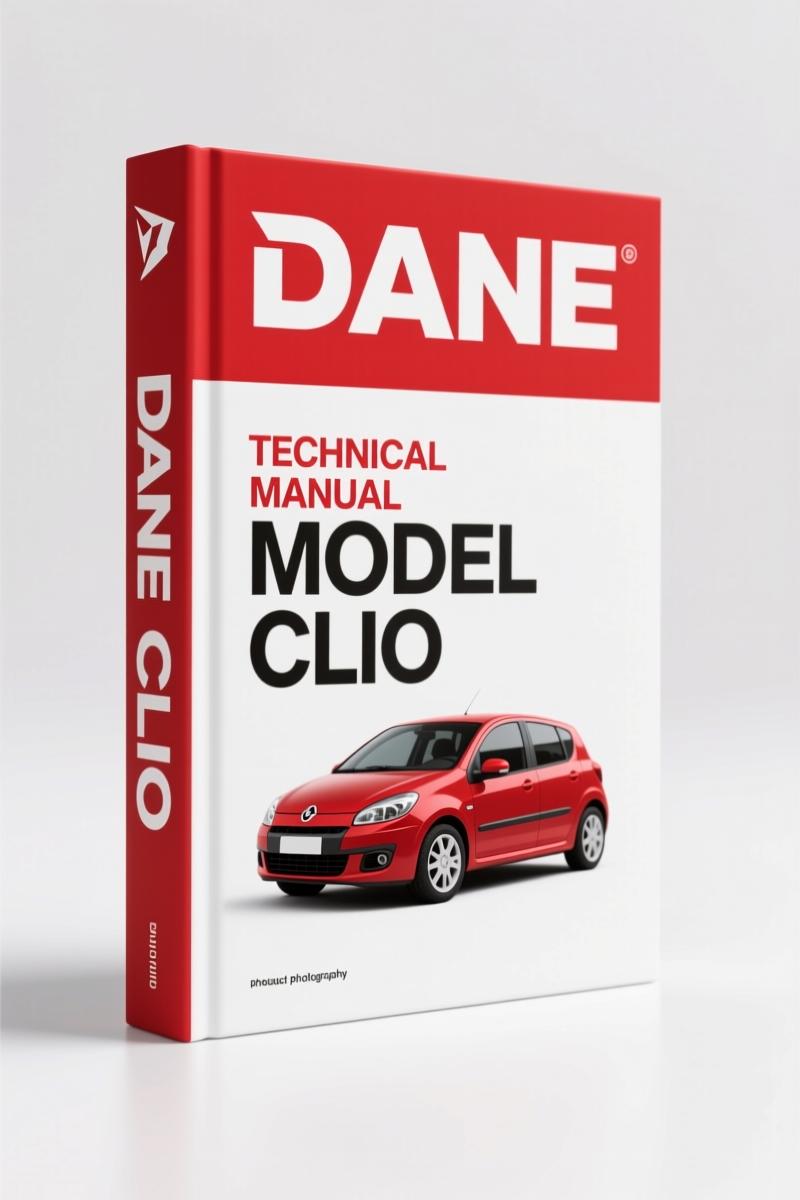
DANE CLIO 2002 Technical Manual – Braking System Analysis for Small Vehicles
Original price was: $33.75.$22.50Current price is: $22.50.
Factory braking system analysis for small vehicles. 20 pages of functional specs, performance criteria, and failure modes.
Description
DANE CLIO 2002 Technical Manual – Brake System Engineering for Small Cars
You are fighting with a spongy pedal on a 2002 CLIO. You pull up a forum post that says “bleed the brakes” but the pedal still sinks. Guesswork eats hours. Aftermarket manuals give you generic diagrams that ignore the actual torque limits and hydraulic pressures designed for that platform. That is when you need the real engineering document — the DANE CLIO 2002 Technical Manual. 20 pages of factory brake system analysis, written for the agrégation at ENS Cachan, but built for anyone who has to understand why a brake works before they start turning wrenches.
Brake System Functional Analysis – Page 2
Page 2 lays out the dual service brake function: slow the moving vehicle and hold it stationary on a gradient up to 18%. The manual defines the environment — pilot, vehicle, wheels, atmosphere — and the four required functions (FP1, FP2, FC1, FC2). This is not a repair sequence; it is the logic behind every component. If you are chasing a pulling brake or a locked rear wheel, understanding that FP1 must transmit torque linearly while FC1 limits that torque to prevent skidding saves you from replacing parts that are fine.
Vehicle Characteristics and Load Conditions
The same page lists the vehicle criteria: mass 800–1200 kg, power 30–60 kW, initial speed up to 130 km/h. These numbers matter when you are swapping master cylinders or choosing a compensator valve. A garden-variety aftermarket chart will tell you “use 10 mm line” — this manual tells you the torque and thermal dissipation limits for the exact CLIO class. Page 3 gives the functional specification table with numerical targets for couple transmissible, flux thermique, and force ranges. You get the actual targets, not a copy of a copy.
FP1 and FP2: Torque Transmission and Heat Dissipation
FP1 is the torque transmitted to the wheel; FP2 is the heat dumped into the air. The manual explains the physics behind brake fade and disc sizing. If you have ever had a customer complain about brakes fading on a downhill grade, you know the flux thermique value (in watts) is where the answer lives. The manual gives the minimum target for that dissipation — not a guess, a number.
3 Key Functional Criteria from Page 3 That Save You Comebacks
First, the torque transmissible Co — without it you cannot set the brake balance. Second, the maximum torque FC1 as a function of load — wrong here and the ABS modulator fights itself. Third, the pilot effort range (0–20 N) — that tells you the pedal ratio and master-vac gain the factory assumed. I have seen guys install aftermarket master-vac units that overshoot the 20 N effort and end up with a pedal that feels like a light switch. The manual prevents that.
Safety Standards and Regulatory Compliance
The manual references ISO CT 22, UTAC, and the French service des mines. That is the regulatory backbone for brake certification in Europe. While you may be in North America, these standards mirror SAE J2788. The manual’s approach to fail-safe design — maintaining trajectory under braking, avoiding head-to-queue — is the same logic you use when inspecting a brake system for safety. It is not a list of torque values; it is the engineering intent behind those values.
Master-Vac and Compensator: The Factory Approach
Page 1 mentions the structures: freins (disc, drum), master-vac, compensateur. The compensator (proportioning valve) is a common failure point on CLIOs of that era. The manual treats it as a functional element, not a part number. You learn the pressure split needed for a loaded vs. unloaded vehicle. That is information no parts-store catalog gives you.
20 pages. That is all it takes to own the design logic of the brake system on a DANE CLIO.
Does This Manual Cover Modern CLIO Models?
The manual was published in 2002 and is specific to the CLIO platform of that generation. Brake system fundamentals — disc/drum geometry, master-vac sizing, compensator calibration — apply to later models, but you will need to cross-reference changes in electronic brake distribution. For the 2002 CLIO, this is the definitive factory reference.
If you need to expand your library, check out related manuals: Drogobych Crane КТА-16, КТА-25, КТА-28 2004 Installation Manual, Injectocean Diablo, Murciélago, Defender, Discovery, Freelander Technical Manual, or Minsk MMVZ-3.11212 Technical Manual – Factory Specs. For broader context on automotive systems, see Automotive Industry Overview and Manual Transmission.
- Is this manual in English?
- Original language is French, but the diagrams and spec tables are universal. The functional criteria table on page 3 uses international symbols (N, m, W).
- Can I use this for a 2005 CLIO brake rebuild?
- The manual covers the generic braking system design for small vehicles of that era, including the CLIO. While it doesn’t cover specific model year changes, the functional analysis of brakes – disc/drum, master-vac, compensator – applies directly. The torque values and hydraulic pressures in the functional criteria table on page 3 are representative of the CLIO platform. If you’re rebuilding a 2002 CLIO brake system, this gives you the engineering intent behind the parts. For later models, you’d need to cross-reference with the 2002 baseline because the principles haven’t changed much. Many techs I know keep this on the bench for understanding brake proportioning in any small car.
If you are tired of chasing brake problems with generic data that does not add up, get the real engineering document. Access the Factory Manual from AutoRepairManuals and put the right info on your bench.
Additional information
| Brand | DANE |
|---|---|
| Language | English |
2 reviews for DANE CLIO 2002 Technical Manual – Braking System Analysis for Small Vehicles
You may also like…
-
Sale!
Acura NSX 1991 Service Manual – 1420 Pages OEM
Original price was: $102.05.$65.00Current price is: $65.00. -
Sale!
2004 Acura TSX Wiring Diagram – 73-Page Factory Electrical Schematics
Original price was: $15.88.$9.99Current price is: $9.99. -
Sale!

CDS 705C, 706C, 708C 1981 Parts Catalog – OEM Forklift Specs
Original price was: $61.60.$40.00Current price is: $40.00. -
Sale!

Acura Integra 1998 Service Manual – 1891 Pages Factory OEM Documentation
Original price was: $31.75.$25.00Current price is: $25.00.
Related products
-
Sale!

1995 Operators Manual – International 1000-4000 Series | OEM Documentation
Original price was: $12.49.$9.99Current price is: $9.99. -
Sale!

Technical Manual – International DT 530 & HT 530 (118 Pages)
Original price was: $37.00.$25.00Current price is: $25.00. -
Sale!
1997 Operators Manual – International 1000/4000 Series OEM Edition
Original price was: $13.49.$9.99Current price is: $9.99. -
Sale!
1996 Operators Manual – International 1000-4000 Series (246 pages)
Original price was: $15.28.$9.99Current price is: $9.99.
Michael T. –
Great OEM spec sheet. Immediate link after checkout. Every spec sheet is provided for DANE CLIO. I will definitely buy again.
David K. –
This is exactly what I needed. Quick access after payment. Contains detailed bolt torque specs for DANE. Highly recommended for mechanics.