
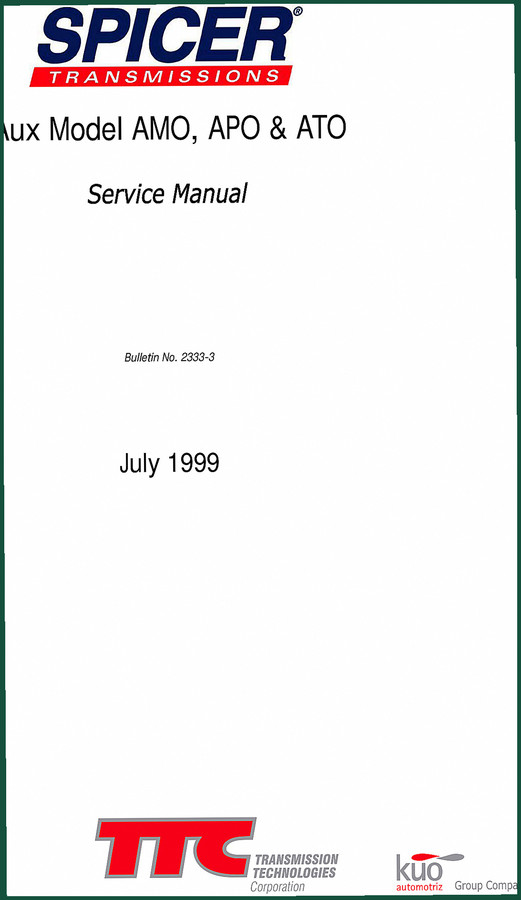
Dana Spicer AMO, APO, ATO 1999 Service Manual – 54 Pages OEM
Original price was: $36.25.$25.00Current price is: $25.00.
Factory 54-page service manual for Dana Spicer AMO, APO, ATO auxiliary transmissions. Includes disassembly, reassembly, air system controls, PTO, troubleshooting.
Description
Dana Spicer AMO, APO, ATO 1999 Service Manual
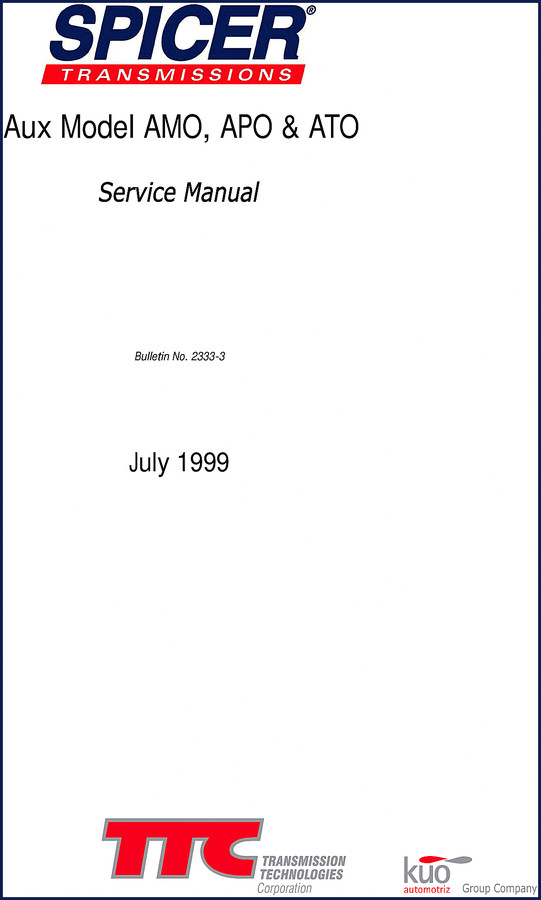
You’ve got a Spicer auxiliary transmission on the bench and the owner wants it back tomorrow. The aftermarket PDF you obtained has torque specs that don’t match the bolt markings, and the wiring diagram is for a different series. That’s where the factory manual earns its keep. The Dana Spicer AMO, APO, ATO 1999 Service Manual is a 54-page printed document, not a scanned reprint. It comes from Transmission Technologies Corporation (TTC), the OEM. Every page in this manual was written for the mechanic who has to get it right the first time.
Dana Spicer AMO, APO, ATO 1999 Service Manual: What You Get
This manual covers the auxiliary models AMO, APO, and ATO. These are the transmissions you find behind the main gearbox in heavy trucks, dump trucks, and equipment. The Table of Contents opens with General Information and Description, then moves through Maintenance Lubrication & Power Flow. You get the full disassembly sequence for all three models: Mainshaft (manual and air shift), Countershaft, Drive Gear and Bearing Retainer, and Shifter Housing. Reassembly procedures mirror the disassembly order with specific torque callouts. The Air System Controls section (page 27) covers the pneumatic shift system. There’s a dedicated Top Mounted PTO section starting at page 36, and a Troubleshooting guide on page 48 that lists common shift problems and oil leaks. No guesswork, no generic diagrams—this is the factory’s own step-by-step procedure.
Transmission Disassembly: From Mainshaft to Shifter Housing
If you’ve ever cracked open an AMO without a manual, you know how easy it is to misplace a snap ring or forget the order of the synchronizer hubs. This manual walks you through each removal step. The Mainshaft-Manual disassembly starts on page 4. The air shift variant begins on page 7. Countershaft removal is on page 8. Drive gear and bearing retainer pull is on page 9. For the shifter housing, manual version starts on page 10, air shift on page 21. Each section lists the required tools—bearing pullers, snap ring pliers, and a light chain hoist for the heavy shafts. The manual also warns against towing the vehicle with a Spicer transmission without pulling the axles or disconnecting the driveshaft, because the internal gear train won’t get lubricated. That’s on page 1.
54 Pages of Factory Procedures
Fifty-four pages doesn’t sound like a lot until you realize every page is dense with cross-sectional diagrams, torque values, and clearance tolerances. The reassembly section for the Mainshaft-Air Shift (page 26) gives you the exact order for installing the shift fork, piston, and seals. The Top Mounted PTO removal and reassembly (pages 36–44) shows you the gasket orientation and bolt pattern. The Air System Controls section (page 27) includes a schematic of the solenoid valves and air lines—critical if you’re chasing an intermittent air shift failure. For related drive-line work, you might also need the Dana Spicer 1372-A Service Manual – Factory Specs & Rebuild Guide for the main transfer case. The Dana Spicer ES60-5, CM59, ES60-5A, ES60-5C, ES60-5D Service Manual covers single-speed rear axles. And the Dana Spicer ES46-5 ES56-5 2002 Service Manual – 40 Pages of Factory Specs is useful for steer axles. Each one is a factory original, not a third-party reprint.
Air Shift vs Manual Shift – What’s Different?
The AMO, APO, and ATO all come in both manual and air shift configurations. The manual gives separate procedures for each. The manual shift shifter housing removal (page 10) involves pulling the shift rails and detent springs. The air shift version (page 21) requires depressurizing the air system, removing the solenoid block, and carefully extracting the piston without damaging the bore. The reassembly steps are model-specific: on page 26 for air shift mainshaft, you’ll find the correct order for installing the snap ring and the shift fork clearance specs. If you’re working on the air system, hit the Manual Transmission section on Wikipedia for background on how these auxiliary units integrate with the main gearbox—but for the actual rebuild, stick to these factory pages.
Get the Right Torque Specs from the Factory
Torque values for the bearing retainer bolts, shifter housing bolts, and mainshaft nuts are scattered throughout the reassembly pages. The air shift mainshaft reassembly on page 26 lists the tightening sequence for the output flange nut. The countershaft reassembly (page 13) specifies the bearing locknut torque. The drive gear bearing retainer (page 14) gives the bolt torque in ft-lbs. Never use aftermarket torque charts for these transmissions—the bolt grades and thread locking requirements are model-specific. If you need to double-check a tolerance, the manual’s General Information section covers bearing preload specs and end-play limits. The factory also warns against hammering on end yokes and flanges—use a proper puller.
Source Authenticity: OEM vs Aftermarket Documentation
This is Bulletin No. 2333-3, dated July 1999, published by Transmission Technologies Corporation, a subsidiary of Dana Spicer. The cover says “SPICER TRANSMISSIONS – Aux Model AMO, APO & ATO Service Manual.” It was produced for service departments, not for quick-print aftermarket distributors. The difference shows in the detail: the trouble-shooting section on page 48 lists 22 specific symptoms, from “Transmission will not shift into gear” to “Oil leaks from shifter housing.” Each symptom has a numbered cause and remedy. Compare that to a generic PDF that lumps all Spicer auxiliaries into one thread. The factory manual also includes the caution about towing on the first page—don’t tow the vehicle without disconnecting the driveshaft. That’s the kind of warning that prevents a $4,000 rebuild. If you’re used to aftermarket manuals that skip the safety notes, spend the 30 minutes reading the trouble-shooting section. The Evaporator Core has nothing to do with this transmission—stay focused on the oil and air circuits.
Who Needs This Manual?
DIY mechanics who pull their own heavy equipment transmissions, home garage enthusiasts rebuilding a dump truck auxiliary, and shop owners who want a printed reference next to the bench. This manual is not for someone who just wants a parts list—it’s for the person who is going to disassemble, clean, inspect, and reassemble every component. The manual recommends a wash tank for parts cleaning and a holding fixture (though the flat case bottom works on a sturdy table at 28–30 inches height). Bearings over 150,000 miles should be replaced. These are the decisions made easier by having the original procedure in front of you.
- Does this manual cover the ATO-65 model?
- It covers the ATO auxiliary series, including the ATO-65, but always verify your transmission tag.
- Can I use this manual for a 2001 transmission?
- The 1999 edition covers units built in that timeframe, but check the serial number range on the ID plate. The manual is specific to AMO, APO, and ATO models.
- What torque values are listed for the mainshaft nut?
- Page 26 of the air shift reassembly gives the mainshaft nut torque. For manual shift, refer to page 11. The manual specifies torque in ft-lbs for each fastener grade.
- Why should I buy this when there are free PDFs online?
- Those free PDFs are often scanned copies with missing pages, wrong torque specs from later revisions, and no factory bulletin updates. This is the original 1999 print from Transmission Technologies Corporation, part of Dana Spicer. The TOC is exact, the trouble-shooting section on page 48 is complete, and the diagrams are full resolution. You risk damaging a $3,000 transmission to save $30 on a manual. The factory cautions and bearing replacement recommendations alone are worth the price. Plus, this is a legal, watermark-free copy you can print and keep in the shop.
Access the Factory Manual and put it next to your bench. It’s 54 pages of OEM procedures that will keep you from guessing on the next AMO rebuild.
Additional information
| Brand | Dana Spicer |
|---|---|
| Language | English |
2 reviews for Dana Spicer AMO, APO, ATO 1999 Service Manual – 54 Pages OEM
You may also like…
-
Sale!
Dana Spicer TE27, TE32 2011 Service Manual – 174 Pages OEM Specs
Original price was: $67.95.$45.00Current price is: $45.00. -
Sale!
Dana Spicer 28000 1995 Service Manual – 92 Pages OEM
Original price was: $70.65.$45.00Current price is: $45.00. -
Sale!
Dana Spicer R, HR Service Manual – 101 Pages OEM Specs
Original price was: $58.95.$45.00Current price is: $45.00. -
Sale!
Dana Spicer 416, 325 1996 Operators Manual – Factory Operation & Maintenance
Original price was: $101.40.$65.00Current price is: $65.00.
Related products
-
Sale!

1991 Electrical Schematic – 112-Page OEM Wiring Diagram for International 1000-3000 Series
Original price was: $22.75.$17.50Current price is: $17.50. -
Sale!
Acura NSX 1991 Service Manual – 1420 Pages OEM
Original price was: $102.05.$65.00Current price is: $65.00. -
Sale!
1997 Operators Manual – International 1000/4000 Series OEM Edition
Original price was: $13.49.$9.99Current price is: $9.99. -
Sale!
1993 Operators Manual – International Bus 1000-3000 OEM Specs
Original price was: $12.30.$7.99Current price is: $7.99.
Richard G. –
I am very pleased with this manual. The PDF is very clear. Every torque spec is included for Dana Spicer Spicer. Saved my weekend project! Thanks.
Robert M. –
Excellent OEM spec sheet. The pages are clean and easy to navigate. It helped me to rebuild my Dana Spicer Spicer engine. Saves me a lot of time.