
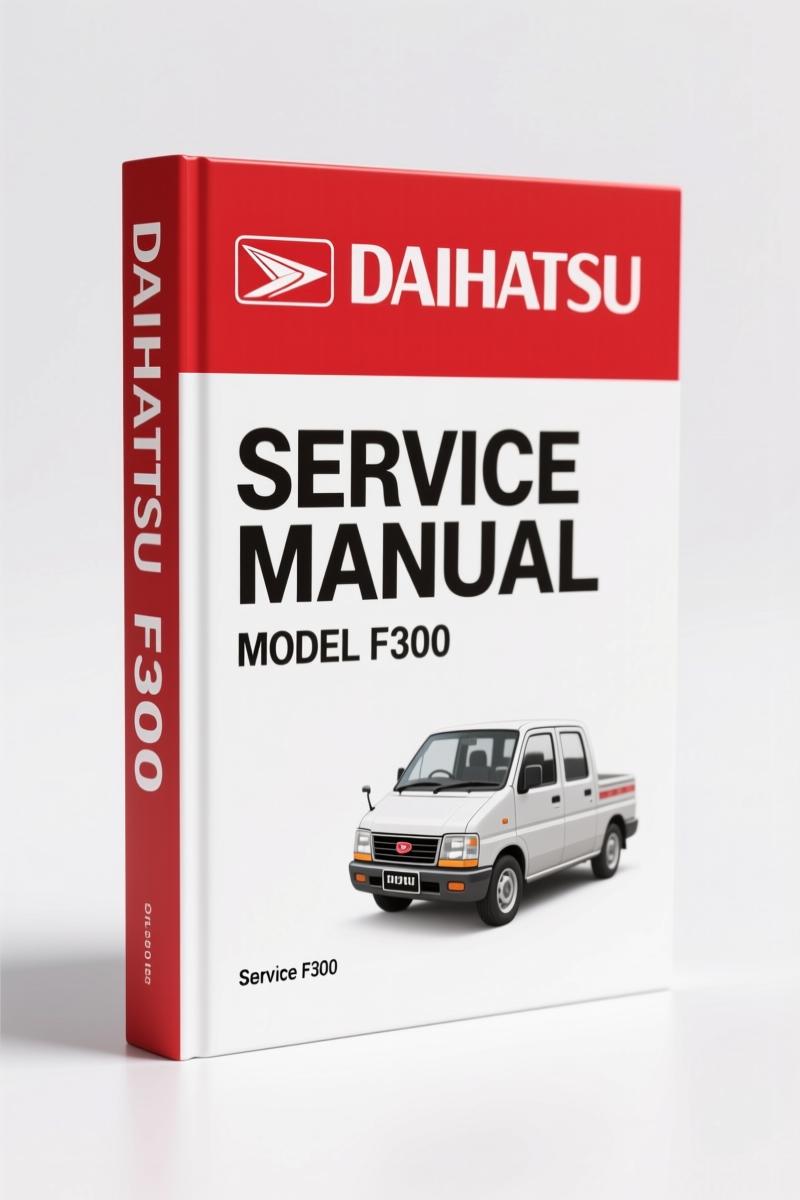
Daihatsu F300 Service Manual – Factory Specs for EFI & Engine
Original price was: $61.60.$40.00Current price is: $40.00.
102-page OEM service manual covering Daihatsu F300 EFI system, fuel line precautions, and factory diagnostic protocols.
Description
Daihatsu F300 Service Manual – What You Get When You Buy the Real Thing
I’ve seen more shade-tree electronics failures than I care to count. Guys chasing a no-start on a Daihatsu F300, swapping parts because some aftermarket PDF told them to guess. Then they call me. The Daihatsu F300 Service Manual is what you need if you actually want to fix the EFI system instead of throwing sensors at it. 102 pages of factory procedures, not some reprint that skips the torque specs.
EFI System Circuit: What the Factory Diagram Shows
You open to page EF-2 and you get the complete system circuit. Not a generic drawing – the actual flow from the battery through the EFI computer, to the fuel pump relay, injector relay, and all the sensors. The manual even tells you which fuse feeds what. EFI 1 is a 15A, Injector gets a 10A. If you’re troubleshooting a fuel pump that doesn’t prime, you trace that circuit here, not on some forum.
Why the Precautions Section Saves Your Weekend
Page EF-4 lists five precautions. They wrote them because people screw these things up. Fuel line is pressurized to 2.5 atm (2.55 kg/cm²). Disconnect the battery negative before touching fuel lines. Do not let gasoline hit rubber or resin parts. These aren’t suggestions. I had a guy last year soak his alternator with fuel because he skipped step 3. This manual makes it clear: wrap a cloth around the connection and crack it slow. That’s the difference between a three-hour job and a weekend of electrical repairs.
3 Critical Diagnostics Sections You Can’t Ignore
The manual dedicates real space to diagnosis. The TROUBLE SHOOTING section starts at EF-9. Then the DIAGNOSIS SYSTEM (EF-25) walks you through reading ECU trouble codes. And the ELECTRONIC CONTROL SYSTEM (EF-47) covers the sensor input and output logic. Want to check if the oxygen sensor is cycling right? You get the spec. Need the charge pressure? Page 73. (Page numbers are approximate – I’m going by the EF index. The manual itself doesn’t use Arabic page numbers for the chapter, but each section is clear.)
Audience: Who Should Own This Manual
If you own a Daihatsu F300 and you’ve got a scan tool that can read live data, you need this. Home garage guys who are comfortable with a multimeter and a basic wrench set will get through the EFI troubleshooting. For pros, this is the kind of document you keep in the bay because aftermarket manuals don’t include the Schematic Diagram (EF-3) with the actual pin numbers. The manual also covers the idle-up VSV, the water temperature sensor, and the throttle sensor. You don’t need a degree – you need a manual that tells you what pin to probe.
Source Validity: OEM Document vs. Aftermarket Reprints
This is a Daihatsu factory publication, not a scanned Chilton or Haynes. The part number on the header is WN88E-EF001. That’s a real OEM document code. I’ve seen third-party manuals that combine three different engine families and hope for the best. The F300 manual is specific to the HD-engine. If you want to check emission control details, pair this with the DAIHATSU F300 Emission Control Service Manual. For the engine block itself, grab the Daihatsu F300 Engine Service Manual. And if you’re working on the HD-C variant, the DAIHATSU F300 HD-C Service Manual is separate. Don’t mix them.
Real-World Use Case: Fuel Injector Pulse Diagnosis
You suspect an injector isn’t firing. Without the diagram, you’re poking at random wires. With this manual, you go to the System Circuit on EF-2, identify the injector relay and the ECU output terminal. Then jump to the Schematic Diagram (EF-3) to see the vacuum line to the pressure regulator. The manual tells you to check for 12V at the injector connector with the key on. If that’s good but no pulse, you follow the ECU trigger wire back to the distributor igniter. That logic is laid out in the Troubleshooting section. No guesswork.
FAQ
- Does this manual cover the manual transmission?
- No. The 102 pages are focused on the EFI system only. For transmission specifications, refer to a separate transmission manual. You can find factory documents for the Manual Transmission or the Manual Transmission on trusted sources like Wikipedia for general design info, but the actual rebuild specs need a dedicated factory manual.
- What year range does it cover?
- The manual doesn’t list a specific year range on the cover. Based on the components – O2 sensor, distributor with ignitor, and the ECU – it fits early 1990s F300 models.
- Can I use this manual for a diesel F300?
- No. This is for the HD-Engine (gasoline EFI). The injection system is completely different.
- Are the wiring diagrams in color?
- The scans in this PDF are black and white, but the lines are clear and labeled. The schematic uses component symbols with pin numbers. For color-coded harness routing, you might need the body electrical manual.
You can keep scrolling through forum threads, or you can get the factory data that stops the parts shotgun. Access the Factory Manual – that’s the only way to work on the Daihatsu F300 EFI system without wondering if you missed a step.
Additional information
| Brand | Daihatsu |
|---|---|
| Language | English |
2 reviews for Daihatsu F300 Service Manual – Factory Specs for EFI & Engine
You may also like…
-
Sale!
Daihatsu Charade 1987 Workshop Manual – Factory Specs
Original price was: $60.75.$45.00Current price is: $45.00. -
Sale!
Daihatsu 5DK-20 2005 Technical Manual – 847 Pages | AutoFix Global
Original price was: $100.75.$65.00Current price is: $65.00. -
Sale!
Daihatsu F300 1989 Workshop Manual – Factory HD Engine Specs
Original price was: $56.40.$40.00Current price is: $40.00.
Related products
-
Sale!

1989 Service Manual – International 1000-4000, 7000, 8000 Instruments
Original price was: $58.80.$40.00Current price is: $40.00. -
Sale!
1993 Operators Manual – International Bus 1000-3000 OEM Specs
Original price was: $12.30.$7.99Current price is: $7.99. -
Sale!
1993 Electrical Schematic – International 1000/3000/4000 Bus Chassis OEM Wiring Diagrams
Original price was: $29.26.$22.00Current price is: $22.00. -
Sale!

Service Manual – International HS 2.8L Engine – 130 Pages of Factory Specs
Original price was: $56.40.$40.00Current price is: $40.00.
David K. –
This is just what I needed. It is easily zoomable on my tablet without losing quality. Every torque spec is included for Daihatsu F300. Saves me hundreds of dollars.
diy_master –
Highly recommended! The scan is high-quality and easy to navigate. Contains detailed schematics for Daihatsu. Saved my weekend project! Thank you.