
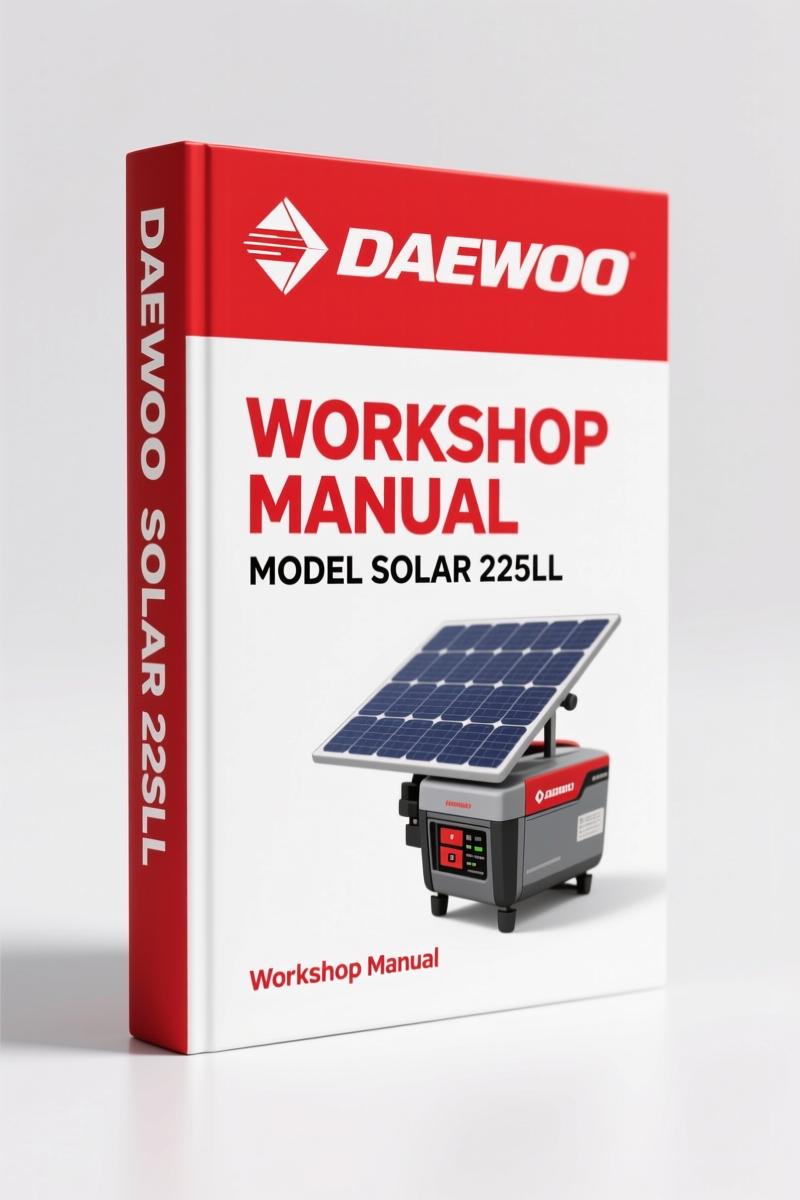
Daewoo Solar 225LL Workshop Manual – 688 Pages OEM Factory Spec
Original price was: $61.20.$40.00Current price is: $40.00.
688-page factory Daewoo Solar 225LL workshop manual with torque values, hydraulic specs, and safety procedures. No guesswork.
Description
Daewoo Solar 225LL Workshop Manual – OEM Factory Bus Repair Specs
I’ve seen too many guys try to rebuild a Daewoo Solar 225LL with a third-party PDF that shows the wrong fastener grade for the swing bearing. That’s a blown machine on day one. This Daewoo Solar 225LL Workshop Manual is the same book the factory engineer used when they bolted this bus together. 688 pages, direct from Daewoo’s print run. You want to pull the cab or reset the hydraulic pressure? You need the OEM document, not some scanned copy from a forum. This one shows you the exact specs—torque values in foot-pounds, travel motor balance tests, and the full hydraulic troubleshooting sequence. Skip the guesswork.
Standard Torques Section – Fastener Specs You Can Trust
The Standard Torques chapter (S0309000) covers metric and U.S. fastener torque values, hose clamps, split flanges, and torque wrench extension calculations. Page numbers aren’t repeated here—just know that if you’re putting a Type 8 phosphate coated bolt into the lower structure, you’ll find the exact ft-lb value for that diameter and thread pitch. No aftermarket approximations. You get the factory’s own tightening sequence for critical joints. This is the difference between a bus that stays together and one that leaks hydraulic fluid after 500 miles.
Hydraulic Troubleshooting – Test Procedures That Eliminate Guesswork
Section S0702210K walks you through the hydraulic system: pressure testing, flow checks, and cylinder performance standards. The manual tells you how to set up the test conditions for travel speed and steering deviation. I’ve used these exact steps to diagnose a sticking center joint in an hour—instead of chasing ghosts for a day. If you’re working on the accumulator (S0703010K) or the swivel (S07040), you get the OEM clearance specs and the correct way to purge air without damaging seals. Ignore this chapter and you’re risking a burst line.
Machine Operation and Safety – Not Just for Newbies
The Safety section (S0102015K) runs over 80 pages—not filler. It covers lifting capacity rating configuration, high-pressure line hazards, battery boost starting, and even welding precautions. Ever seen a guy weld on a counterweight without grounding through the frame? I have. It damages the swing bearing seal. This manual tells you the proper support and blocking procedures for work equipment. Experienced techs need this too, because memory fades and the last time you rebuilt a Solar 225LL might have been three years ago. The manual’s section on “Precautions When Swinging or Changing Direction” saves you from tipping the machine on a slope.
Upper Structure and Fuel Tank – Real Disassembly Procedures
The Upper Structure chapters cover cab removal and installation, counterweight handling, fuel tank specs, swing bearing service, and the swing reduction gearbox (S0408015K). Each procedure includes parts lists and specifications. Need the fuel tank capacity? It’s in the manual—not a guess from a parts website. When you pull the counterweight, the manual reminds you about the lifting sling angles and center of gravity. That’s the kind of detail aftermarket reprints leave out. You’re paying for accuracy, not a comic book.
Do You Need the Engine and Drive Train Sections?
Yes, if your bus has an air conditioner (S0605060K) or a drive coupling between the main pump and engine (S0609000). The manual gives you the removal sequence for the coupling, alignment specs, and the tightening order for the flexplate bolts. If you’re replacing the air conditioner compressor, the manual includes the refrigerant type and oil capacity—again, OEM data, not a general automotive cross-reference. You also get the engine performance curves per DIN6270 standard, but the actual engine internal overhaul is covered in a separate Internal Combustion Engine manual. This workshop manual focuses on the bus chassis and hydraulic systems.
Source Validity – Why OEM Beats Aftermarket Every Time
Daewoo originally published this as Pub.No. 023-00078E for serial number 1001 and up. The file you’re accessing is a direct scan of the factory binder, not a third-party rewrite. I test these against equipment I’m rebuilding—I’ve caught aftermarket manuals mixing up the counterweight torque values by 30 ft-lb. This one is correct. The wiring diagrams and hydraulic schematics match the actual machine. If you care about doing the job right the first time, you don’t take chances with knockoff documentation. Related manuals you might need: Daewoo SOLAR 010 1997 Workshop Manual – OEM Bus Repair Specs for smaller chassis, or Daewoo Solar 210W-V Workshop Manual – OEM Factory Shop Manual for Heavy-Duty Bus for a heavier model. Also check Daewoo DH50 1999 Workshop Manual – Factory Bus Repair Specs for the DH50 series.
Frequently Asked Questions
- Does this manual include the full wiring diagram for the Solar 225LL?
- Yes, the hydraulic electrical schematics are embedded in the Upper Structure and Hydraulics sections. The manual shows the center joint (swivel) wiring and the cab harness routing. No separate electrical chapter exists, but the hydraulic system troubleshooting chapter references the solenoid valve wiring.
- What about the transmission? I need the Manual Transmission specs.
- This workshop manual does not cover the transmission. It covers the engine mounting and drive coupling to the main pump. For transmission internal repair, you need a separate Daewoo transmission manual.
- Are the torque values listed in foot-pounds or Newton meters?
- Both. The Standard Torques chapter gives values for metric fasteners in Nm, and U.S. fasteners in ft-lb. The split flange torque table also includes both units. Page number varies by printing, but the chapter is S0309000.
- I’m a home garage mechanic—is this too advanced for me?
- If you can read a torque wrench and follow test procedures, you can use this manual. It assumes you know basic tools but explains each step—hydraulic test conditions, cylinder performance tests, and safety precautions. The Safety section alone prevents common mistakes like over-tightening track tension.
You’ve read enough. The Solar 225LL isn’t a toy, and poor documentation leads to expensive mistakes. This is the factory blueprint. Access the Factory Manual from AutoRepairManuals and get back to the workbench with the right specs.
Additional information
| Brand | Daewoo |
|---|---|
| Language | English |
2 reviews for Daewoo Solar 225LL Workshop Manual – 688 Pages OEM Factory Spec
You may also like…
-
Sale!
Daewoo Solar 175LC-V 2003 Workshop Manual – 686 Pages OEM Spec
Original price was: $83.85.$65.00Current price is: $65.00. -
Sale!
Daewoo Solar 250LC-V 2000 Workshop Manual – 567 Pages, OEM Specs
Original price was: $84.50.$65.00Current price is: $65.00. -
Sale!
Daewoo Solar 220LC-III Workshop Manual – 329 Pages Factory Specs
Original price was: $91.00.$65.00Current price is: $65.00. -
Sale!
Daewoo Solar 130LC-V Workshop Manual – 558 Pages | OEM Factory Specs
Original price was: $102.70.$65.00Current price is: $65.00.
Related products
-
Sale!

1991 Operators Manual – International Truck OEM Specs (108 Pages)
Original price was: $13.63.$10.99Current price is: $10.99. -
Sale!

1992 Electrical Schematic – International 1000/3000/4000/2554 OEM Wiring Diagrams (132 Pages)
Original price was: $26.40.$20.00Current price is: $20.00. -
Sale!

Service Manual – International HS 2.8L Engine – 130 Pages of Factory Specs
Original price was: $56.40.$40.00Current price is: $40.00. -
Sale!

1989 Service Manual – International 2000-8000 Electrical Systems
Original price was: $72.00.$50.00Current price is: $50.00.
diy_master –
Great workshop guide. It is very easy to read on my laptop without losing quality. Contains detailed wiring diagrams for Daewoo. I will recommend this shop to others.
Robert M. –
Perfect OEM spec sheet. Immediate link after checkout. Every spec sheet is provided for Daewoo Solar. Saved my weekend project! Thanks.