
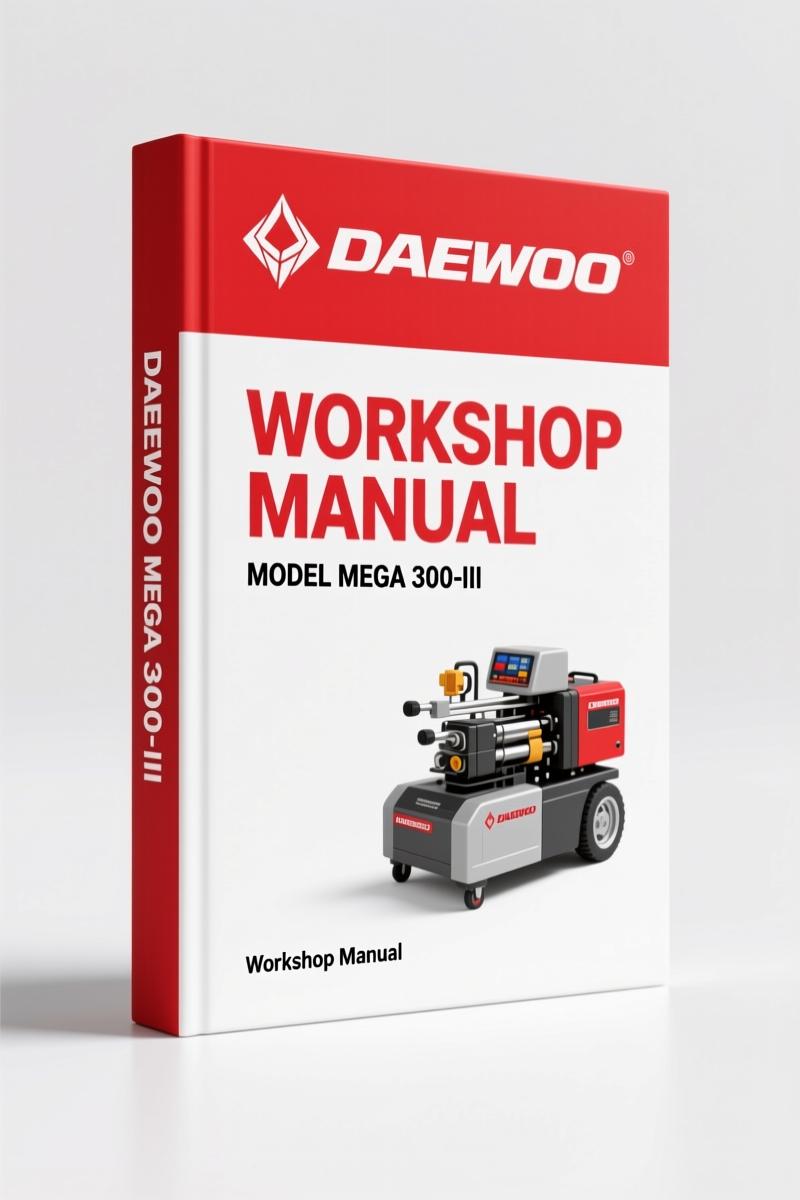
Daewoo MEGA 300-III MEGA 400-III 1997 Workshop Manual – 277 Pages
Original price was: $84.50.$65.00Current price is: $65.00.
OEM Daewoo MEGA 300-III and MEGA 400-III wheel loader workshop manual. 277 pages covering engine, transmission, hydraulics, and electrical systems.
Description
Daewoo MEGA 300-III, MEGA 400-III 1997 Workshop Manual – What’s Inside
You’ve got a Daewoo wheel loader in the bay – maybe a MEGA 300-III or a MEGA 400-III – and the aftermarket manual you pulled says “tighten to spec” without telling you which spec. I’ve seen that cost a shop a transmission rebuild because the converter clutch valve was set wrong. This is the real thing. 1997 Daewoo factory manual, 277 pages, serial number 0001 and up. Published June 1997. The same binder the dealer techs used. If you’re serious about keeping these buses on the road without comebacks, this is what you need.
Bolt Torque Chart – Why OEM Specs Matter
Chapter 3 of this manual includes a full bolt torque chart (page 3-27). Not a generic chart that says “Grade 8 bolts get 90 ft-lb.” Daewoo lists the torque for every fastener on the machine, from the axle housing bolts to the cylinder head. That chart alone saves you from stripping threads in the differential housing – I’ve seen it happen with a Milwaukee impact and a loose grip. The manual also covers the recommended lubricants table (page 3-3) so you know what goes in the axles versus the transmission. No guessing.
What Does Chapter 8 Cover?
Engine work. Specifically the D2366T diesel. You get the valve adjustment sequence, cylinder compression test procedure, wear limits for major components (pistons, liners, bearings), oil pump overhaul steps, and the fuel injection pump installation and timing procedure. Every spec came off Daewoo’s test bench. The cylinder head bolt torque requirements are on page 8-11 – that’s where you find the tightening sequence and the final angle. Use a split-beam torque wrench, not a clicker that hasn’t been calibrated since the Bush administration.
3 Major Systems You’ll Service
The manual splits the chassis into three heavy sections: torque converter and transmission (Chapter 4), axles and brakes (Chapter 6), and hydraulic system (Chapter 7). Each chapter begins with troubleshooting tables – hydraulic pump dead? Chapter 7 walks you through checking pressures at the test ports. Transmission slipping? Chapter 4 gives you the WG-180 control valve disassembly steps. The hydraulic circuits description (page 7-1) shows you the return-to-dig and boom float circuits. This isn’t a general theory book; it’s a step‑by‑step breakdown with exploded views.
Get the Right Hydraulic Pressure Data
Hydraulic pressures are a common place where aftermarket manuals fudge numbers. This manual gives you the exact pressures for the implement circuit, steering system, and torque converter charge pressure. You’ll find the check procedure in Chapter 3 under “General Maintenance” (page 3-22). Do not use a gauge that reads in 500-psi increments – get a 0–600 psi gauge with a 0.5% accuracy class. Your pump relief valve will thank you.
Torque Converter: Disassembly and Assembly Procedure
Chapter 4 dives into the WK torque converter and its clutch valve. If you’re rebuilding a unit, you need the clutch valve piston clearance specs and the spring free lengths. The manual gives you the order of clutch plate installation and the torque for the converter housing bolts. That’s the difference between a converter that holds pressure and one that dumps oil into the pan forty miles later.
Electrical System Schematic – 24-Volt Operation
Chapter 9 provides the complete electrical schematic for the 24-volt system. Wiring color codes are included – Daewoo uses a color code table (page 9-1) that maps every wire to a function. You get the engine start circuit, stop motor circuit, intake preheat circuit, and windshield wiper circuit. Troubleshooting electrical problems without this is just poking at wires with a test light. With it, you trace the circuit back to the relay in minutes.
Source Authenticity – Factory OEM vs. Aftermarket Reprints
This is a direct scan of the original Daewoo shop manual printed in the USA in 1997. Not a third-party compilation. Not a reprint that loses resolution on the schematics. The page margins show the original part number (2023-7105E) and copyright. If you’ve ever tried to use an aftermarket hydraulic diagram that had a shifted circuit path, you know why this matters. When you’re bleeding brakes on a MEGA 400-III or adjusting the parking brake (page 6-9), the step sequence matches what Daewoo tested on the prototype.
FAQ – Daewoo MEGA 300-III / 400-III Manual
- Does this manual cover the MEGA 400-III as well as the 300-III?
- Yes. The manual covers both models from serial number 0001 and up. Each chapter specifies when a component applies to one model only (e.g., axle ratios).
- Are the wire colors in the schematic matched to the actual harness?
- Yes. The wiring color code table on page 9-1 lists every color stripe and its function. I’ve used it to trace a no-start on a 400-III – the start circuit schematic (page 9-2) showed a broken wire at the ignition relay that matched the gray/red stripe in the harness.
- What torque conversion is used in the transmission chapter?
- All torque values are in foot-pounds (ft-lb) and inch-pounds (in-lb). No metric conversion tables needed – the manual uses imperial units throughout.
- Is there a troubleshooting section for the automatic bucket return-to-dig system?
- Yes, Chapter 7 covers the automatic bucket return-to-dig system, the boom kick-out, and the float system. The troubleshooting table lists symptoms like “bucket stops short of digging position” and gives the likely valve adjustment.
Related Manuals
- Daewoo SOLAR 010 1997 Workshop Manual – OEM Bus Repair Specs
- Daewoo Solar 210W-V Workshop Manual – OEM Factory Shop Manual for Heavy-Duty Bus
- Daewoo DH50 1999 Workshop Manual – Factory Bus Repair Specs
For background on how the D2366T engine works, read up on the Internal Combustion Engine fundamentals. If you’re rebuilding the Manual Transmission section, the disassembly sequence in Chapter 4 is critical – don’t skip the differential output gearing page.
You need the real specs, not a book that says “refer to dealer.” This manual gives you the torque values, the clearance limits, and the wiring diagrams that keep a MEGA 300-III or MEGA 400-III running at 24 volts. Access the Factory Manual and put it on your shop tablet. Bookmark page 3-27 for bolts, page 8-11 for cylinder head torque. That’s the difference between a job that holds and a callback.
Additional information
| Brand | Daewoo |
|---|---|
| Language | English |
3 reviews for Daewoo MEGA 300-III MEGA 400-III 1997 Workshop Manual – 277 Pages
You may also like…
-
Sale!
Daewoo Solar 175LC-V 2003 Workshop Manual – 686 Pages OEM Spec
Original price was: $83.85.$65.00Current price is: $65.00. -
Sale!
Daewoo Solar 220LC-III Workshop Manual – 329 Pages Factory Specs
Original price was: $91.00.$65.00Current price is: $65.00. -
Sale!
Daewoo Solar 250LC-V 2000 Workshop Manual – 567 Pages, OEM Specs
Original price was: $84.50.$65.00Current price is: $65.00. -
Sale!
Daewoo Solar 130LC-V Workshop Manual – 558 Pages | OEM Factory Specs
Original price was: $102.70.$65.00Current price is: $65.00.
Related products
-
Sale!

1991 Operators Manual – International Truck OEM Specs (108 Pages)
Original price was: $13.63.$10.99Current price is: $10.99. -
Sale!

Technical Manual – International 6.0L Power Stroke FICM Diagnostics
Original price was: $29.80.$20.00Current price is: $20.00. -
Sale!

1992 Electrical Schematic – OEM Wiring Diagrams for International 1000-3800
Original price was: $24.48.$18.00Current price is: $18.00. -
Sale!

2011 Parts Catalog – International Truck OE Parts Documentation (1786 Pages)
Original price was: $34.50.$25.00Current price is: $25.00.
gearhead88 –
Highly recommended! The PDF looks clean. It guided me to fix my Daewoo MEGA electrical system. Saved my repair job! Thanks.
William H. –
This is exactly what I required. It is easily zoomable on my phone without blur. Every spec sheet is included for Daewoo MEGA. Saved my repair job! Thank you.
Charles W. –
Great buy! The text is searchable and easy to navigate. Contains precise bolt torque specs for Daewoo. Saved my weekend project! Thanks.