
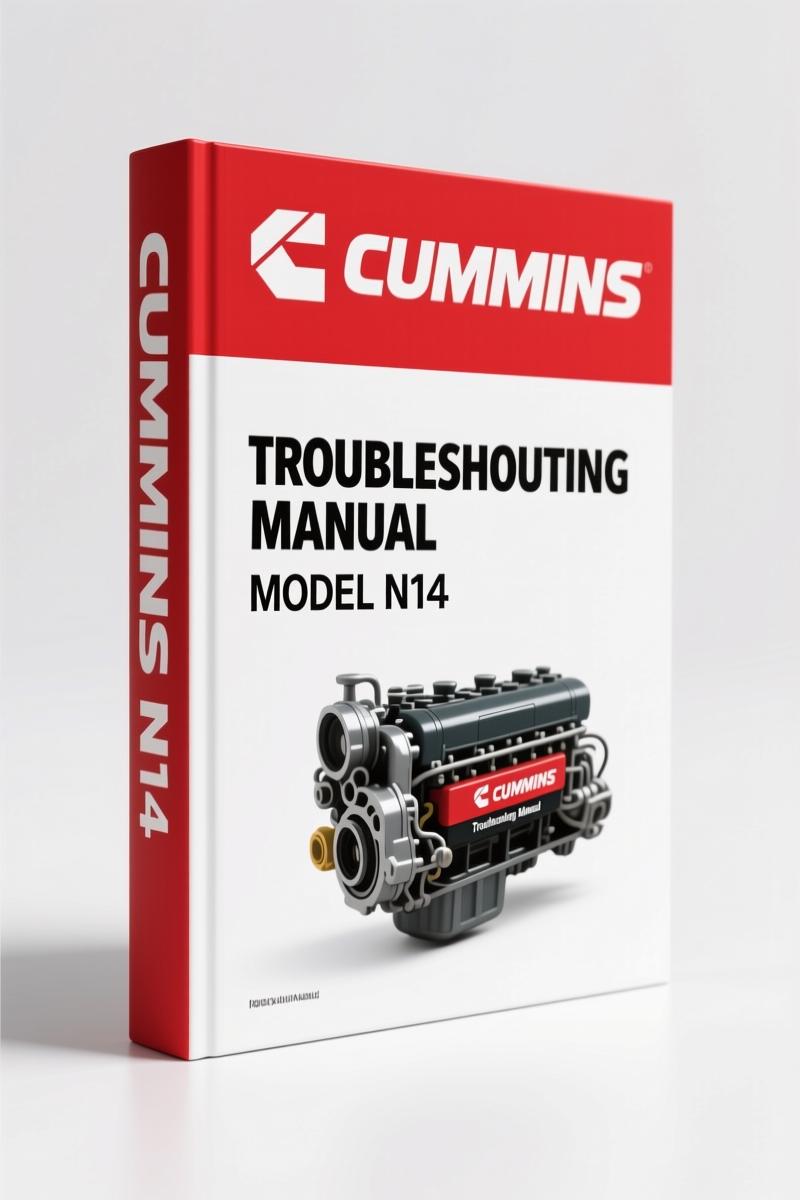
Cummins N14 1992 Troubleshooting Manual – 812 Pages of Factory Diagnostics
Original price was: $59.20.$40.00Current price is: $40.00.
Official 1992 Cummins N14 Troubleshooting Manual with 812 pages of factory diagnostic procedures and specifications for professional repair.
Description
Cummins N14 1992 Troubleshooting Manual
Let me tell you what I think of aftermarket troubleshooting guides for a Cummins N14 – most belong in the scrap bin. You’ve got an engine that can push 500 hp and you’re going to trust a generic wiring diagram? Not on my bay floor. This 1992 Factory Troubleshooting Manual is the real thing, printed by Cummins Engine Company, Inc. in July of 1992, Bulletin No. 3810456-01. 812 pages thick. That’s not a spiral-bound cheat sheet; that’s a service library. If you’re chasing a no-start on a PT fuel system or a gradual overheat and you don’t have this manual, you’re burning billable hours. Every torque spec, every diagnostic flowchart, every cleaning procedure comes from Columbus, Indiana – not some third-party reprint. I’ve used this manual on N14s that were still pulling trailers in 2024. It works.
What the 812 Pages Actually Cover
Open the manual and you hit three sections: Introduction (Section I), Engine Identification (Section E), and Troubleshooting (Section T). The Introduction alone covers safety, repair instructions, and cleaning methods – including solvent/acid, steam, and glass or plastic bead cleaning. That’s not fluff. That’s how you avoid turning a cylinder head into a paperweight. Section E gives you the engine dataplate locations, fuel pump dataplate, and full specs for the air induction, lubricating oil, cooling, exhaust, fuel, and electrical systems. Batteries? Specific gravity is right there. Then Section T – that’s the heart. Over sixty symptoms listed in the troubleshooting symptoms chart, from “Engine Cranks But Will Not Start (No Smoke From Exhaust)” to “Turbocharger Boost Pressure Low.” Each symptom has a dedicated procedure. Page numbers aren’t my thing to memorize, but when I need charge pressure diagnosis, I flip to that section. You should too.
Engine Identification: Don’t Guess What You’ve Got
N14 engines came in different configurations – PT fuel system, CELECT, different horsepower ratings. This manual tells you how to read the engine dataplate and the fuel pump dataplate. If you skip this step, you might order the wrong injectors or set the wrong governor speed. Section E includes a full engine diagram with all major components labeled. I’ve seen techs try to diagnose a low power complaint without confirming the engine model. That’s like changing spark plugs on a diesel. Waste of time. The manual gives you the dataplate location and explains the Cummins model name format. Use it.
Troubleshooting Symptoms Chart: Real-World Application
Here’s where this manual earns its place on the workbench. The Troubleshooting Symptoms Chart lists every common failure mode for the N14. Need to diagnose “Engine Shuts Off Unexpectedly or Dies During Deceleration”? There’s a procedure. “Fuel Consumption Excessive”? There’s a performance test evaluation procedure. The chart covers air compressor issues, alternator charging, coolant loss (external and internal), crankcase blowby, engine brake problems, and noise diagnostics (main bearing, connecting rod, piston, turbocharger). Each symptom leads you through a logical sequence of checks, with required tool lists and safety warnings. I’ve used this to isolate a connecting rod knock in a 1993 N14 that three other shops misdiagnosed as a bad injector. The manual doesn’t let you skip steps. It’s not a quick reference; it’s a process.
Fuel System Coverage: PT and CELECT
The manual explicitly covers the PT (pressure-time) fuel system troubleshooting. Note: the CELECT system is not covered here – that’s a separate manual (Bulletin No. 3810469). If you have a CELECT engine, you need the companion manual. But for PT systems – which are still common on older N14s – this manual gives you the full repair procedure in Section 5: Fuel System Repair. You get step-by-step instructions for fuel pump removal and installation, injector timing, and fuel line checks. The torque values for fuel fittings? Factory OEM. No approximate values. Another point: the manual includes a procedure for “Fuel in the Lubricating Oil” and “Lubricating Oil in Fuel.” Cross-contamination kills engines fast. This manual shows you where to look first – injector O-rings, fuel pump seals, return line restrictions. Don’t guess.
Audience Fit: Who Should Buy This
If you’re a professional diesel mechanic working on over-the-road trucks or industrial N14s, you need this manual. Period. But I also recommend it for serious DIY owners who maintain their own equipment. If you own a truck or generator with a 1992 N14, buy this. The manual assumes you have basic mechanical knowledge – it’s a troubleshooting guide, not a training course. You need to know how to use a multimeter, a torque wrench, and a fuel pressure gauge. If you’re a beginner, pair this with the Cummins N14 Operation and Maintenance Manual to understand routine service before tackling diagnostics. For those with later N14 models, check out the Cummins N14 Engine 2001 Diagnostics Manual for updated procedures. And if your 1991 N14 shares the same platform, the Cummins N14 1991 Workshop Manual offers complementary rebuild specs. This troubleshooting manual is the diagnostic core.
Source Authenticity: OEM vs Aftermarket
I’ve seen PDFs floating around with watermarked third-party logos. Half of them have wrong torque specs or missing pages. This manual is the original factory scan from Cummins. The OCR excerpt shows the copyright 1992 and the phrase “The information, specifications, and recommended repair procedures in this publication are based on the information in effect at the time this manual was printed.” That’s legal language, not marketing. You get the same content a Cummins dealer tech would have used. For transmission-related issues on the truck itself (not engine-driven), you’d need a separate manual – see Manual Transmission diagnostics from the vehicle manufacturer. The engine manual does not cover vehicle or equipment problems. That’s stated in the foreword. Know your scope.
Why Safety Warnings Matter Here
General Safety Instructions are in Section I, including an Important Safety Notice. The manual also includes symbols used to warn about high pressure, hot surfaces, and moving parts. I’ve seen techs skip the steam cleaning instructions and damage seals. The manual dedicates a subsection to solvent and acid cleaning, steam cleaning, and glass or plastic bead cleaning – each with specific cautions. If you’re bead cleaning a cylinder head, you need to know which plugs to install to keep media out of oil passages. This manual tells you. Aftermarket manuals rarely include this level of detail. Another thing: the electrical system section covers batteries and specific gravity. If you’re jumping a truck with an N14, the manual tells you the correct procedure to avoid damaging the ECM (if equipped). Don’t skip it.
- Does this manual cover the CELECT fuel system?
- No. That’s Bulletin No. 3810469. This manual covers PT fuel system only.
- What page contains torque specifications for the cylinder head?
- Torque values are within the specific repair section – you won’t find a single table of all torques. The manual spreads specs across each procedure: fuel pump mounting bolts, injector hold-down, main bearing cap, etc. Each step lists the exact value and sequence. For example, the fuel system repair section gives you the fitting torque for the PT fuel pump. There’s no generic page; you follow the procedure for your symptom. That’s why flipping through the 812 pages takes time, but it’s time well spent. The manual assumes you have the shop manual for rebuild procedures – this troubleshooting manual is for in-chassis work.
- Can I use this to rebuild the engine?
- Not entirely. This manual covers troubleshooting and in-chassis repair. For complete rebuild, use the N14 Engine Shop Manual. This one will help you diagnose what needs rebuilding.
- How is this different from a generic diesel repair manual?
- Generic manuals compile information from multiple sources and often miss model-specific nuances. This 1992 Cummins manual was written by Cummins engineers for the N14 only. Every spec – from the air induction system pressure drop to the lubricating oil temperature – is verified. No guesswork. The troubleshooting symptoms chart is organized by symptom, not by system, making it faster to find the root cause. I’ve used both; OEM is faster.
You want to troubleshoot your N14 right, or you want to throw parts at it? The choice is yours. 812 pages of factory procedures, safety instructions, and symptom-based diagnostics. No generic content. No missing torque specs. Access the Factory Manual and get the N14 running the way Cummins intended.
Additional information
| Brand | Cummins |
|---|---|
| Language | English |
3 reviews for Cummins N14 1992 Troubleshooting Manual – 812 Pages of Factory Diagnostics
You may also like…
-
Sale!
Cummins QSB6.7, ISL, ISC, ISB, QSB4.5 2014 Repair Manual – 810 Pages
Original price was: $109.20.$70.00Current price is: $70.00. -
Sale!
Cummins NT 855 Service Manual – 693 Pages of OEM Repair Data for Big Cam III & IV
Original price was: $104.00.$65.00Current price is: $65.00. -
Sale!
Cummins 495, 743, 855, V-1710, KT-1150 Service Manual – 143 Pages
Original price was: $89.70.$65.00Current price is: $65.00. -
Sale!
Cummins ISB, ISBe2, ISBe3, ISBe4, QSB4.5 Troubleshooting Manual
Original price was: $92.30.$65.00Current price is: $65.00.
Related products
-
Sale!

1991 Electrical Schematic – 112-Page OEM Wiring Diagram for International 1000-3000 Series
Original price was: $22.75.$17.50Current price is: $17.50. -
Sale!

2006 Service Manual – International DT 466E, 530E Diesel Engine
Original price was: $67.50.$50.00Current price is: $50.00. -
Sale!
Acura NSX 1991 Service Manual – 1420 Pages OEM
Original price was: $102.05.$65.00Current price is: $65.00. -
Sale!

Technical Manual – International DT 530 & HT 530 (118 Pages)
Original price was: $37.00.$25.00Current price is: $25.00.
Michael T. –
Superb resource! It is very easy to read on my iPad without blur. It guided me to troubleshoot my Cummins N14 engine. Saves me a lot of money.
Richard G. –
I am extremely satisfied with this manual. Instant access after payment. It assisted me to repair my Cummins N14 transmission. Highly recommended for mechanics.
Robert M. –
Great buy! Immediate link after payment. A must-have for any Cummins N14 owner doing repairs. I will recommend this shop to others.