
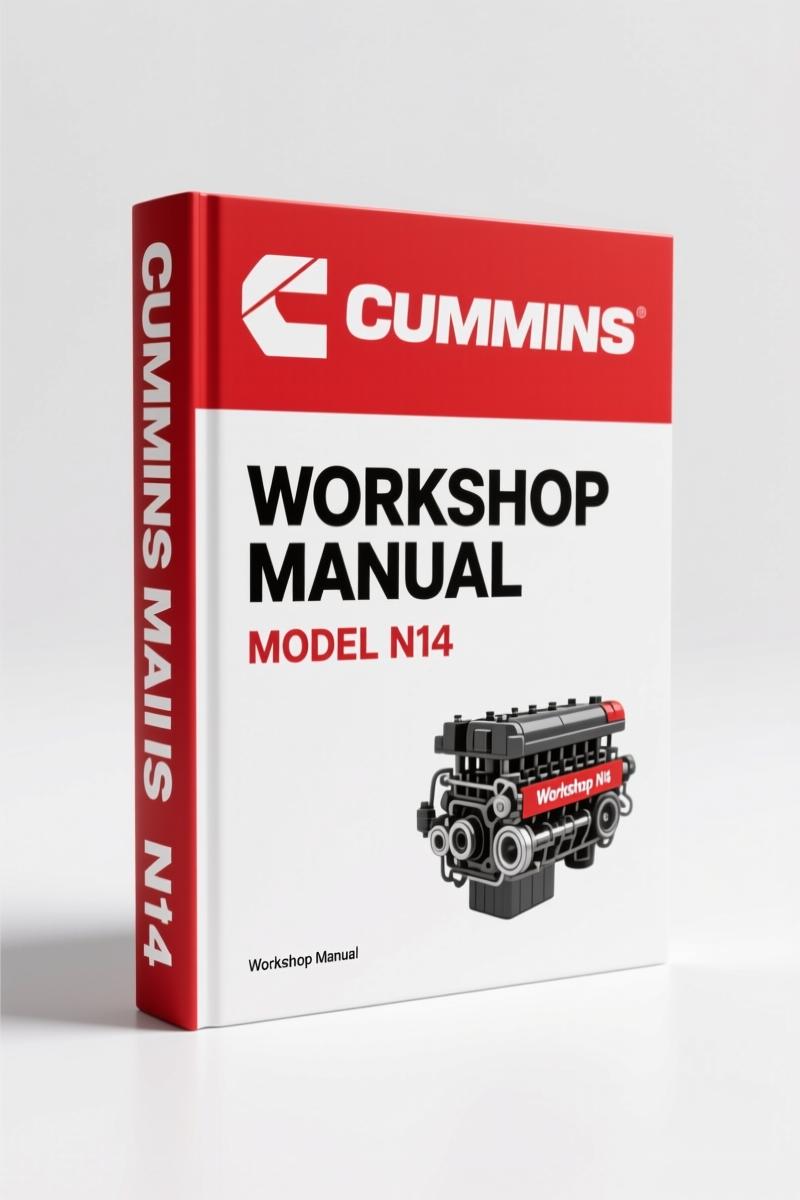
Cummins N14 1991 Workshop Manual – Factory Rebuild Specs
Original price was: $55.20.$40.00Current price is: $40.00.
Factory workshop manual for Cummins N14 engines. 587 pages covering full rebuild, CELECT/STC systems, torque specs, and diagnostics.
Description
Cummins N14 1991 Workshop Manual – OEM Factory Rebuild Specs
If you have ever guessed a torque value on a Cummins N14 head bolt and then watched coolant weep out at 20,000 miles, you know why factory documentation is not optional. That mistake costs you a head gasket job and a lot of swearing. The Cummins N14 1991 Workshop Manual is the only document that gives you the original factory rebuild sequence, clearances, and torque specs as Cummins printed them in 1991. 587 pages of procedures that start with draining coolant and end with final assembly specs. No shortcuts written in.
587 Pages of Factory Rebuild Data
Each page of this manual covers a critical piece of the N14 engine. From the foreword on page 2: “This manual contains complete rebuild specifications and information for the N14 model engines, and all associated components.” That includes the CELECT and STC fuel systems, the ECM, turbocharger, cylinder head, camshaft, and everything under the valve cover. You get the full Group 0 disassembly and assembly sequence, plus separate groups on cylinder block, cylinder head, rocker levers, cam followers, and more. The introduction alone includes general safety instructions, a glossary of terms, engine identification, and engine diagrams. That is the kind of detail you need when you are 20 hours into a rebuild and need to confirm a clearance.
Use the Right Service Tools
Every procedure in Group 0 lists the required service tools. For example, cylinder head installation requires a torque wrench capable of reading in ft-lbs, a protractor for angle torque, and specific Cummins tools for guide sleeves. The manual warns: “Make sure the correct tools are used as described in the procedures.” I have seen guys try to use a cheap clicker on a main bearing cap and snap the bolt. Don’t be that guy. The service tools section of Group 0 tells you exactly what you need before you start.
What Torque Values Does This Manual List?
All critical fasteners have specified torque values. Cylinder head bolts, connecting rod nuts, main bearing caps, flywheel bolts – each with the required sequence and angle if applicable. The manual includes both assembly and disassembly torque references. On page 2, Cummins also recommends using genuine Cummins or ReCon parts for replacement. That foreword reminds you that aftermarket bolts may not meet the same tensile strength. When you are torquing a head to 300 ft-lbs plus 90 degrees, you need the factory number.
Cylinder Head Installation Procedure
The cylinder head section (Group 2) walks you through cleaning the deck, installing the gasket, positioning the head, torquing in the specified pattern, and then the final angle torque. The manual includes bore alignment measurements for the flywheel housing and face alignment – things you will not find in any aftermarket book. If you skip the alignment step, you risk destroying the rear main seal and transmission input shaft. That is not a risk worth taking on a $15,000 engine.
CELECT System: Handling the Electronic Components
The N14 can be either CELECT (electronic) or STC (mechanical). This manual covers both. For CELECT engines, there are removal procedures for the ECM, ambient air pressure sensor, lubricating oil pressure sensor, boost pressure sensor, intake air temperature sensor, and the engine position sensor (EPS). Each removal and installation includes the correct disconnection order to avoid frying the ECU. Page 2 of the manual also provides a supplier list for components not covered – something aftermarket manuals omit entirely.
Who Needs This Manual?
If you are doing an in-frame or out-of-frame rebuild on an N14, this is the manual you need. It is not for oil changes or belt adjustments – that is what the operation and maintenance manual is for. This workshop manual is for the guy who has the engine on a stand, pulling pistons, measuring liner protrusion, and setting injector timing. It is for the shop owner who wants to avoid comebacks from a mis-torqued head. It is for the DIYer who has rebuilt a few small blocks and is ready for a big-bore diesel. The 587 pages cover everything from cleaning instructions to final assembly checks.
OEM Factory Print vs. Aftermarket Copies
This is the original Cummins factory publication, printed in 1991 with Bulletin No. 3810487. Aftermarket reprints often omit the glossary, safety symbols in multiple languages, and the specific supplier list. They also compress the diagrams and lose detail on the torque sequences. If you have ever tried to follow a grayscale photocopy of a factory page, you know the frustration of missing a torque step because the last digit was cut off. This is a clean digital copy of the original OEM document. The difference between this and an aftermarket scan is the difference between a proper rebuild and a leaky engine.
- Does this manual cover the CELECT fuel system?
- Yes. The manual includes separate removal and installation procedures for CELECT and STC injectors and fuel pumps.
- Are torque specifications given in ft-lbs or Nm?
- Both. The manual uses imperial units primarily but includes metric conversions in the METRIC INFORMATION section of the Introduction.
- How do I know if my N14 engine is CELECT or STC?
- The manual includes engine identification information in the Introduction. You can cross-reference your engine serial number to determine the fuel system type. Also check for the presence of an ECM on the side of the engine. If you have a mechanical fuel pump with a separate STC control valve, it is an STC engine. If you see a rectangular ECM box with a wiring harness, it is CELECT. The manual also lists the specific differences in injection timing procedures between the two systems.
- What is the difference between this workshop manual and the operation and maintenance manual?
- The workshop manual is intended for major rebuilds – it covers complete disassembly and assembly of the engine, including all groups from cylinder block to cylinder head, rocker levers, cam followers, injection timing, and all the CELECT electronic components. It includes every torque spec, clearance, and alignment procedure required to put the engine back to factory condition. The operation and maintenance manual is a lighter document that covers daily checks, fluid capacities, belt adjustments, and minor repairs. For a proper in-frame or out-of-frame rebuild, you need the workshop manual. The Cummins N14 Operation and Maintenance Manual is a good companion for routine service, but this 587-page book is where you find the numbers that keep the engine alive.
Stop relying on forum posts and generic scans. Get the original Cummins factory documentation – the same one used in Cummins authorized rebuild centers. Access the factory manual today. Pair it with the Cummins N14 Engine 2001 Diagnostics Manual for troubleshooting and the Cummins N14 Parts Catalog for correct parts identification. For transmission work, refer to Manual Transmission and Manual Transmission for general principles. But for the engine itself, this is the only manual that has the factory rebuild data you need.
- Cummins N14 Operation and Maintenance Manual
- Cummins N14 Engine 2001 Diagnostics Manual
- Cummins N14 Parts Catalog
Additional information
| Brand | Cummins |
|---|---|
| Language | English |
2 reviews for Cummins N14 1991 Workshop Manual – Factory Rebuild Specs
You may also like…
-
Sale!
Cummins 495, 743, 855, V-1710, KT-1150 Service Manual – 143 Pages
Original price was: $89.70.$65.00Current price is: $65.00. -
Sale!
Cummins ISB, ISBe2, ISBe3, ISBe4, QSB4.5 Troubleshooting Manual
Original price was: $92.30.$65.00Current price is: $65.00. -
Sale!
Cummins NT 855 Service Manual – 693 Pages of OEM Repair Data for Big Cam III & IV
Original price was: $104.00.$65.00Current price is: $65.00. -
Sale!
Cummins QSB6.7, ISL, ISC, ISB, QSB4.5 2014 Repair Manual – 810 Pages
Original price was: $109.20.$70.00Current price is: $70.00.
Related products
-
Sale!

International 1000-3000 Series Operators Manual – 132 Pages of OEM Specs
Original price was: $14.40.$10.99Current price is: $10.99. -
Sale!
1995 Operators Manual – International 1000-4000 Series | OEM Documentation
Original price was: $12.49.$9.99Current price is: $9.99. -
Sale!

Technical Manual – International 6.0L Power Stroke FICM Diagnostics
Original price was: $29.80.$20.00Current price is: $20.00. -
Sale!
1989 Service Manual – International 1000-4000, 7000, 8000 Instruments
Original price was: $58.80.$40.00Current price is: $40.00.
diy_master –
Perfect OEM spec sheet. The text is searchable and well indexed. Contains clear bolt torque specs for Cummins. Great value for money.
pro_mechanic –
Great factory service manual. The text is searchable and easy to navigate. It guided me to rebuild my Cummins N14 electrical system. I will definitely buy again.