
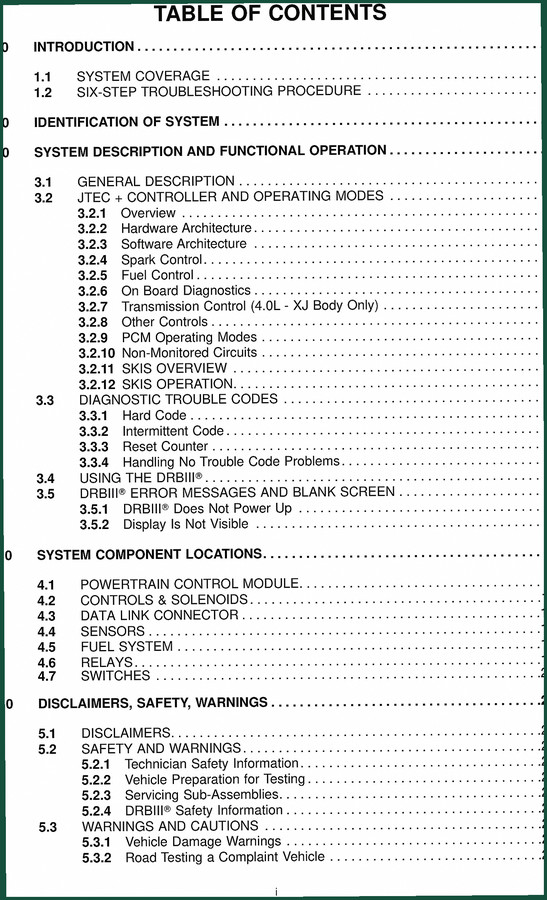
Chrysler TJ-XJ Diagnostics Manual – 504 Pages OEM
Original price was: $33.50.$25.00Current price is: $25.00.
Factory diagnostics manual for Chrysler TJ & XJ models. 504 pages with structured trouble code tests and immobilizer system coverage.
Description
Chrysler TJ/XJ Diagnostics Manual – 504 Pages of Factory Test Procedures
You’ve got a Chrysler TJ or XJ on the lift with a check engine light that won’t clear, or a no-start that’s eating into flat-rate time. The manual you need is the factory diagnostics book – not a third-party rewrite that skips the critical steps. This is the OEM Chrysler TJ/XJ Diagnostics Manual, 504 pages of verified test sequences, wiring pinouts, and torque specs that came straight from the engineering team. If you’ve ever wasted an hour hunting for a DTC definition that doesn’t match the aftermarket scanner, you know why this document exists.
Dig into the bookmarks and you’ll find 58 trouble code tests (TC-1A through TC-236A), each one a diagnostic tree that starts with the symptom and ends with a confirmed repair. The section Trouble Code Tests covers everything from TC-5A (fuel system) to TC-157A (transmission communication). Page references aren’t needed when you can jump straight to the test number – but when you need the charge pressure spec, flip to the verification section.
You’ll also see the Sentry Key Immobilizer System with nine separate tests (SK-1A through SK-9A). That’s the subsystem that locks out the starter when the key chip doesn’t match – and it’s the first place a lazy scan tool will lead you astray. This section gives you the factory resistance values and the exact procedure to bypass the module without triggering a security event.
Trouble Code Tests: 58 Diagnostic Paths
Each TC test is laid out with a pass/fail decision point. You don’t get a generic flowchart – you get the OEM’s own logic: “Is the voltage at pin 22 above 4.6 volts? If yes, go to TC-14A. If no, check the ground circuit at C101.” The manual includes specific test conditions (engine at operating temp, A/C off, headlights on) that aftermarket manuals omit. Don’t skip those conditions – they are there to prevent false passes that lead to swapping parts you don’t need.
The No Trouble Code Tests (NTC-1A through NTC-27A) are for the cases where the PCM reports no codes but the customer says it runs rough. That’s where you start measuring fuel pressure, injector pulse, and ignition dwell. The manual gives you the tool list for each test: Fluke meter with min/max, breakout box, and a fuel pressure gauge with a Schrader adapter. Don’t use a generic gauge – the adapters differ between years.
Does This Manual Cover the Sentry Key Immobilizer?
Yes, and it does it with nine specific tests that walk you through the SKIM module, the antenna ring, and the key transponder. In test SK-3A the manual tells you to measure the resistance across the antenna coil (should be 2.0 ohms ± 0.2 at 20°C). If you get infinite resistance, you’re replacing the antenna ring, not the key. That kind of specificity is what separates an OEM document from a photocopied aftermarket binder. See the Automotive Industry Overview for background on how OEMs standardize these diagnostics.
You’ll also use the No Start Tests (NS-SEL through NS-9A) when the engine cranks but doesn’t fire. The manual splits no-start by cause: fuel, spark, or compression. Each branch has its own voltage and resistance targets. NS-4A, for example, checks the crankshaft position sensor signal at the PCM – you need an oscilloscope for that one, not just a multimeter. I tell my junior techs: if you don’t own a scope, you don’t own this job.
Get the Right Diagnostic Flow
Start with the verification test (VER-1A through VER-4A) after any repair. The manual insists on a road test with the scan tool logging fuel trim and oxygen sensor activity. That’s the only way to confirm the fix didn’t create a secondary issue. Skip the verification step and you’ll see the car back in the bay next week. The torque chart on the verification page lists the exact values for intake manifold bolts (21 ft-lb for TJ, 16 ft-lb for XJ aluminum intake) – cross-check that with the engine section of the manual.
The Charging Tests (CH-1A) are a single procedure, but it covers the alternator output at idle, at 2,000 RPM, and under load. The manual specifies a load test with the headlights on high beam and the blower motor on high. If the voltage drops below 13.2 volts during that test, you’re looking at a bad rectifier diode. Don’t replace the alternator until you’ve checked the B+ wire voltage drop under load – the manual shows you the exact measurement points.
OEM vs Aftermarket: Why It Matters
I’ve seen aftermarket manuals that list the same diagnostic tree but omit the “test time” and “tools required” callouts. This factory document includes the actual test conditions that the PCM engineers used when writing the software. For example, the DTC test for TC-86A (fuel injector circuit) requires the engine to be at operating temperature and the fuel pressure to be between 39 psi and 42 psi with the pump running. A generic manual will skip the temperature condition, and you’ll waste time chasing a code that only sets when cold. This is why I tell every tech to treat aftermarket manuals like a schematic drawn from memory: close, but not exact. For a deeper understanding of how combustion systems relate to diagnostics, check the Internal Combustion Engine article.
The 504 pages are divided into major sections: 1.0 through 12.0. Section 3.0 alone (diagnostics) has 12 subsections with 3.2.1 through 3.2.12 covering everything from PCM reset to sensor voltage ranges. Section 5.0 handles the Speed Control Tests (SC-1A through SC-5A), which is what you need when the cruise control refuses to engage. The manual lists the specific tool: a DRB-III scan tool running the latest firmware. If you’re using a generic OBD-II tool for this, you’re guessing.
504 Pages of Verified Diagnostics
Every page count matters when you’re on the clock. This manual has 504 pages because Chrysler packed in all the notes, diagrams, and test conditions that don’t fit in a pocket guide. The bookmarks alone show 58 TC tests, 27 NTC tests, 9 SK tests, 5 SC tests, and 1 CH test – that’s 100 diagnostic paths in one document. You don’t need an internet connection or a subscription. It’s a PDF you can keep on your tablet or print out for the workbench. The font is the same as the original dealer print – no re-cropped images or missing pages.
When you’re down to the last hour of the shift and the customer is waiting, having the verified test sequence saves your back. The verification section (VER-1A to VER-4A) is the same sign-off the dealership techs use before handing the keys back. It includes a specific road test protocol: 10 minutes at highway speed, three full-throttle accelerations to 60 mph, and an idle check with the A/C on. If the DTC doesn’t return, the job is done.
- What is the difference between TC tests and NTC tests in this manual?
- TC tests are for active trouble codes logged in the PCM. NTC tests are for symptoms without a stored code – you use them when the car runs poorly but the check engine light is off.
- How do I use the Sentry Key Immobilizer section without a dealer scan tool?
- You need a digital multimeter that reads duty cycle and resistance, plus a breakout box for the SKIM connector. The manual’s SK-2A test tells you to measure the voltage at pin 4 of the SKIM connector with the ignition on. If it’s below 10 volts, check the ground at G100. If it’s above 12.5 volts, go to SK-3A which measures the antenna coil resistance. Without a dealer tool, you can still complete all nine SK tests using the listed resistance and voltage targets. The manual also includes a procedure for using a DRB-III emulation tool, but the factory method is to follow the test flow exactly – don’t take shortcuts because the immobilizer system will lock you out for 30 minutes after three failed attempts. I’ve seen techs replace the entire steering column because they skipped the antenna resistance check. Don’t be that guy.
If you’re working on TJ or XJ models from the 1990s through mid-2000s, this is the diagnostic bible. Don’t trust a scanned copy from a website that blurred the voltage tables. Access the Factory Manual now and have the correct test conditions in front of you before you touch the wiring.
Additional information
| Language | English |
|---|
3 reviews for Chrysler TJ-XJ Diagnostics Manual – 504 Pages OEM
You may also like…
-
Sale!
Acura NSX 1991 Service Manual – 1420 Pages OEM
Original price was: $102.05.$65.00Current price is: $65.00. -
Sale!

Caterpillar 305CR/305C Training Manual – 33 Pages OEM Documentation
Original price was: $94.20.$60.00Current price is: $60.00. -
Sale!

Toyota 8FGU15-8FGU30 Repair Manual – 227 Pages Factory Service Data
Original price was: $87.60.$60.00Current price is: $60.00. -
Sale!

2002 Yale GLP/GP 030-040 AF Parts Catalog – 384 Pages OEM
Original price was: $93.60.$65.00Current price is: $65.00.
Related products
-
Sale!

2005 Parts Catalog – International NGD 3.0 L Engine (77 pages)
Original price was: $44.70.$30.00Current price is: $30.00. -
Sale!

1989 Service Manual – International 1000-4000, 7000, 8000 Instruments
Original price was: $58.80.$40.00Current price is: $40.00. -
Sale!
1993 Operators Manual – International Bus 1000-3000 OEM Specs
Original price was: $12.30.$7.99Current price is: $7.99. -
Sale!

2011 Parts Catalog – International Truck OE Parts Documentation (1786 Pages)
Original price was: $34.50.$25.00Current price is: $25.00.
Robert M. –
Excellent factory service manual. The PDF quality is excellent. Every spec sheet is provided for TJXJ. Saved my repair job! Thanks.
John S. –
This is exactly what I was looking for. The PDF is high resolution. A must-have for any TJXJ mechanic doing maintenance. Saved my repair job! Thank you.
William H. –
This is exactly what I was looking for. Instant access after payment. Contains clear wiring diagrams for . Saves me hundreds of money.