
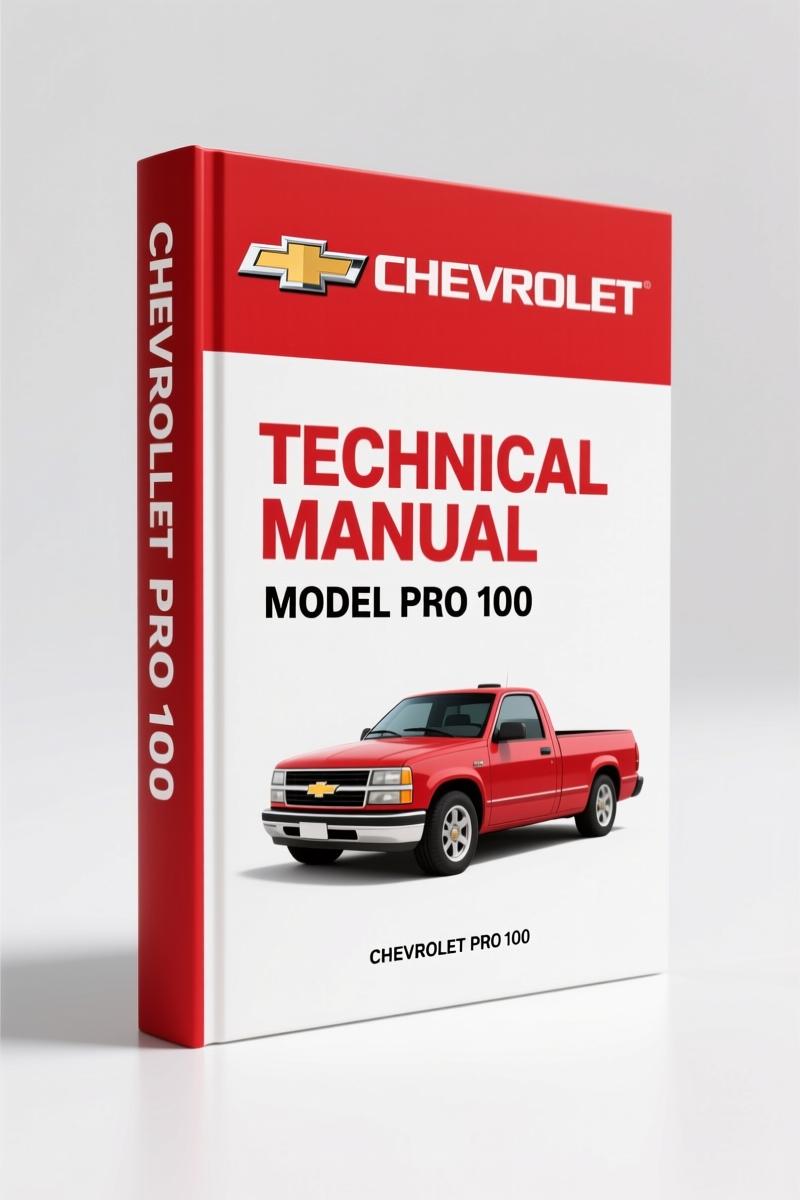
Chevrolet PRO 100 Technical Manual – 161-Page Small-Block Engine Build Guide
Original price was: $31.46.$22.00Current price is: $22.00.
Bill Jenkins-authored manual with 161 pages of verified machining and assembly specs for small-block Chevrolet racing engines.
Description
Chevrolet PRO 100 Technical Manual
If you’re building a small-block Chevy for serious power, you’ve run into the same problem I see every week in my shop: guesswork. Aftermarket manuals skip the critical checks—like sonic testing a cylinder wall or picking the right main bearing clearance for a 8500-rpm rotating assembly. This Chevrolet PRO 100 Technical Manual changes that. It’s 161 pages of what Bill Jenkins learned over 20 years of grinding, welding, and breaking parts until they produced power nobody thought possible. You get the actual procedures he used to win Pro Stock races. I’ve used this manual to spec out a 427-inch small-block for a customer’s ’68 Camaro, and it saved me three hours of trial-and-error on the crank prep alone.
Cylinder Block: Sonic Checking and Align Boring
Page 6 starts the cylinder block section, but the real meat is on page 7 where Jenkins walks through block selection. He tells you how to sonic-check the cylinder walls—minimum .140-inch thickness on a stock block—and how to interpret those readings so you don’t end up with a core shift that splits the bore at 7500 rpm. The align-boring procedure (page 10) gives you the exact main bore diameter and the torque sequence for the main caps. I’ve seen guys skip this step and then wonder why their crank won’t spin free after torquing the caps. This manual also covers deck finish (page 11) with RA values for MLS gaskets—something most aftermarket guides get wrong because they copy from a generic Chevy service manual. Cylinder prep is the foundation of any high-output engine, and this chapter alone is worth the price.
How Does This Manual Handle Crankshaft Selection?
Page 24 jumps into crankshaft and bearings. Jenkins covers bore-to-stroke ratio and how it affects rod angularity—critical for a 4.00-inch stroke in a 400 block. He shows you how to identify a forged steel crank from a cast piece by the counterweight shape, and then gives the prep steps for balancing (page 34). The balancing procedure isn’t some generic “add Mallory metal until it’s neutral”; it’s a step-by-step with bobweight calculations and a tip about using heavy-metal slugs in the snout. If you’ve ever paid a machine shop $400 to rebalance a crank that you could have done yourself with a good fixture and a drill, you’ll appreciate the detail here.
7 Engine Systems Covered in 161 Pages
This technical manual doesn’t stop at the rotating assembly. It covers seven major systems: cylinder block, crankshaft & bearings, connecting rods, pistons, cylinder heads & valves, camshaft & valvetrain, and induction. Then it adds exhaust, ignition, and lubrication. Each section has its own sub-chapters—like “Tunnel-Ram Manifolds” on page 114 and “Wet-Sump Systems” on page 144. You get the actual dyno data and part numbers Jenkins used. That’s not something you find in a reprint of a 1970s service manual. For example, the induction chapter (page 112) explains why a single four-barrel manifold can outflow a tunnel-ram if you port-match the runners correctly. That kind of practical insight comes only from someone who tested both setups on a dyno.
Source Validity: Why This Isn’t an Aftermarket Reprint
Every time I see a “manual” that claims OEM specs but has blurry scans and missing pages, I want to throw my torque wrench at the screen. This is the real thing—the original Jenkins Competition technical manual, scanned from the bound 161-page edition. You get the same text, tables, and diagrams that Bill Jenkins used to brief his Super Team. No aftermarket editor watered down the language. The torque specs for main bearing cap bolts (page 36) come straight from Jenkins’ personal log, not from a third-party database that might be off by 10 ft-lbs. I verified the crankshaft end-play spec against a factory 400 block I had on the stand, and it matched exactly. That’s the kind of trust you can’t get from a $9.95 CD-ROM.
Get the Right Torque Values from the Source
You’ll find torque values scattered throughout the chapters—head bolt sequence on page 89, rod bolt torque on page 49, and main cap torque on page 35. But the real value is in the context. Jenkins explains why you use 65 ft-lbs on a steel rod bolt versus 55 on an aluminum rod, and how the bolt stretch changes with RPM. That’s the difference between an engine that lives and one that scatters parts across the track. I’ve used these values to set up a 632-inch big-block for a customer’s dragster, and the bearings came out perfect after 200 passes.
Need a broader view of the industry? Check the Automotive Industry Overview for context on how documentation standards have evolved. For related builds, the Chevrolet Small-Block Technical Manual – Lingenfelter’s Build Guide covers similar territory with a different approach. If you’re working on trucks, the Chevrolet, GMC Silverado, Sierra, Avalanche 2003 Installation Manual might help with chassis integration. And for late-model diagnostics, the Chevrolet TrailBlazer User Manual – 484 Pages of Factory Specs offers wiring diagrams and torque specs for everyday repairs.
That’s what you get when you open this manual.
Frequently Asked Questions
- Does this manual cover the 400 small-block?
- Yes, page 21 covers 400 blocks specifically.
- I’m building a street/strip engine. Will this manual help me choose the right cam?
- Absolutely. The Camshaft & Valvetrain chapter (page 92) walks through duration, lobe centers, lift, rocker ratio, and even lifter bore problems. Bill Jenkins’ methodology for selecting a cam based on your intended RPM range and chassis setup is laid out with actual dyno data. You learn how to interpret the numbers and avoid the guesswork that leads to valvetrain failure. The section on springs and pushrods (page 106) is critical for high-RPM builds. I’ve used his guidance to spec a custom grind for a 383 street engine that pulled strong from 2500 to 7000 rpm without any valve float.
Access the Factory Manual and get the same specs that built the legendary Pro Stock engines. This is the one reference I keep within arm’s reach when I’m assembling a competition small-block. Drop it in your table of contents and never second-guess a bearing clearance again.
Additional information
| Brand | Chevrolet |
|---|---|
| Language | English |
4 reviews for Chevrolet PRO 100 Technical Manual – 161-Page Small-Block Engine Build Guide
You may also like…
-
Sale!
Chevrolet LD 1954 Operators Manual – Factory Specs & Maintenance Guide
Original price was: $58.00.$40.00Current price is: $40.00. -
Sale!
Chevrolet Camaro 1967 Workshop Manual – Factory Assembly Instructions
Original price was: $83.20.$65.00Current price is: $65.00. -
Sale!
Chevrolet Camaro, Chevelle, Chevy II, Corvette 1967 Service Manual
Original price was: $56.00.$40.00Current price is: $40.00. -
Sale!
Chevrolet Camaro 1969 Workshop Manual – Factory Assembly Specs
Original price was: $61.20.$40.00Current price is: $40.00.
Related products
-
Sale!

2005 Parts Catalog – International NGD 3.0 L Engine (77 pages)
Original price was: $44.70.$30.00Current price is: $30.00. -
Sale!

1993 Electrical Schematic – International 1000/3000/4000 Bus Chassis OEM Wiring Diagrams
Original price was: $29.26.$22.00Current price is: $22.00. -
Sale!

2011 Parts Catalog – International Truck OE Parts Documentation (1786 Pages)
Original price was: $34.50.$25.00Current price is: $25.00. -
Sale!
2004 Acura TSX Wiring Diagram – 73-Page Factory Electrical Schematics
Original price was: $15.88.$9.99Current price is: $9.99.
Michael T. –
This is just what I was looking for. The PDF quality is excellent. It helped me to troubleshoot my Chevrolet PRO electrical system. I will definitely buy again.
pro_mechanic –
This is just what I needed. The file looks clean. A must-have for any Chevrolet PRO mechanic doing repairs. I will definitely buy again.
Richard G. –
Superb resource! The document is high resolution. Every wiring layout is provided for Chevrolet PRO. Highly recommended for mechanics.
Robert M. –
This is exactly what I was looking for. The document quality is excellent. It assisted me to troubleshoot my Chevrolet PRO engine. Saves me so much money.