
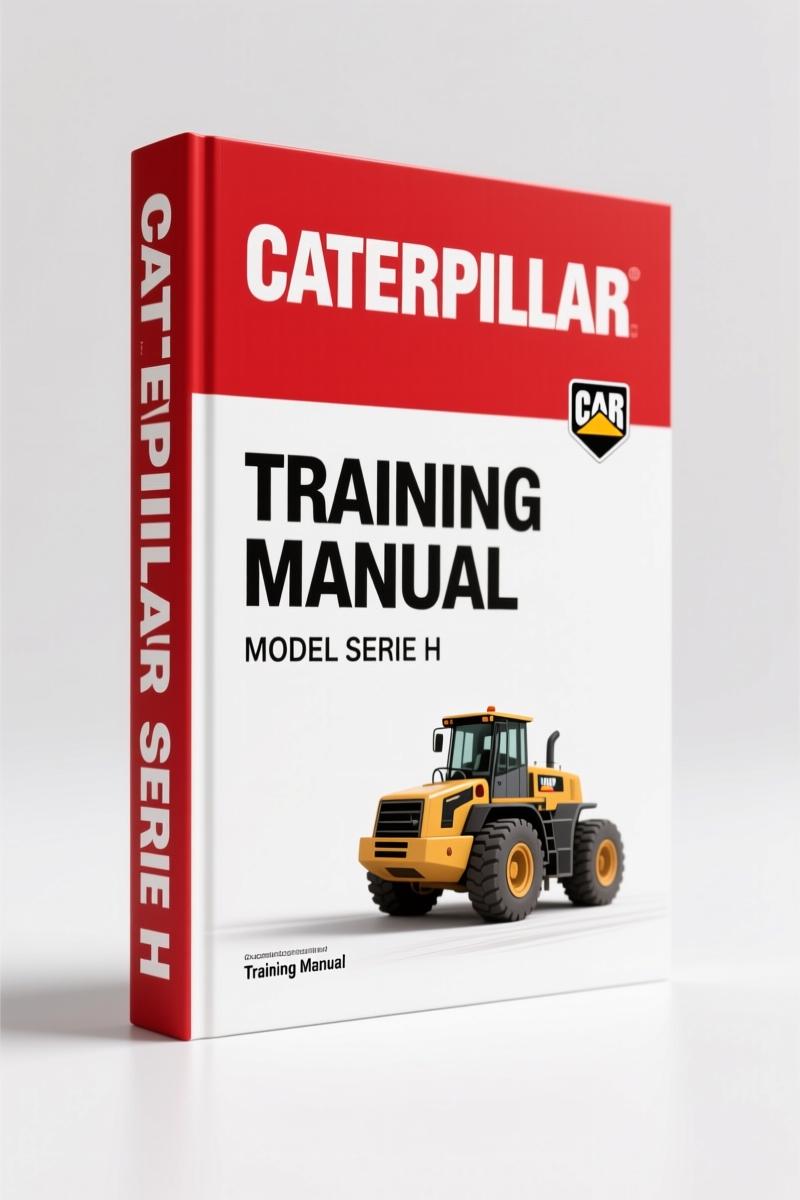
Caterpillar serie H 2006 Training Manual – Factory Systems Testing & Adjustments
Original price was: $34.50.$25.00Current price is: $25.00.
Official 2006 Caterpillar training manual for serie H loaders. 177 pages of systems testing, adjustments, and Tier 3 emissions coverage.
Description
Caterpillar serie H 2006 Training Manual
If you own or work on a Caterpillar serie H medium wheel loader, you already know the cost of guessing wrong. A misdiagnosed hydraulic issue or a skipped torque step can turn a routine repair into a wallet-draining mess. That’s why you need the Caterpillar serie H 2006 Training Manual – 177 pages of factory-developed instruction that covers exactly what the name says: operation, testing, and adjustment of systems.
A training manual like this one is not a quick reference. It takes you through each system in the same order Caterpillar teaches its own technicians. You get safety checklists, component identification, and step-by-step fault location procedures. The table of contents alone runs seven modules, from machine familiarization to the brake system calibration.
The 177 pages are divided into seven modules. Module 1 starts with safety, specifications, daily maintenance, and cab controls – the stuff you need to know before you touch anything. Page 18 is where you find the specifications. Module 2 dives into the electrical system and the Electronic Monitoring System (EMS), including warning categories and service modes (page 40). Module 3 covers the electronic engine with EUI system and sensor diagnostics. Modules 4 through 7 handle the powertrain, implement hydraulics, steering, and brakes.
Caterpillar serie H 2006 Training Manual: What This Book Gives You
This is not a reprint of a parts catalog or a generic overview. It is the actual student manual used in Caterpillar’s formal training course. Each lesson includes text references, worksheets (Hojas), and laboratory exercises. For example, Module 2 has Lab 2.1 for sensor evaluation and Lab 2.2 for relay testing. The manual expects you to have the machine in front of you and a multimeter in hand. That’s the kind of hands-on detail that keeps a repair from turning into a parts-swapping session.
You also get references to external resources. For understanding the torque converter and Manual Transmission, the manual cites supporting material. If you need more background on Manual Transmission, the textbook lists reference literature. This is not a stand-alone rebuild guide – it’s a training course that teaches you how to test and adjust, not just replace parts.
Page 18 gives you the specifications. Page 40 shows the EMS warning categories. Two page numbers you’ll likely bookmark.
Module 1: Machine Familiarization – Don’t Skip the Safety Sheet
Module 1 covers safety, daily maintenance, and cab controls. The “Hoja 1.1: Seguridad” is a full page on safe operation. Many guys jump straight to the hydraulic diagrams and ignore this. That’s a mistake. The manual also includes Hoja 1.3 for identification plates – critical when ordering parts or matching serial numbers. If you don’t know where the hydraulic filler cap is, Hoja 1.5 shows the service points.
3 Modules That Cover the Powertrain and Hydraulics
Modules 4, 5, and 6 are the meat of this course. Module 4 (Tren de Potencia) covers the torque converter, transmission, differentials, and the integrated brake system – including the hydraulic and electronic controls. Module 5 (Sistema Hidráulico de Implementos) goes through pump control, valve operation, and calibration procedures. Module 6 covers both conventional and Command Control steering systems with full hydraulic schematics. These three modules alone are worth the price for anyone who deals with drivability complaints or hydraulic lag.
Why a Training Manual Over a Service Manual?
Some people ask why buy a training manual if you already have a service manual. The answer is depth. A service manual gives you torque values and removal/replacement steps. This training manual teaches you how the system works and how to test it. For instance, Module 5 includes Hoja 5.9 – calibration of the implement pump control. That’s not a torque spec; it’s a procedure. If your machine’s hydraulics are sluggish or you can’t get the steering to center properly, this manual walks you through the diagnosis.
Torque Specs and Calibrations: Page 18 and Beyond
You won’t find every bolt torque in this manual, but you will find adjustment procedures and essential specs. The specifications on page 18 include fluid capacities, system pressures, and other key numbers. The calibration sections (e.g., Hoja 7.6 for brakes) give you step-by-step adjustment data. For a full fastener torque table, you’d pair this with the factory service manual. But for understanding why a system operates the way it does and how to test it, this training manual is the one to have.
Related manuals you might also need:
Caterpillar 994F, 994D, 992G 2005 Training Manual Review
Caterpillar 307D 308D CR 308D CR SB 2008 Training Manual Review
Caterpillar 246C 256C 262C 272C 277C 2007 Training Manual
Frequently Asked Questions
- Is this Caterpillar serie H training manual in English?
- No, it is in Spanish.
- What does the EMS section cover?
- Module 2, Lección 2.2 covers the Electronic Monitoring System (EMS). It explains the three warning categories – Warning, Derate, Shutdown – and the service modes. You get laboratory exercises on sensor evaluation and relay testing. The manual includes schematic references and step-by-step fault location. The EMS is critical because a misinterpreted warning can lead to engine damage. The manual walks you through the Category 1, 2, and 3 alerts and what each means for the machine’s operation. You will also work through Lab 2.3 and 2.4 covering start and charge system troubleshooting. This is not a quick reference; it is a thorough course designed to make you understand the system logic.
- Does this manual include wiring diagrams?
- It includes electrical schematics and references for fault location, but full wiring diagrams are not printed in the training manual. You will need the electrical schematic manual for detailed component-to-component wiring.
- Can I use this to rebuild the transmission?
- This is a training manual for systems operation and diagnostics, not a rebuild guide. For transmission teardown and reassembly, get the factory service manual. But for understanding how the torque converter lockup works or how the modulating valve operates, this manual is excellent.
This training manual is the real deal – direct from Caterpillar’s 2006 course. Access the Factory Manual from AutoRepairManuals and put the specs and procedures on your bench where they belong.
Additional information
| Brand | Caterpillar |
|---|---|
| Language | English |
2 reviews for Caterpillar serie H 2006 Training Manual – Factory Systems Testing & Adjustments
You may also like…
-
Sale!

Caterpillar 3500B 2000 Service Manual – MEUI Fuel System
Original price was: $93.00.$75.00Current price is: $75.00. -
Sale!

Caterpillar 3116, 3126, 3114 2010 Troubleshooting Manual – 89 Pages
Original price was: $107.10.$70.00Current price is: $70.00. -
Sale!

Caterpillar 14M, 16M 2007 Training Manual – OEM Service Training Guide
Original price was: $108.50.$70.00Current price is: $70.00. -
Sale!

Caterpillar CP-563E CS-563E CS-573E CS-583E 2002 Service Manual
Original price was: $102.70.$65.00Current price is: $65.00.
Related products
-
Sale!

1995 Operators Manual – International 1000-4000 Series | OEM Documentation
Original price was: $12.49.$9.99Current price is: $9.99. -
Sale!
Acura NSX 1991 Service Manual – 1420 Pages OEM
Original price was: $102.05.$65.00Current price is: $65.00. -
Sale!
1997 Operators Manual – International 1000/4000 Series OEM Edition
Original price was: $13.49.$9.99Current price is: $9.99. -
Sale!
1996 Operators Manual – International 1000-4000 Series (246 pages)
Original price was: $15.28.$9.99Current price is: $9.99.
Richard G. –
Excellent workshop guide. The pages are clean and well indexed. Contains precise schematics for Caterpillar. Great value for money.
Charles W. –
Outstanding! The file looks clean. It guided me to repair my Caterpillar serie engine. Worth every penny.