
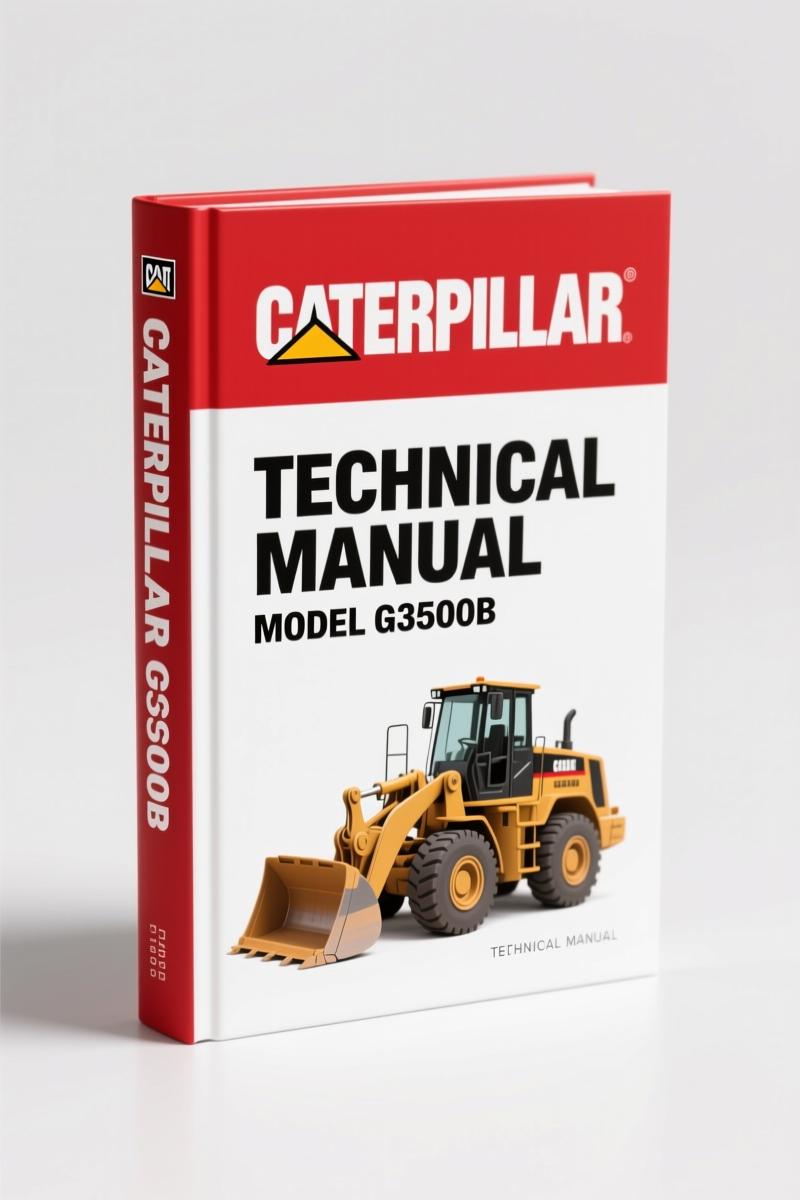
Caterpillar G3500B 2009 Repair Manual – 156 Pages OEM Disassembly & Assembly
Original price was: $72.60.$60.00Current price is: $60.00.
Caterpillar G3500B 2009 Repair Manual – 156 pages of OEM disassembly and assembly procedures for certified technicians.
Description
Caterpillar G3500B 2009 Repair Manual
I’ve seen a guy snap a head bolt on a G3500B because he used a generic torque chart. That mistake costs you a block and a week of downtime. This Caterpillar G3500B 2009 Repair Manual is the original factory print – 156 pages, published December 2009, part number KENR8147-01. No aftermarket guesswork. If you’re pulling a turbocharger or resealing an aftercooler on a JEF1-Up engine, you need the exact specs Caterpillar wrote.
Every page in this manual came from the same engineers who designed the engine. The disassembly and assembly procedures are laid out in the order you work – not alphabetically by part name. You’ll see sections like “Electronic Control Module – Remove and Install” (page 5), “Gas Pressure Regulator Solenoid – Remove and Install” (page 5), and all the way through to the engine oil pan reassembly. Page 26 gives you the torque for the fuel control actuator. Don’t look for those values in a third-party book – they belong here.
Disassembly and Assembly Procedures for the G3500B
The manual covers 41 separate procedures, each written for a specific component. You get “Air Starting Motor – Disassemble” then “Air Starting Motor – Assemble” then “Air Starting Motor – Install” – a logical flow that mirrors what you do on the floor. The water pump section alone has four sub-procedures: remove, disassemble, assemble, install. These aren’t generic steps. They include the tools you need and the safety locks required before you touch a fitting. For the accumulator, page 38 tells you exactly how to discharge the gas pressure before you separate the halves. Miss that step and you’re handling a spring-loaded bomb.
What Does the 2009 Repair Manual Cover?
It covers the entire engine from the electronic control module down to the oil pan. Specific chapters include: exhaust elbow and bypass valve removal/install, turbocharger removal and install, aftercooler removal and install, water temperature regulators, thermostatic valve, water pump and auxiliary water pump, prelubrication oil pump, engine oil pump, engine oil cooler, engine oil filter housing, engine oil and water pump drive, engine oil pan. Every procedure lists required torque values and special tool callouts. For the engine oil cooler, you get disassembly and assembly steps with seal replacement intervals. The 156 pages are dense with notes – not fluff.
156 Pages of Factory-Specified Repairs
That page count is important. A 50-page “manual” is a summary. This one has room to warn you about hazards. The first two pages are safety – the important safety information from Caterpillar that tells you to read all operation and maintenance info before you start. The safety alert symbol appears on every procedure page. You won’t find a single “Caution” missing. Page 2 states: “Improper operation, lubrication, maintenance or repair of this product can be dangerous and could result in injury or death.” That’s not a suggestion – it’s the standard. The manual also includes “NOTICE” labels for procedures that cause product damage if done wrong.
Torque values are sprinkled throughout the TOC. The fuel control valve (low pressure) on page 26, the throttle control valve on page 27 – each has its own spec. If you’re rebuilding the air starting motor, the disassembly runs from page 8 to page 15, then assembly from page 16 to page 23. That’s 16 pages of step-by-step with part orientation and gear mesh checks. Compare that to any aftermarket version that might combine them into two paragraphs.
Start with the Torque Values on Page 26
Page 26 is where the fuel control actuator lives. If you’ve ever had an actuator come loose at full load, you know why that torque matters. The manual specifies both the tightening sequence and the final torque in lb-ft (imperial – because we work in North America). For the exhaust manifold, pages 32-33 give you the removal and install with specific stud torque and the order to tighten – cross-pattern, not around the clock. That’s the difference between a sealing manifold and a warped flange. Check page 26 before you touch any fuel system component.
For the full operation theory that backs up these procedures, pair this manual with the Caterpillar G3500B Engine Systems Operation Manual. It explains how the gas pressure regulator solenoid interacts with the ECM – the repair manual just tells you how to remove and install it. If you run into a no-start condition, the Caterpillar G3500B Engines Troubleshooting Manual has the diagnostic flow charts. And for older 3500B variants, the Caterpillar 3500B 2002 Repair Manual – Factory Specs is still available.
Safety Alert: Important Information from Caterpillar
The manual opens with a full safety section – not just a paragraph, but a page explaining the hazard severity system (DANGER, WARNING, CAUTION). Caterpillar’s words: “Most accidents that involve product operation, maintenance and repair are caused by failure to observe basic safety rules or precautions.” This manual doesn’t assume you know how to lock out the engine before you work on the electric starting motor. It tells you to disconnect the battery and the ECM power supply. The gas pressure regulator section warns about residual fuel pressure – you vent it before you crack a line. That kind of detail is missing from reprints.
When you’re working on the air starting motor, you’ll encounter gear engagement specs that are specific to Caterpillar’s design. For understanding the basic mechanics of how a starter engages a flywheel ring gear, a reference like the Manual Transmission article on Wikipedia can give you background on gear tooth profiles – but don’t trust it for the Caterpillar clearances. Similarly, the engine oil pump drive train uses a gear mesh that shares principles with manual transmission gear sets; see the same Manual Transmission page for general gearing concepts, then come back to this manual for the actual specs.
Who Should Buy This Manual?
If you own a G3500B engine – in a landfill gas system, a generator set, or a pipeline compressor – you need this. Fleet mechanics, industrial maintenance crews, and serious DIY operators. Beginners: don’t start on a G3500B without reading the safety section and the first procedure. You’ll waste time and risk injury. Experienced techs will appreciate the exact removal sequences that prevent breaking brittle exhaust elbows. The manual is written for a technician who has tools and knows how to use them – it assumes you can read a torque wrench and interpret a wiring diagram.
Check page 26 for the fuel control actuator torque. Then access the manual and keep it on the tablet next to the engine stand.
- Does this manual include torque values for all fasteners?
- Yes, it covers fuel control actuator and valve removal/install (page 26).
- Is this the same manual Caterpillar dealers use?
- Yes, it’s the official OEM publication KENR8147-01 with the same content dealer technicians receive. The only difference is the format – digital PDF instead of a binder. All 156 pages, all safety warnings, all torque specs are identical.
- Can I use this manual for a G3500A engine?
- No, the G3500A has different fuel controls and a different ECM. This manual is specific to G3500B serial numbers JEF1-Up, JHH1-Up, RBK1-Up. Using it on a G3500A will give you wrong torque values and misaligned procedures.
- Does the manual cover the electronic control module removal?
- Yes. The ECM removal and installation is on page 5, including connector disconnection sequence and mounting bolt torque. The manual also warns about static damage to the control unit.
Access the Factory Manual to get the complete disassembly and assembly procedures for your G3500B. Keep it on your workbench – you’ll reference it on every rebuild.
Additional information
| Brand | Caterpillar |
|---|---|
| Language | English |
2 reviews for Caterpillar G3500B 2009 Repair Manual – 156 Pages OEM Disassembly & Assembly
You may also like…
-
Sale!

Caterpillar 14M, 16M 2007 Training Manual – OEM Service Training Guide
Original price was: $108.50.$70.00Current price is: $70.00. -
Sale!

Caterpillar 3500B 2000 Service Manual – MEUI Fuel System
Original price was: $93.00.$75.00Current price is: $75.00. -
Sale!

Caterpillar 3116, 3126, 3114 2010 Troubleshooting Manual – 89 Pages
Original price was: $107.10.$70.00Current price is: $70.00. -
Sale!

Caterpillar CP-563E CS-563E CS-573E CS-583E 2002 Service Manual
Original price was: $102.70.$65.00Current price is: $65.00.
Related products
-
Sale!

1993 Operators Manual – International Bus 1000-3000 OEM Specs
Original price was: $12.30.$7.99Current price is: $7.99. -
Sale!
1994 Troubleshooting Manual – International 1000-4000 FBC
Original price was: $60.00.$50.00Current price is: $50.00. -
Sale!
Acura NSX 1991 Service Manual – 1420 Pages OEM
Original price was: $102.05.$65.00Current price is: $65.00. -
Sale!

Technical Manual – International DT 530 & HT 530 (118 Pages)
Original price was: $37.00.$25.00Current price is: $25.00.
workshop_guy –
Perfect workshop guide. Quick access after payment. It assisted me to fix my Caterpillar G3500B transmission. Great value for money.
Robert M. –
Excellent quality! The text is searchable and easy to navigate. Contains detailed schematics for Caterpillar. I will recommend this shop to others.