
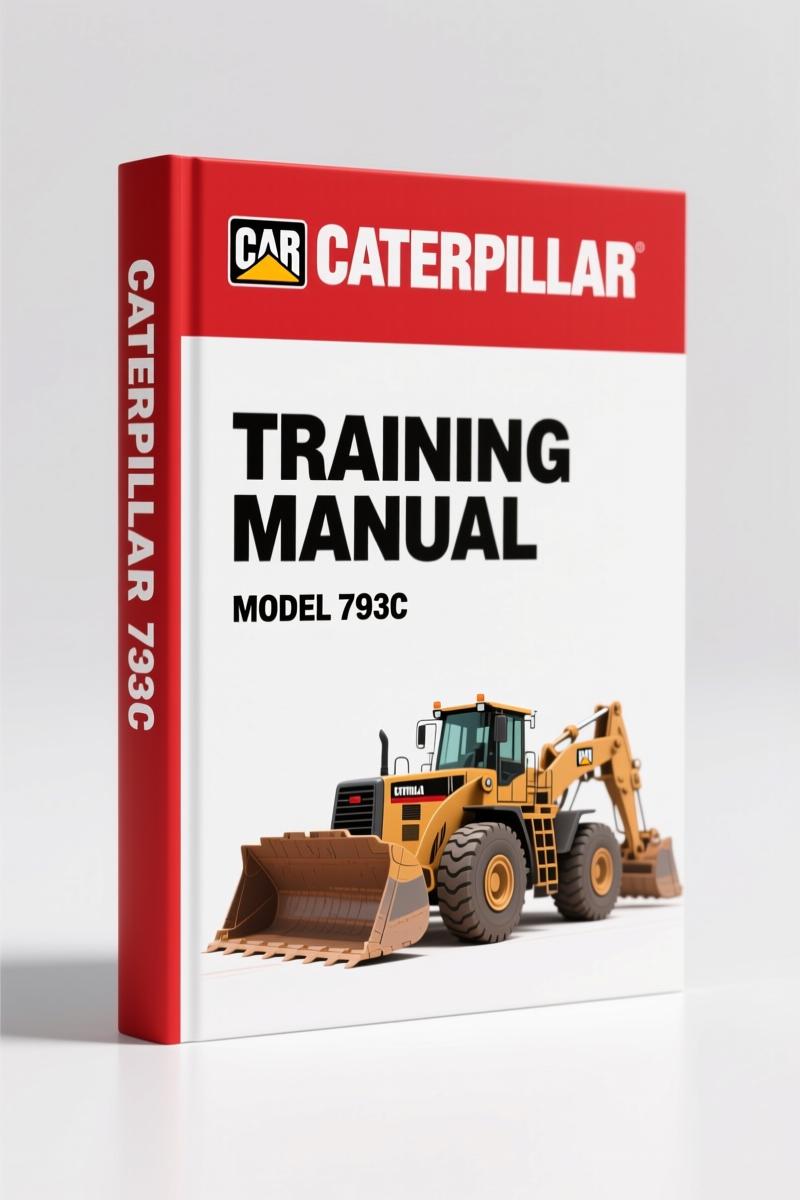
Caterpillar 750G, 793C 1997 Training Manual
Original price was: $55.65.$35.00Current price is: $35.00.
OEM Caterpillar 1997 training manual for 750G and 793C. 232 pages covering engine, powertrain, steering, hoist, brakes, ARC, TCS.
Description
Caterpillar 750G, 793C 1997 Training Manual – OEM Factory Documentation
You have a 793C off-highway truck in the bay with a power train complaint, and the aftermarket PDF you pulled says “refer to factory manual for torque values.” That’s useless. This Caterpillar 750G, 793C 1997 Training Manual is the real deal – 232 pages of factory training materials designed for Level II service personnel. Caterpillar built this to teach technicians how the engine, power train, steering, hoist, brakes, ARC, and TCS actually work before you start wrenching. I’ve seen too many guys skip the system fundamentals and end up chasing hydraulics for three days. This manual stops that.
7 Systems Covered – From Engine to Traction Control
Caterpillar starts with a walk-around inspection on page 11, then moves into the operator station on page 36. The engine section begins on page 49 and breaks down the cooling, lubrication, fuel, and air induction/exhaust systems. Cooling system covers the radiator, fan, and pump circuits. Lubrication shows the oil flow through the filter and cooler. Fuel system includes the transfer pump, injection lines, and return. If you need to trace air flow from the intake to the turbo and aftercooler, it’s on page 85. This is not a parts list – it’s a fluid-flow and circuit-level explanation.
Power Train – Hydraulics and EPTC II Control
Power train coverage starts on page 90, with component identification and then the hydraulic system on page 103. The Electronic Programmable Transmission Control (EPTC II) section on page 120 is critical for diagnosing shift issues. You’ll see how the torque converter and transmission clutch feeds work, and how the ECM modulates pressure. Understanding the Manual Transmission principles in this hydraulic context helps you separate mechanical noise from electronic misbehavior. The factory training manual includes flow diagrams and pressure tap locations – stuff aftermarket reprints leave out.
Steering and Hoist – Factory System Operation
Steering system starts on page 128. Covers the steering pump, metering section, and cylinders. Hoist system begins on page 157, showing the control valve, tank, and cylinder circuits. These sections explain the load-sense and priority valve logic. If you’re troubleshooting a slow hoist or dead steering, you need the oil flow path from the manual, not a generic hydraulic theory textbook.
Does This Manual Cover the ARC and TCS?
Yes – Automatic Retarder Control (ARC) on page 206 and Traction Control System (TCS) on page 211. These are often misunderstood by mechanics who treat them as add-ons. The training manual explains the ARC logic for downhill speed control and the TCS valve modulation for wheel slip. Without this, you’ll misdiagnose a TCS fault as a brake issue every time.
Who Needs This Manual – Real-World Use Case
You’re a shop owner, a mobile diesel tech, or a farm/construction fleet mechanic with a 793C or 750G in the fleet. You don’t need a sales pitch – you need to know that this 1997 Caterpillar training manual gives you the OEM system descriptions, the test procedures, and the component locations so you can walk up to the machine with a plan. One example: the air charging system for the brakes begins on page 182. If you have a low air pressure complaint, you trace the compressor, governor, and dryer circuits right out of this manual. No guessing which unloader valve is causing the drop.
OEM vs Aftermarket – Why Factory Training Matters
Caterpillar printed this training manual in March 1997 under part number SESV1682. It’s not a scanned aftermarket copy with faded torque specs and missing pages. Every diagram, every fluid flow arrow, every reference to the service manual (SENR1440) or VIMS service manual (SENR6059) is intact. The serviceman handouts start on page 224, giving you data sheets for on-machine practice. Aftermarket “workshop manuals” often skip the training angle – they dump steps without explaining why the EPTC II behaves a certain way. That leads to swapped good parts. This manual fixes that.
Get the Right Torque Specs and Safety Warnings
While this is a training manual (not the service manual itself), it includes critical torque values and tightening sequences for major components. For example, the engine cylinder head torque sequence is referenced in the system operation. The power train hydraulic pressure checks are specified. You still need the full service manual for every fastener, but this training manual gives you the context to use those numbers correctly. Safety warnings are peppered throughout – Caterpillar requires pressure release procedures before opening any hydraulic line.
- Does this manual include step-by-step repair procedures?
- No – it’s a training manual that teaches system operation, component identification, and oil/air flow tracing. You use it to understand the system before diving into the service manual for repairs. For actual removal/replacement steps, get the 793C service manual SENR1440.
- What machines are covered in this 1997 manual?
- Caterpillar 750G (crawler dozer) and 793C off-highway truck. The content focuses on the 793C systems but includes cross-references to the 750G where applicable.
- Can a beginner use this manual?
- It’s designed for Level II service personnel – people who already know basic hydraulics and electrical. A beginner would need the prerequisites listed in the manual (fundamentals of mobile hydraulics and electrical systems).
- How does this compare to aftermarket training guides?
- Aftermarket guides often paraphrase or omit the EPTC II logic, ARC/TCS details, and the specific oil flow paths. This is the original Caterpillar document – the same one used in factory training classes. You get the real flow schematics and the serviceman handouts. No third-party interpretation.
You want to be the mechanic who understands why the ARC engages or why the EPTC II holds a gear, not the one who swaps parts hoping for a fix. Access the Factory Manual now, and get the OEM training that Caterpillar intended for their service teams.
- Caterpillar 793C 793B Training Manual – Hydraulic System Diagnostics”>Caterpillar 793C 793B Training Manual – Hydraulic System Diagnostics
- Caterpillar 793C 2009 Service Manual – OEM Factory Specs”>Caterpillar 793C 2009 Service Manual – OEM Factory Specs
- Caterpillar 793C Technical Manual – Factory Power Train Specs”>Caterpillar 793C Technical Manual – Factory Power Train Specs
External reference: Manual Transmission”>Manual Transmission.
Additional information
| Brand | Caterpillar |
|---|---|
| Language | English |
2 reviews for Caterpillar 750G, 793C 1997 Training Manual
You may also like…
-
Sale!

Caterpillar 3500B 2000 Service Manual – MEUI Fuel System
Original price was: $93.00.$75.00Current price is: $75.00. -
Sale!

Caterpillar 3116, 3126, 3114 2010 Troubleshooting Manual – 89 Pages
Original price was: $107.10.$70.00Current price is: $70.00. -
Sale!

Caterpillar 14M, 16M 2007 Training Manual – OEM Service Training Guide
Original price was: $108.50.$70.00Current price is: $70.00. -
Sale!

Caterpillar CP-563E CS-563E CS-573E CS-583E 2002 Service Manual
Original price was: $102.70.$65.00Current price is: $65.00.
Related products
-
Sale!
2004 Acura TSX Wiring Diagram – 73-Page Factory Electrical Schematics
Original price was: $15.88.$9.99Current price is: $9.99. -
Sale!

Service Manual – International HS 2.8L Engine – 130 Pages of Factory Specs
Original price was: $56.40.$40.00Current price is: $40.00. -
Sale!

1996 Operators Manual – International 1000-4000 Series (246 pages)
Original price was: $15.28.$9.99Current price is: $9.99. -
Sale!
1989 Service Manual – International 1000-4000, 7000, 8000 Instruments
Original price was: $58.80.$40.00Current price is: $40.00.
James L. –
Great factory service manual. The file quality is excellent. It guided me to troubleshoot my Caterpillar 750G, engine. Highly recommended for mechanics.
David K. –
I am extremely satisfied with this transaction. The pages are clean and easy to navigate. It guided me to troubleshoot my Caterpillar 750G, transmission. Saved my weekend project! Thanks.