
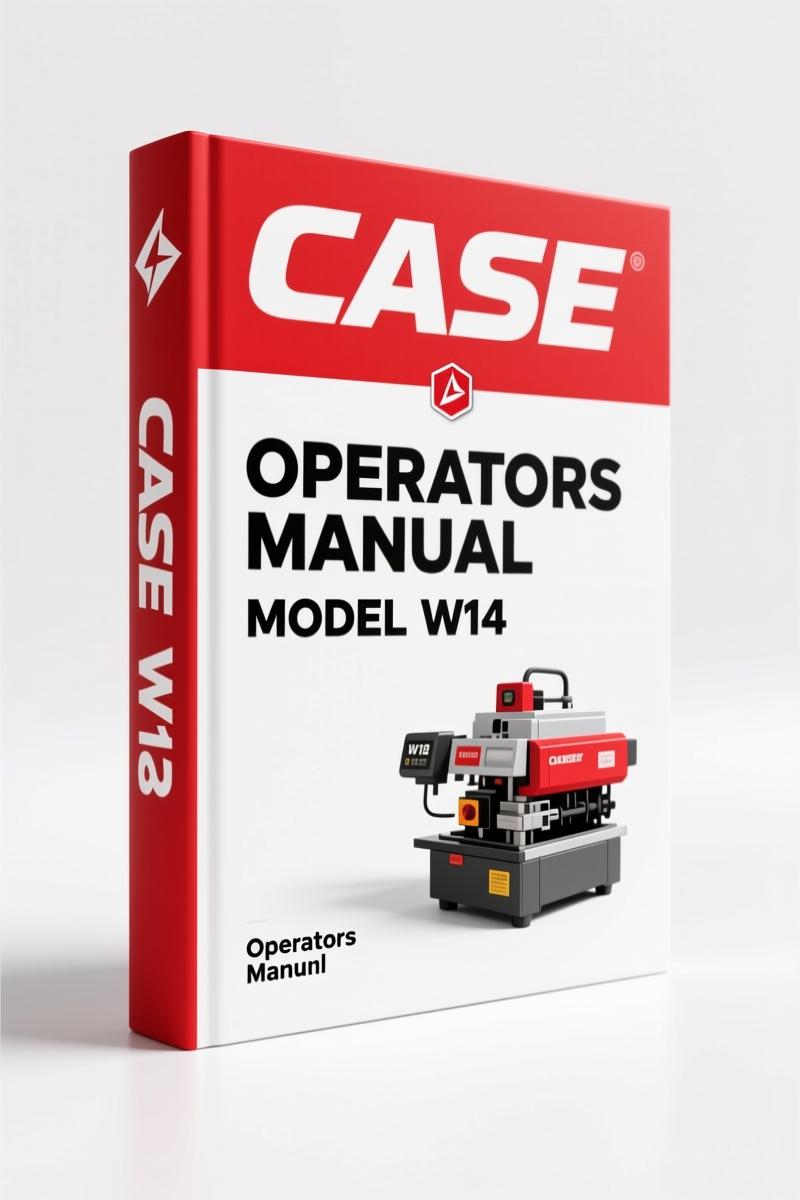
Case W14 1975 Operators Manual – Factory Specs for Articulated Loader
Original price was: $14.89.$9.99Current price is: $9.99.
Factory operators manual for Case W14 1975 articulated loader. 104 pages of safety, operation, and maintenance procedures.
Description
Case W14 1975 Operators Manual – Factory Specs for the Articulated Loader
You’re staring at a Case W14 loader that’s been sitting for years. No manual, no idea if the fuel is bad or the brakes are gone. You need the factory book – the Case W14 1975 Operators Manual. This is it. 104 pages of what Case printed in October 1975 for serial numbers 9119395 to 9119672. Not a reprint from some aftermarket house that copied until the ink blurred. Original OEM document.
Every operator, whether you run a six-bay shop or own one loader in your gravel pit, knows the difference between guessing and having the factory procedure. This manual kills the guesswork. The first time you fire up that old Case after years of sitting, you want the starting procedure right – see page 32. You want the fuel specs from the Fuel and Lubricants section on page 45, not a generic diesel recommendation. That section lists ASTM grade, cetane number, and storage requirements. Skip that and you’ll be bleeding the system twice.
Safety Rules – Page 2 Is Non-Negotiable
Section opens with the Safety Alert Symbol. Page 2 spells out exactly what that triangle means. Roll-over protection structure (ROPS) is covered on page 11, spark arresting muffler on page 10. If you’re operating in California or any fire-prone area, you need that spark arrestor verified. The manual doesn’t tell you to “be careful” – it tells you which thread locker to use on the muffler bracket bolts. That’s the difference between factory and fluff.
Specifications – What the Machine Can Handle
Turn to page 15 for the full spec table. Engine power, bucket capacity, operating weight, tire pressure – all in Imperial units as printed in 1975. Need the charge pressure for the transmission/converter hydraulic system? Page 82. But start with the basics on page 15: fuel tank capacity, cooling system volume, hydraulic oil type. If you’re putting in a replacement engine or swapping axles, those numbers keep you from overfilling or under-spec’ing components. I’ve seen guys put 10W-30 in a Case diesel because the generic chart said so. Factory says SAE 30 or 10W depending on ambient temp – page 48.
Operating Instructions – Controls and Loader Operation
From page 20 onward, the manual walks through the instrument cluster (left and right), operator’s compartment, and loader controls. The Return-To-Dig operation on page 44 is a time-saver if the machine has that option – the manual explains the mechanical linkage adjustment, not just how to flip a switch. Cold weather operation (page 38) and hot weather operation (page 39) each have specific starting aid procedures. Jump starting? Page 36 – and it includes the battery cable sequence that won’t fry the alternator. If you’ve got a later model, say the 1980 version, grab the Case W14 Loader 1980 Service Manual for the updated electrical system. But for the 1975 serial range, this operators manual has the right wiring notes.
Fuels and Lubricants – Fuel Specs and Storage
Page 45 gets into diesel fuel specifications – ASTM, sulfur content, water and sediment limits. Then lubricants on page 47: U-joints, articulation pivot points, bucket pins. The chart on page 48 lists every fluid and lubricant with Case part numbers or equivalent standards. This section alone saves you from buying the wrong hydraulic oil. The manual also covers fuel storage – don’t let water settle in the tank, and it tells you why. That’s not in a generic manual. For a deeper dive into transmission specifics, refer to the Manual Transmission chapter in a general service guide – but the operators manual gives you the lubricant grade and change intervals for the W14’s transmission/converter system.
Maintenance/Lubrication – Scheduled Maintenance Chart
Page 49 introduces the safety link. Then the run-in maintenance chart on page 50 – first 50 hours, then 100, then 200. Scheduled maintenance chart follows: daily, weekly, monthly, 500-hour. Lubrication points are diagrammed starting page 52. Engine lubrication (page 54) covers oil level and filter change. Air cleaning system (page 56) – restriction indicator, safety filter, servicing steps. Cooling system (page 61) – radiator cap pressure, coolant type, thermostat replacement. Drive belts (page 65). Fuel system bleeding procedure on page 69. Electrical system (page 71) – battery specific gravity check on page 75. Hydraulic system oil and filter change on page 77. Braking system: air compressor, reservoir, master cylinders, alcohol evaporator – all on pages 79-81. Transmission/converter hydraulic system oil level and change on pages 82-83. Axles and wheels on pages 86-88. Bucket teeth replacement page 90. Machine storage and reactivation pages 90-92. That’s everything you need to keep the loader running without a trip to the dealer.
After Delivery Checkup – 200-Hour Inspection
Back of the manual contains three copies of the after delivery checkup form. The dealer does this inspection after the first 200 hours – filters, oils, accessories. The manual explains that the charge is only for consumables, not labor. This is factory procedure – not an afterthought. If you’re buying a used W14, that form tells you what was checked. Also, for the later W14 models like the 1981, check the Case W14 1981 Service Manual for changes in the hydraulic system. And if you need the 1995 version for a newer machine, the CASE W14 Articulated Loader 1995 Operators Manual covers that generation. But for a 1975, this is the one.
Finally, a word about aftermarket documentation: I don’t trust it. Had a guy bring in a transmission he rebuilt using a third-party manual – torque specs were off by 20 ft-lbs on the valve body bolts, and the pump alignment procedure was wrong. The factory manual – this one – lists every torque value for the W14’s drivetrain from the original Case engineering. The Manual Transmission section in a generic book might give you a range; Case gives you a number. That’s the difference between a job that lasts and a return customer.
Frequently Asked Questions
- Is this manual for the W14 with a specific serial number range?
- Yes, serial numbers 9119395 to 9119672.
- What if my machine has a different serial number?
- If your serial number falls outside that range, some procedures and spec tables may not match exactly – especially after the 1975 model year changes. Case updated the articulated loader in 1976 and again in 1980. You can still use this manual for general operation and maintenance principles, but for precise torque values and fluid capacities, you need the manual that matches your specific serial number. Check with your Case dealer or cross-reference the engine and axle serial numbers. If you’re starting a full overhaul, it’s better to get the correct manual for your machine to avoid pulling a valve body with the wrong bolt pattern.
Access the Factory Manual. 104 pages, original OEM content, no aftermarket reinterpretation. Get the Case W14 Operators Manual for your 1975 articulated loader and have the factory data on your bench where it belongs.
Additional information
| Brand | Case |
|---|---|
| Language | English |
2 reviews for Case W14 1975 Operators Manual – Factory Specs for Articulated Loader
You may also like…
-
Sale!
Case 26, 26B, 26S 1975 Parts Catalog – Factory Exploded-View Parts Identification
Original price was: $114.00.$75.00Current price is: $75.00. -
Sale!
Case 2500 Service Manual – OEM Factory Specs for Cruz-Crane
Original price was: $97.30.$70.00Current price is: $70.00. -
Sale!
Case 34, 680 CK 1967 Parts Catalog – OEM Factory Parts
Original price was: $107.25.$75.00Current price is: $75.00. -
Sale!
Case 50 Crawler Series D Service Manual – Factory Specs & Electrical
Original price was: $98.00.$70.00Current price is: $70.00.
Related products
-
Sale!

1992 Electrical Schematic – International 1000/3000/4000/2554 OEM Wiring Diagrams (132 Pages)
Original price was: $26.40.$20.00Current price is: $20.00. -
Sale!
2004 Acura TSX Wiring Diagram – 73-Page Factory Electrical Schematics
Original price was: $15.88.$9.99Current price is: $9.99. -
Sale!

1989 Service Manual – International 2000-8000 Electrical Systems
Original price was: $72.00.$50.00Current price is: $50.00. -
Sale!

Technical Manual – International 6.0L Power Stroke FICM Diagnostics
Original price was: $29.80.$20.00Current price is: $20.00.
John S. –
I am so happy with this purchase. The PDF is high resolution. It guided me to rebuild my Case W14 transmission. Saved my weekend project! Thanks.
Charles W. –
I am extremely satisfied with this manual. Immediate link after checkout. Every wiring layout is provided for Case W14. I will definitely buy again.