
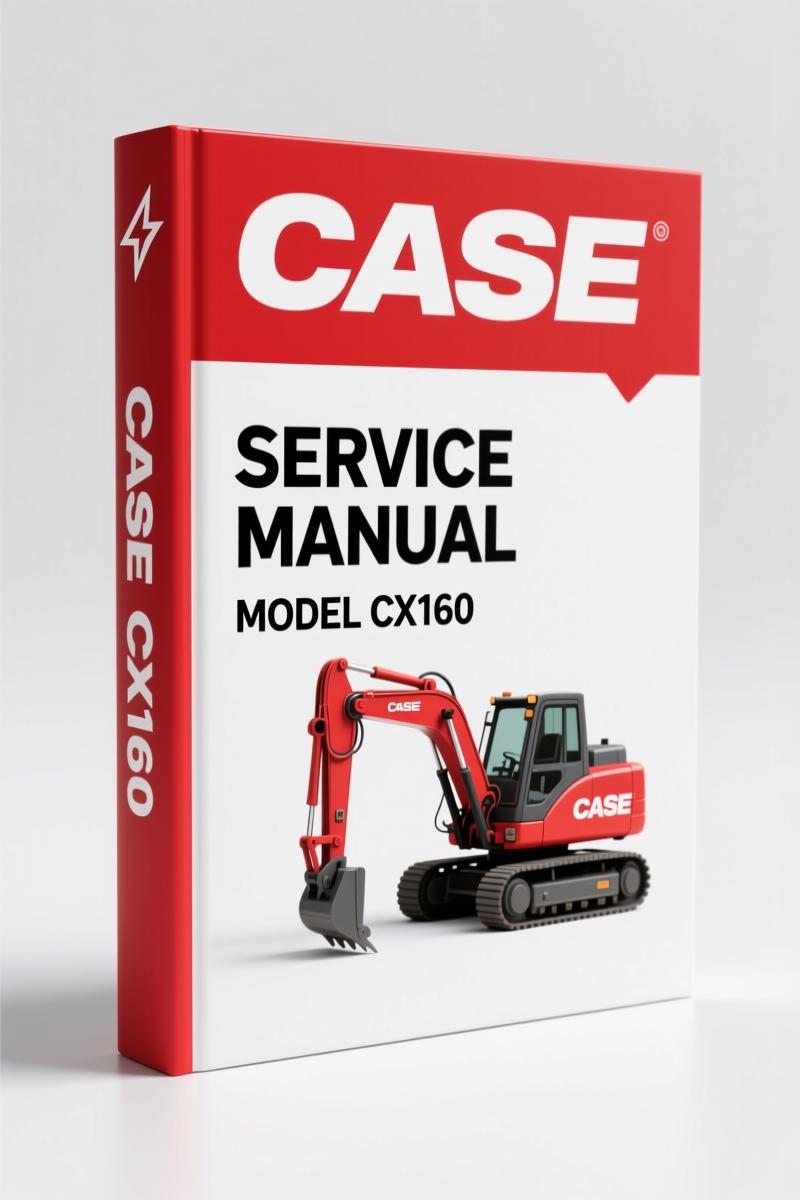
Case CX160 Service Manual – Factory Repair Specs for Excavator Technicians
Original price was: $88.40.$65.00Current price is: $65.00.
634-page OEM service manual for Case CX160 excavator. Includes torque data, electrical diagnostics, hydraulic system procedures, drive train specs, and emissions compliance.
Description
Case CX160 Service Manual – Factory Specs for the Crawler Excavator
If you’ve ever pulled a head bolt off a CX160 without the right torque wrench in hand, you already know what a stripped thread costs. I’ve been turning wrenches in San Antonio for twenty-eight years, and the first thing I tell any tech who touches a Case CX160 is: get the factory manual. Not a reprint. Not a third-party PDF that guessed the spec. The real OEM document. This one from Case runs 634 pages, covers the CX160 crawler excavator from the engine block to the final drive, and includes the exact torque values and hydraulic pressures that Case engineers wrote into the build. You want to avoid a come-back or a blown seal? You start here.
Engine Removal and Reassembly – Section 2000
The manual opens with Section 2000: Removal and installation of the engine. If you’re swapping a powerplant on a CX160, you need the lifting points, the bolt sequence for the engine mounts, and the cooling system drain procedure. Page 26 in that section gives the torque values for the flywheel housing bolts – 85 ft-lbs, and don’t guess the order. The manual calls out a star pattern. I’ve seen DIY guys skip the step where you disconnect the fuel lines before dropping the engine and then wonder why they have air in the system. Read that section once with a highlighter, and you’ll save yourself a Saturday.
Hydraulic Pressure Settings – Section 8001
Hydraulics are where most home-garage guys get into trouble on a CX160. Section 8001: Specifications, troubleshooting, checks and hydraulic pressure settings. Need the main relief pressure? It’s listed in the chart on that page. The manual shows you how to depressurize the system before you crack a line – Section 8000 covers that procedure with the vacuum pump method. If you skip depressurization, you’re looking at a face full of hot oil. Case engineers wrote this manual for technicians who value their skin. Follow the step order. No shortcuts.
3 Reasons This OEM Manual Beats Aftermarket Copies
First, the wiring diagrams in the electrical section (Section 4001) are factory-original. I’ve seen aftermarket drawings that swap pin numbers and leave you chasing a ghost ground for three hours. Second, the torque data for the idler wheel and tension shock absorber in Section 5005 is cross-referenced to Case part numbers. Third, the manual includes the safety section (Section 1001) with standard torque data for all fasteners. Third-party manuals cut that out to save ink. That’s how bolts snap.
If you’re working on a CX160, you’ll also want to check the Case CX160, CX210, CX240, CX130 2001 Training Manual – OEM Specs for additional training-level detail on the hydraulic system. For operator-level information, the Case CX160, CX130 Operators Manual – OEM Factory Document covers daily inspection and fluid capacities. And if you’re moving up to the B-series machines, the Case CX210B, CX230B, CX240B 2009 Service Manual – OEM Factory Specs uses the same engineering format.
Does This Manual Cover the Undercarriage?
Yes. Section 5 covers removal and installation of tracks (5001), rollers (5003), sprocket (5004), and the idler wheel with tension shock absorber (5005). Each subsection has a parts breakdown and the correct tightening sequence. If you’re replacing a sprocket on a CX160, you want the bolt torque from the manual – not the guess from a forum. The tension shock absorber on the idler requires a specific preload. Page numbers for those specs: Section 5005, around page 14 in that PDF. Don’t trust a memory – check the book.
For reference on general transmission theory, the Manual Transmission article can help you understand the gear reduction principles inside the final drive. The drive motor and final drive transmission removal and installation is Section 6001. The disassembly and assembly follows in 6002. Same principle – factory steps only.
Electrical troubleshooting on the CX160 (Section 4001) is where most DIY guys lose their patience. The manual walks you through the main and engine electronic control boxes (Section 4003). Battery inspection and booster connection is in 4002. If you’re diagnosing a no-crank condition, start at Section 4001 and follow the logic tree. Don’t jump to replacing parts.
Fuel System and Engine Specs
Section 3 covers the fuel tank (3001) and the fuel engine system. The engine specifications are in Section 2 along with disassembly and assembly procedures. If you’re rebuilding the pump or injectors, you’ll need the fuel pressure values from the manual – not a generic diesel spec. Case uses a specific setting on the CX160. I’ve seen a shop rebuild a fuel system with aftermarket data and then have to redo it because the delivery pressure was off by 10 psi. The manual gets it right.
Standard torque data is in Section 1001. Special torque settings in Section 1002. Page 73 for the general specifications table. Use it. Every single time.
FAQ – Case CX160 Service Manual
- Is this manual the same as the one Case dealers use?
- Yes. This is the OEM factory manual. Same part number, same specs, same procedures the Case dealer techs follow.
- Does it include wiring diagrams?
- Yes. Section 4001 covers electrical system troubleshooting with full wiring diagrams, connector pinouts, and component locations. No generic schematics – Case factory drawings.
- What about hydraulic pressure specs – are they in imperial units?
- Yes. All pressure values are given in psi. For example, the main relief pressure for the CX160 is listed in Section 8001. The manual also includes the conversion chart in the general information section if you need bar values.
- Can I use this manual if I have zero experience with excavators?
- You can, but start with the safety section (1001) and read the depressurization procedure (8000) before you touch any hydraulic line. The manual is written for experienced technicians, but the steps are clear and the illustrations show component locations. Take it slow, follow the sequence, and don’t skip the torque values. I’d also recommend the operator’s manual for daily checks before diving into the service manual.
If you own a CX160 and plan to keep it running without paying dealer labor rates, this manual pays for itself the first time you avoid a stripped thread or a misdiagnosed electrical fault. Access the Factory Manual and keep a physical copy on the bench next to your torque wrench. That’s how real repairs get done.
Additional information
| Brand | Case |
|---|---|
| Language | English |
4 reviews for Case CX160 Service Manual – Factory Repair Specs for Excavator Technicians
You may also like…
-
Sale!
Case 34, 680 CK 1967 Parts Catalog – OEM Factory Parts
Original price was: $107.25.$75.00Current price is: $75.00. -
Sale!
Case 2500 Service Manual – OEM Factory Specs for Cruz-Crane
Original price was: $97.30.$70.00Current price is: $70.00. -
Sale!
Case 50 Crawler Series D Service Manual – Factory Specs & Electrical
Original price was: $98.00.$70.00Current price is: $70.00. -
Sale!
Case 26, 26B, 26S 1975 Parts Catalog – Factory Exploded-View Parts Identification
Original price was: $114.00.$75.00Current price is: $75.00.
Related products
-
Sale!

1996 Operators Manual – International 1000-4000 Series (246 pages)
Original price was: $15.28.$9.99Current price is: $9.99. -
Sale!
1992 Electrical Schematic – OEM Wiring Diagrams for International 1000-3800
Original price was: $24.48.$18.00Current price is: $18.00. -
Sale!

2005 Parts Catalog – International NGD 3.0 L Engine (77 pages)
Original price was: $44.70.$30.00Current price is: $30.00. -
Sale!

Service Manual – International HS 2.8L Engine – 130 Pages of Factory Specs
Original price was: $56.40.$40.00Current price is: $40.00.
William H. –
This is exactly what I required. The scan is high-quality and easy to navigate. It assisted me to fix my Case CX160 transmission. Worth every penny.
John S. –
Excellent quality! The file looks clean. It helped me to rebuild my Case CX160 transmission. Saves me so much money.
Robert M. –
Perfect OEM spec sheet. The pages are clean and well indexed. A must-have for any Case CX160 mechanic doing repairs. Worth every penny.
pro_mechanic –
I am extremely satisfied with this transaction. Immediate link after checkout. It assisted me to fix my Case CX160 engine. Saves me hundreds of time.