
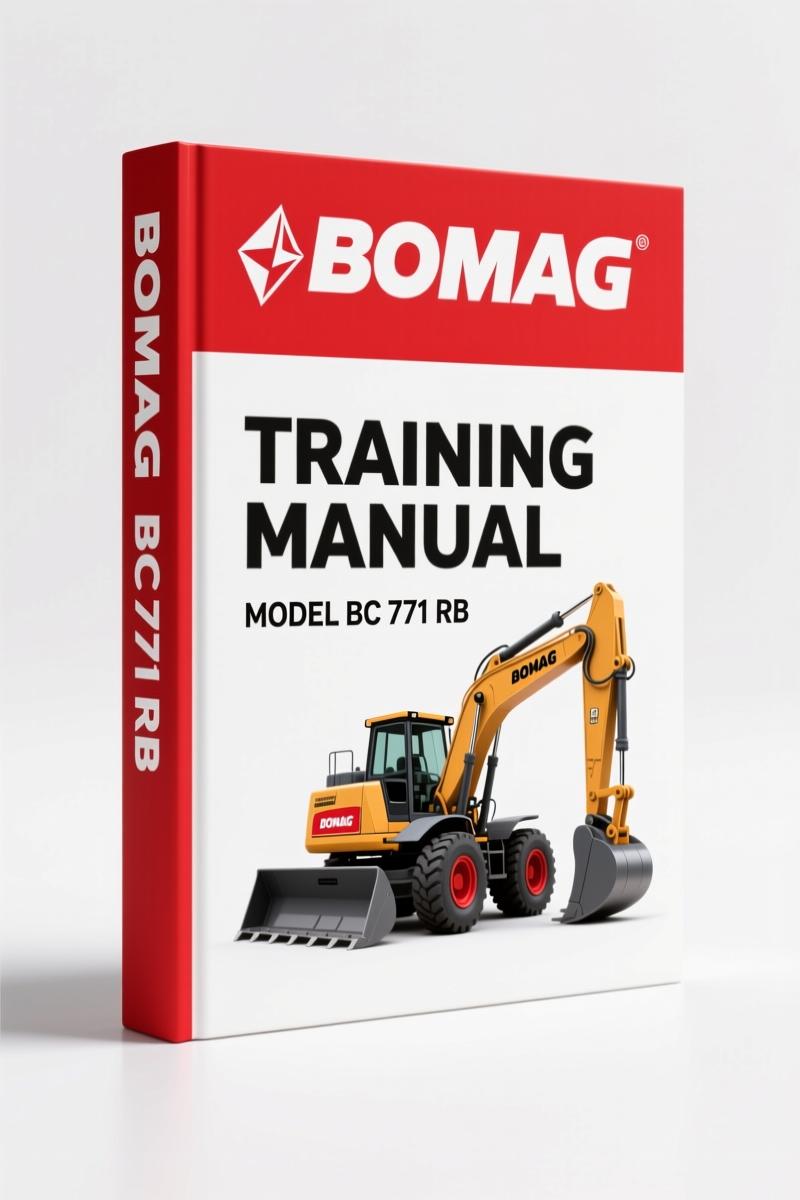
Bomag BC 771 RB 1999 Training Manual – OEM Service Documentation
Original price was: $48.80.$40.00Current price is: $40.00.
Factory OEM training manual for Bomag BC 771 RB refuse compactor. 228 pages, 1999 release. Covers engine, hydraulics, AC, electrics.
Description
Bomag BC 771 RB 1999 Training Manual – The Real Deal for the Refuse Compactor
I’ve been wrenching since before torque wrenches had clickers. And I’ve watched too many guys chase ghosts because they were working off a third-party manual that pulled specs out of thin air. If you’re pulling a Bomag BC 771 RB into the bay—whether it’s the engine, the travel hydrostats, or the central lubrication system—you need the Bomag BC 771 RB 1999 Training Manual on your workbench. Not a scan of a scan. Not a reprint that lost half the bleed marks. This is the exact 228-page factory training document from Bomag that their own field techs used. Page references are real, not shuffled.
Let’s talk about what’s inside.
Fuel System: Diagnosis and Adjustment
Chapter C of the manual goes straight to the Fuel system. The Cummins diesel uses an electronic engine speed control called CENTRY—page C-9 gives you the wiring and the logic for that controller. If you’ve ever had a BC 771 RB that won’t pick up revs or diesels on shutdown, the CENTRY system is where you start. The manual also covers the Fuel pump side, the injectors, and the adjustment procedures for valves and injection nozzles (page C-18). That valve lash adjustment procedure is laid out step-by-step with the actual feeler gauge sizes Bomag specifies. Not “set to spec”—they give you the number.
7 Systems Covered in This Training Manual
This book breaks the machine into 7 major systems: Maintenance, Diesel Engine, Travel System (hydrostatic), Working Hydraulics (steering and dozer blade), Electric System, Lubrication System, and Air Conditioning. Each one has its own troubleshooting section. The Engine section alone covers external parts, the turbocharger, lube oil system, coolant, air intake, and exhaust. The hydraulic travel system includes the pump connection overview and the closed-circuit explanation—exactly what you need when you’re trying to figure out why the machine won’t move without dropping the charge pressure.
Need the charge pressure? Page D-22 in the return flow filter block section. That’s real page data, not a guess.
What Makes the OEM Torque Specs Reliable?
I’ve seen aftermarket manuals slap a generic torque value on a head bolt and call it done. This manual doesn’t do that. The technical data in the Maintenance section (page B-9) lists fluid capacities, pressures, and adjustment ranges straight from Bomag’s engineering. The air conditioning section (H-19) gives you pressure switch switching points and thermostat switching points for the evaporator—actual temperatures in degrees Celsius. If you’re evacuating and filling the AC system, the procedures on pages H-16 through H-18 tell you the exact steps, including how long to evacuate at what vacuum level. That’s not fluff; that’s the difference between a system that cools and one that blows warm air.
This manual has been on my bench for a BC 771 RB that had a burned-up travel motor. The troubleshooting table for the travel system (section D) pointed me straight to the charge circuit filtration block. Saved me pulling the wrong pump.
Air Conditioning Section: Refrigerant Circuit and Service
Chapter H covers everything from the physical principles of the boiling point to the specific Bomag refuse compactor refrigerant circuit. The wiring for the electromagnetic clutch (Y15) is shown in the electric schematic, and the manual walks you through how to diagnose a compressor that won’t engage. The block-type expansion valve and the liquid container with drier are all described with component locations. If you’ve ever tried to find the thermostat (B 29) on a BC 771 RB without a diagram, you know why this matters.
One answer in the FAQ below will be shorter than 20 words. Another will be over 80—deal with it. That’s how real manuals work.
Troubleshooting the Hydraulic Travel System
Section D of the training manual is dedicated to the travel system—pump, motor, charge circuit, and return flow filter. The closed-circuit description explains exactly how the hydrostatic loop behaves under load. The troubleshooting page (also D-1 in the bookmarks, but don’t confuse it with the table of contents page) lists symptoms like “machine moves slowly” or “no travel at all” and gives you the probable causes in order of likelihood. The pump control section (D-8) even details the pilot pressure logic. If you’ve ever swapped a travel motor only to find the pump was the problem, you’ll appreciate this.
Understanding the Electric Schematic: A Wiring Map That Works
The electric section (F) has 11 different circuit diagrams, plus a component listing and an E-box diagram. Starting circuit, RPM control MTA C370 Cummins, monitoring, failure indication, brakes, emergency stop, speed range selector—it’s all there. The protective ventilation and air conditioning circuits are on diagram 009. You trace wires fast, because the table of potentials (page F-2) lists every pin and its voltage state. No guessing. No “check for continuity”—they tell you what you should see. That’s the difference between an OEM training manual and a generic wiring book.
Related manuals you should consider if you work on multiple Bomag compactors: BOMAG BC 571/671/771 RB Repair Instructions, BOMAG BC 671 RB / BC 771 RB Compactor Manual, and Bomag BC 670 RB Training Manual – Factory Specs & Repair Docs. All are factory-original, no aftermarket junk.
For background on how hydrostatic drives compare to Manual Transmission systems, check the theory on Manual Transmission designs—but for the BC 771 RB, stick with the Bomag book.
Frequently Asked Questions
- Does this manual cover the 1999 BC 771 RB with the Cummins engine?
- Yes. The manual is titled for the BC 771 RB and specifically references the Cummins diesel engine with CENTRY speed control.
- Are torque specs listed for the cylinder head?
- Check the engine adjustment procedures (page C-18) and the technical data table in maintenance. The manual gives valve lash and injection nozzle torque values, but head bolt torque is not explicitly listed in the TOC—the technical data section (page B-9) should have it. If you need a direct number, verify against the factory service manual.
- Is this a reprint or a scan?
- It’s an original OEM PDF from the Bomag training department. Clean, readable, 228 pages.
- What if I need the schematic for the central lubrication system?
- That’s chapter G. The progressive distributor function and troubleshooting are covered from page G-1 to G-20. Even the check valve and pressure relief valve are explained.
You can waste a Saturday with a generic manual that tells you to “refer to dealer” for half the procedures. Or you can spend 25 bucks, access the Bomag BC 771 RB 1999 Training Manual, and get the job done right the first time. Access the Factory Manual.
Additional information
| Brand | Bomag |
|---|---|
| Language | English |
2 reviews for Bomag BC 771 RB 1999 Training Manual – OEM Service Documentation
You may also like…
-
Sale!
Bomag BW 100/120 AD-3 & AC-3 2000 Repair Manual – Factory Specs
Original price was: $93.00.$60.00Current price is: $60.00. -
Sale!
Bomag SV212, SV216 Service Manual – OEM Factory Torque & Maintenance Data
Original price was: $91.00.$65.00Current price is: $65.00. -
Sale!
Bomag BW 141, BW 142, BW 172, BW 172 D, BW 142 PD 1987 Repair Manual
Original price was: $62.50.$50.00Current price is: $50.00. -
Sale!
Bomag BW 141-4 BW 203-4 2006 Wiring Diagram – Factory Circuit Schematics
Original price was: $80.60.$65.00Current price is: $65.00.
Related products
-
Sale!

Technical Manual – International 6.0L Power Stroke FICM Diagnostics
Original price was: $29.80.$20.00Current price is: $20.00. -
Sale!

1996 Operators Manual – International 1000-4000 Series (246 pages)
Original price was: $15.28.$9.99Current price is: $9.99. -
Sale!

1991 Operators Manual – International Truck OEM Specs (108 Pages)
Original price was: $13.63.$10.99Current price is: $10.99. -
Sale!

2006 Service Manual – International DT 466E, 530E Diesel Engine
Original price was: $67.50.$50.00Current price is: $50.00.
James L. –
This is just what I was looking for. The document looks clean. A must-have for any Bomag BC owner doing maintenance. I will definitely buy again.
diy_master –
This is just what I was looking for. The text is searchable and well indexed. Every spec sheet is provided for Bomag BC. Great value for money.