
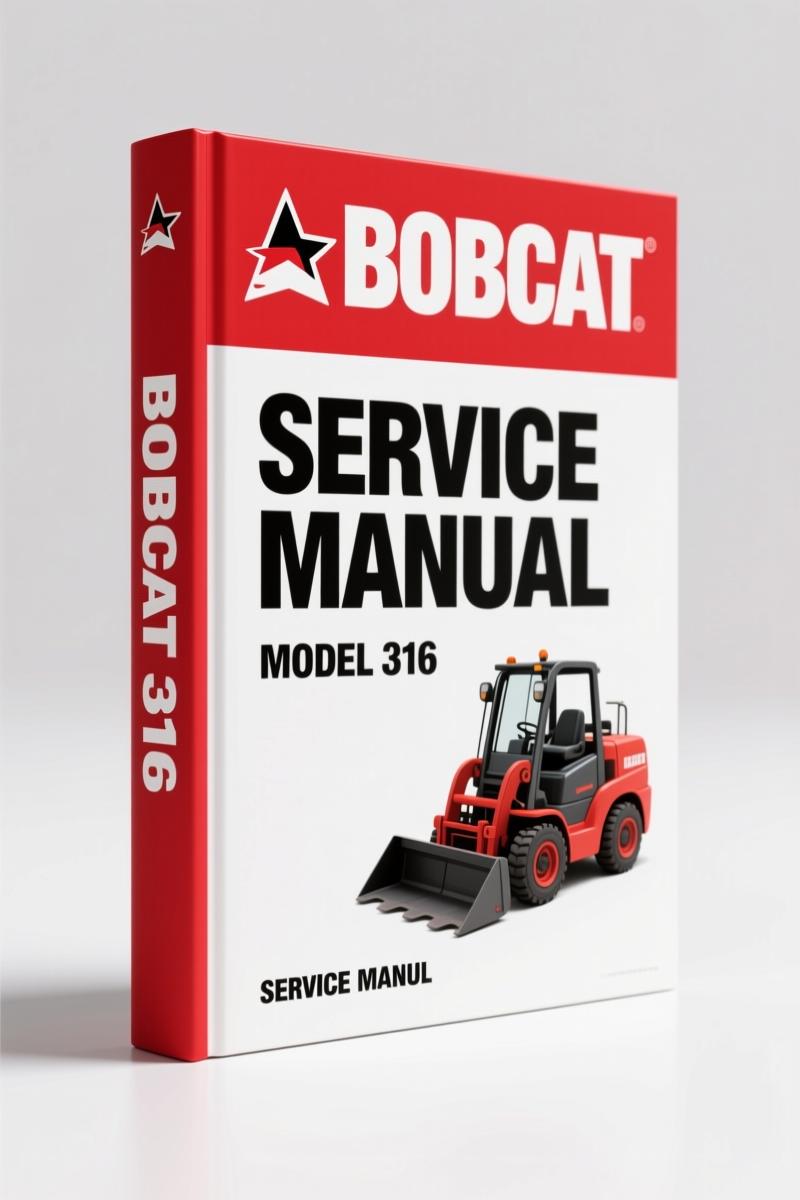
Bobcat 316 2006 Service Manual – Factory Specs for Excavator
Original price was: $109.60.$80.00Current price is: $80.00.
Official Bobcat 316 Service Manual: 481 pages of factory torque specs, hydraulic system procedures, and preventive maintenance chart.
Description
Bobcat 316 2006 Service Manual – What You Get with Factory Documentation
If you’ve ever torn down a hydraulic cylinder using a generic online guide and ended up with a seal that leaked because the spec was off by 5 ft-lbs, you know what this manual saves you from. The Bobcat 316 2006 Service Manual is the OEM document, 481 pages thick, printed by Bobcat Company in 2006 for dealers only. It covers serial numbers 522811001 and above, 522911001 and above. This is not a reprint or a third-party compilation—it’s the actual binder that a tech at a Bobcat dealer would pull off the shelf. If you’re rebuilding a 316 excavator and want the engine, hydraulic, and undercarriage specs to be right the first time, this is the only source you should trust.
What Makes This 481-Page Factory Manual Different?
Aftermarket manuals often skip safety procedures and cut corners on torque values. This one starts with a full section on MAINTENANCE SAFETY—fire prevention, lifting procedures, exhaust fume warnings. Page 3 of the PDF has the warning: “Never service the Bobcat Hydraulic Excavator without instructions.” That’s the kind of language that keeps a rookie from crushing his leg under a machine. The manual also includes SERIAL NUMBER LOCATIONS for both the excavator and the engine, so you can verify you have the right document for your specific machine. Every procedure in this manual corresponds to those serial number ranges. Run your machine’s numbers against the listed ranges before getting deep into a job.
Engine Lubrication System: OEM Specs for Oil and Filter
The ENGINE LUBRICATION SYSTEM chapter gives you the exact oil capacity, viscosity grades for your climate, and the correct filter part number. You’ll find the procedure for checking engine oil, replacing oil and filter, and the torque value for the drain plug—something that gets stripped all the time when people crank it down with an impact gun. The oil change procedure is listed alongside the service schedule chart, so you can plan maintenance intervals by engine hours. Need to remove air from the fuel system after a filter change? That’s in the FUEL SYSTEM chapter, right after the fuel specifications and the process for draining the tank. No guesswork.
Hydraulic System Troubleshooting: Factory Procedure
Hydraulic failures are where most shop time gets wasted. The HYDRAULIC SYSTEM section covers the boom cylinder, arm cylinder, boom swing cylinder, bucket cylinder, blade cylinder, and track frame expansion cylinder. For each cylinder you get a checking procedure, removal and installation, parts identification, disassembly, and assembly. The manual includes the main relief valve testing and adjusting procedure, plus port relief valve specs. If your 316 is losing power on the slew or the blade won’t hold position, turn to the HYDRAULIC/HYDROSTATIC SCHEMATICS and the Troubleshooting Chart. That chart lists symptoms like “cylinder drifts down” and gives the possible causes in order of likelihood. No flipping through random forum threads.
Wiring and hydraulic line routing? The manual includes the hydraulic control valve disassembly by sections: P1 and P2, boom and arm, upperstructure slew, left travel and blade, right travel and bucket. If you’re converting between Standard and ISO control patterns, the Standard Hydraulic Control Change and ISO Hydraulic Control Change procedures are right there. One chapter walks you through swapping the hoses and which detent balls need to be reset. That’s the kind of detail that saves you a callback on a machine that’s “not responding” to the joysticks.
Safety and Maintenance: Fire Prevention and Lifting
The SAFETY AND MAINTENANCE section opens with LIFTING THE EXCAVATOR—exact procedure, not just “use a jack.” It tells you to lower the blade fully before jackstands, and it has diagrams showing correct and incorrect lifting points. The UPPERSTRUCTURE SLEW LOCK operation procedure is included. For TRANSPORTING, it covers loading onto a transport vehicle, including tie-down points. The chapter on the cooling system gives you the cleaning procedure, checking coolant level, and replacing coolant. No “refer to dealer” nonsense. Every step is written for a person in a shop with basic tools. The SPARK ARRESTOR MUFFLER section is there for machines operating in fire-risk areas. If you’re working on a job site with fire regulations, that section is mandatory reading.
Undercarriage and Tracks: Keeping the Machine on the Ground
The UNDERCARRIAGE chapter covers the blade, tracks, and track frame. Track lug height measurement and adjustment procedure is included—critical for extending track life. The blade removal and installation covers the extension and retraction mechanism. For the track frame, there’s disassembly and assembly, removal and installation of the expandable track frame, plus the drive sprocket removal procedure. Track damage identification is covered: cutting of steel cords, abrasion of embedded metals, separation due to corrosion, cuts on the lug side rubber, cracks on the track body. If you’re buying a used 316 and want to inspect the undercarriage before a rebuild, this manual tells you exactly what to look for.
Factory documentation like this replaces the guesswork you’d have from a generic Manual Transmission guide that doesn’t know how a final drive sprocket is keyed. This manual is written for the Bobcat 316, not for “any compact excavator.” When you’re torquing the swivel joint bolts or setting the swing motor backlash, you need the number that came from the engineer who designed it. That’s what you get with this Bobcat 316 2006 Service Manual.
3 Reasons to Choose OEM Documentation Over Aftermarket
First, the torque specs are taken from original engineering drawings, not from a technician’s recollection on a forum. Second, the safety warnings are printed exactly as they appear on the machine’s decals—no paraphrasing that misses a critical warning about battery explosion or hydraulic injection injury. Third, the parts identification diagrams use the same part numbers your Bobcat dealer uses. You can order replacement seals without cross-referencing three different lists. If you need manuals for other Bobcat models, consider these related factory documents: Bobcat S175 2008 Service Manual – OEM Factory Repair Specs and Bobcat S185 2008 Service Manual – 998 Pages of Factory Specs are both OEM, direct from the manufacturer archive.
Does This Manual Cover the Engine Rebuild?
The manual includes the ENGINE SERIAL NUMBER location and the ENGINE LUBRICATION SYSTEM chapter, but it does not contain a full engine disassembly/reassembly procedure—that would be in a separate engine service manual for the specific engine model (likely a Kubota or Yanmar). However, the 316 Service Manual does cover all the maintenance procedures, belt adjustment, fuel system bleeding, and cooling system work. For complete engine overhaul, you’d need the engine manufacturer’s manual. This manual is focused on the excavator itself: hydraulics, undercarriage, controls, and safety. That’s the right scope for 90% of the repairs you’ll do on a 316.
- How do I verify that this manual matches my machine?
- Check the serial number ranges printed on the cover. This manual covers excavator serial numbers 522811001 and above, and 522911001 and above. The engine serial number location is shown on page 9 of the manual.
- What prevents hydraulic cylinder failure during rebuild?
- The manual provides exact disassembly and assembly procedures for each cylinder—boom, arm, bucket, blade, boom swing, and track frame expansion. Each cylinder section includes a parts identification diagram with torque values for the gland nut and piston bolt. It also tells you the correct order for removing retaining rings and seals. The hydraulic system troubleshooting chart lists symptoms like “cylinder will not hold position” and directs you to check the port relief valve setting. Without those specs, you’re likely to overtighten a seal or leave an o-ring out of its groove. I’ve seen it happen. The factory manual prevents that by giving you the step sequence and the critical fastener torques in the same chapter. There is also a testing procedure for the boom cylinder that involves pressurizing the line and measuring drift—something no aftermarket document includes.
Every job on a Bobcat 316—from replacing a fuel filter to swapping a swing motor—requires the correct sequence and the right number. This manual has both. Access the Factory Manual and put it on your tablet or print the pages you need. It stays on your bench, not in a cloud drive that drops signal when you’re under the machine.
Additional information
| Brand | Bobcat |
|---|---|
| Language | English |
4 reviews for Bobcat 316 2006 Service Manual – Factory Specs for Excavator
You may also like…
-
Sale!
Bobcat 1213 1985 Service Manual – Factory Specs for Skid-Steer
Original price was: $105.00.$70.00Current price is: $70.00. -
Sale!
Bobcat 553 1998 Service Manual – Factory Specs for Skid-Steer Loader
Original price was: $90.35.$65.00Current price is: $65.00. -
Sale!
Bobcat 2000 RTF 1983 Service Manual – Factory Specs for Construction Equipment
Original price was: $133.00.$100.00Current price is: $100.00. -
Sale!
Bobcat 337, 341 2007 Service Manual – Factory OEM Repair Specs
Original price was: $92.95.$65.00Current price is: $65.00.
Related products
-
Sale!

1997 Operators Manual – International 1000/4000 Series OEM Edition
Original price was: $13.49.$9.99Current price is: $9.99. -
Sale!

Technical Manual – International 6.0L Power Stroke FICM Diagnostics
Original price was: $29.80.$20.00Current price is: $20.00. -
Sale!
1991 Electrical Schematic – 112-Page OEM Wiring Diagram for International 1000-3000 Series
Original price was: $22.75.$17.50Current price is: $17.50. -
Sale!

Acura Integra 1998 Service Manual – 1891 Pages Factory OEM Documentation
Original price was: $31.75.$25.00Current price is: $25.00.
workshop_guy –
Great buy! It is easily zoomable on my phone without losing quality. A must-have for any Bobcat 316 mechanic doing maintenance. Worth every penny.
William H. –
Superb resource! The scan is high-quality and well indexed. Every torque spec is included for Bobcat 316. Great value for money.
Robert M. –
Outstanding! The document is high resolution. Every torque spec is included for Bobcat 316. I will definitely buy again.
diy_master –
Outstanding! The scan is high-quality and well indexed. It guided me to rebuild my Bobcat 316 transmission. Saves me a lot of dollars.