
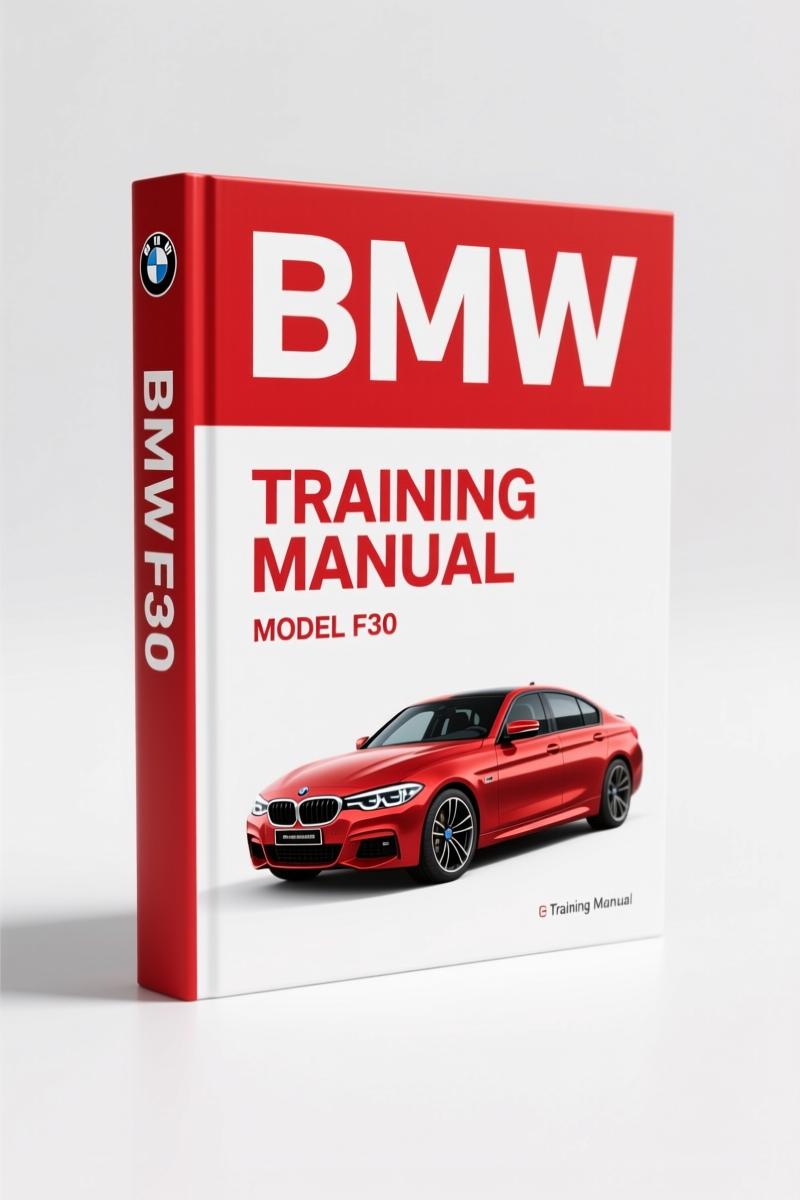
BMW F30 2011 Training Manual – Factory System Documentation
Original price was: $22.34.$14.99Current price is: $14.99.
Factory BMW training manual for F30 3 Series – 46 pages covering 8 systems. Develop diagnostic proficiency with OEM-level system knowledge.
Description
BMW F30 2011 Training Manual – Factory Specs for Chassis and Electronics
You want to work on a BMW F30 without the OEM training material? That’s a chance to break something expensive. I’ve been turning wrenches 28 years, and I’ve seen techs skip factory training then chase electrical ghosts for hours. This BMW F30 2011 Training Manual is the real deal – straight from BMW Group Technical Training. 46 pages of the same content they use to certify dealer techs. If you’re touching a 2011 F30, this belongs on the bench, not buried in a drawer.
Chassis Dynamics: The Factory Take on Suspension and Handling
Section 03_F30 Chassis Dynamics runs deep. It’s not just struts and sway bars – it covers the driving dynamics systems, bus architecture, and how the modules coordinate. Page 1 lists the model variants. Page 2 explains the safety symbol – read that before you start, because the manual flags critical interactions. For example, if you’re coding a new DSC module, you need to understand the signal flow from the steering angle sensor. Aftermarket books give you a generic pinout. This training manual tells you why that signal matters.
Powertrain Section: Engine and Transmission Logic
Section 02_F30 Powertrain covers engine management, direct injection, and transmission control. This is training material, not a step-by-step repair guide – but it shows how the systems behave. Need the charge pressure control logic for the N20? It’s explained here. If you’re replacing a high-pressure fuel pump, you’ll understand the system bleed sequence. I’ve seen guys skip this and flood the engine bay with fuel. The manual doesn’t replace ISTA, but it gives you the foundation to use diagnostic tools correctly. Check BMW F30 2011 Training Manual – Factory Specs for Techs for more detail on powertrain data.
3 Reasons to Choose OEM Documentation Over Aftermarket
Accuracy. Aftermarket manuals reprint generic CAN bus diagrams that may have wrong wire colors. This one uses BMW’s own schematics from Section 04 – General Vehicle Electronics. Safety. The training manual specifically highlights critical steps with the warning symbol on page 2. That symbol means ‘stop and verify or you’ll damage something.’ System integration. Driver assistance systems (Section 05) like lane departure and adaptive cruise require precise sensor alignment. Aftermarket books often give a one-size-fits-all procedure that fails on F30s. This manual tells you the factory calibration routine. For wider context, see Automotive Industry Overview on OEM documentation standards.
General Vehicle Electronics: The Bus Architecture You Need
Section 04 covers the bus overview – CAN, MOST, FlexRay. If you’re troubleshooting a no-start that turns out to be a gateway module failure, you need to know which bus carries engine control versus body control signals. The training manual lays out the topology. For a home mechanic, this is the difference between swapping random modules and actually fixing the problem. Pair this with the electrical system guide from BMW F30 2011 Training Manual – Factory Electrical & Systems Guide for complete coverage.
Safety Warnings: Page 2 Isn’t Decoration
The symbol on page 2 is BMW’s way of saying ‘stop and think.’ It appears throughout the manual. In Section 08 (Passive Safety Systems), airbag deployment procedures are critical – one wrong voltage spike and you’re replacing an SRS module. This manual lists the required precautions. Ignoring them gets you a car that won’t pass inspection. It’s 46 pages, but each one carries weight. For related chassis training on other models, look at BMW X5 2002 Training Manual – EHC2 Air Suspension & 4.6is Specs.
Does This Manual Cover the 2011 Model Year Only?
The information status is September 2011. It covers the early F30 production run. Many systems carried over to later F30 variants (up to 2019), but always cross-reference with the latest ISTA for updates. If you’re working on a 2012 or 2013, this manual gives you the baseline logic. For fuel system specifics, Section 02 includes direct injection control – not just component location but how the high-pressure system regulates. You won’t get that from a generic service manual. Check Automotive Industry Overview for more on training manual applications across model years.
FAQ – Common Questions from Techs and DIYers
- Is this manual for the F30 sedan only, or does it cover the wagon?
- It covers the F30 sedan. Wagon (F31) and GT (F34) share many chassis and electrical systems, but confirm with a specific supplement for those body styles.
- Can I use this to replace an engine or transmission?
- This is a training manual, not a step-by-step repair guide. It teaches system behavior and diagnostics. For removal and installation procedures with torque specs and part numbers, you need the BMW factory repair manual or ISTA. However, understanding the powertrain logic from Section 02 will prevent you from making mistakes like improper coding after an engine swap. Many DIYers cause drivability issues because they don’t know how the DME expects to see signals from sensors. This manual gives you that background so you can diagnose problems instead of replacing parts blindly.
- What torque values are listed in this manual?
- This training manual does not list component torque specs. It focuses on system function and diagnostic strategy. For torque values on F30, use the official BMW repair manual or ISTA – those give you the exact ft-lb for head bolts, calipers, and suspension fasteners.
- How does a home garage mechanic benefit from 46 pages of training?
- Home mechanics often get stuck on electrical issues they never experienced in older cars. This manual teaches you how the F30’s systems think. For example, Section 05 explains driver assistance sensor alignment – after a windshield replacement, the lane departure camera needs recalibration. Without that knowledge, you end up with a car that pulls left and a warning light that won’t clear. This is the kind of information that saves you from expensive dealer visits. The 46 pages are dense with diagrams and explanations that reduce diagnosis time dramatically.
If you’re serious about working on the F30 Chassis, don’t rely on compressed PDFs from unknown sources. This is the original BMW training document – same content as the dealer techs get. Access the Factory Manual and keep it on your tablet next to the car.
Additional information
| Brand | BMW |
|---|---|
| Language | English |
4 reviews for BMW F30 2011 Training Manual – Factory System Documentation
You may also like…
-
Sale!

BMW 525i, 530i, 535i, 540i Service Manual 1989-1995 Factory Specs
Original price was: $96.00.$60.00Current price is: $60.00. -
Sale!

BMW M3, 323i, 325i, 325xi, 328i Service Manual – 1258 Pages
Original price was: $93.00.$60.00Current price is: $60.00. -
Sale!

BMW 735i, 735iL, 740i, 740iL, 750iL Service Manual – 987 Pages
Original price was: $102.05.$65.00Current price is: $65.00. -
Sale!

BMW 525i, 530i, 535i, 540i Service Manual – 459 Pages Factory Specs
Original price was: $73.20.$60.00Current price is: $60.00.
Related products
-
Sale!

1994 Troubleshooting Manual – International 1000-4000 FBC
Original price was: $60.00.$50.00Current price is: $50.00. -
Sale!
2004 Acura TSX Wiring Diagram – 73-Page Factory Electrical Schematics
Original price was: $15.88.$9.99Current price is: $9.99. -
Sale!

2011 Parts Catalog – International 7400 SFA 6X6 – 1886 Pages of OEM Part Numbers
Original price was: $32.00.$25.00Current price is: $25.00. -
Sale!
1991 Electrical Schematic – 112-Page OEM Wiring Diagram for International 1000-3000 Series
Original price was: $22.75.$17.50Current price is: $17.50.
William H. –
This is just what I needed. The scan is high-quality and well indexed. It guided me to rebuild my BMW F30 electrical system. I will recommend this shop to others.
James L. –
Excellent quality! It is easily zoomable on my iPad without blur. It helped me to troubleshoot my BMW F30 transmission. I will recommend this shop to others.
diy_master –
This is just what I was looking for. The PDF quality is excellent. A must-have for any BMW F30 DIYer doing repairs. Saved my weekend project! Thank you.
pro_mechanic –
Superb resource! It is very easy to read on my tablet without blur. It assisted me to fix my BMW F30 engine. I will definitely buy again.