
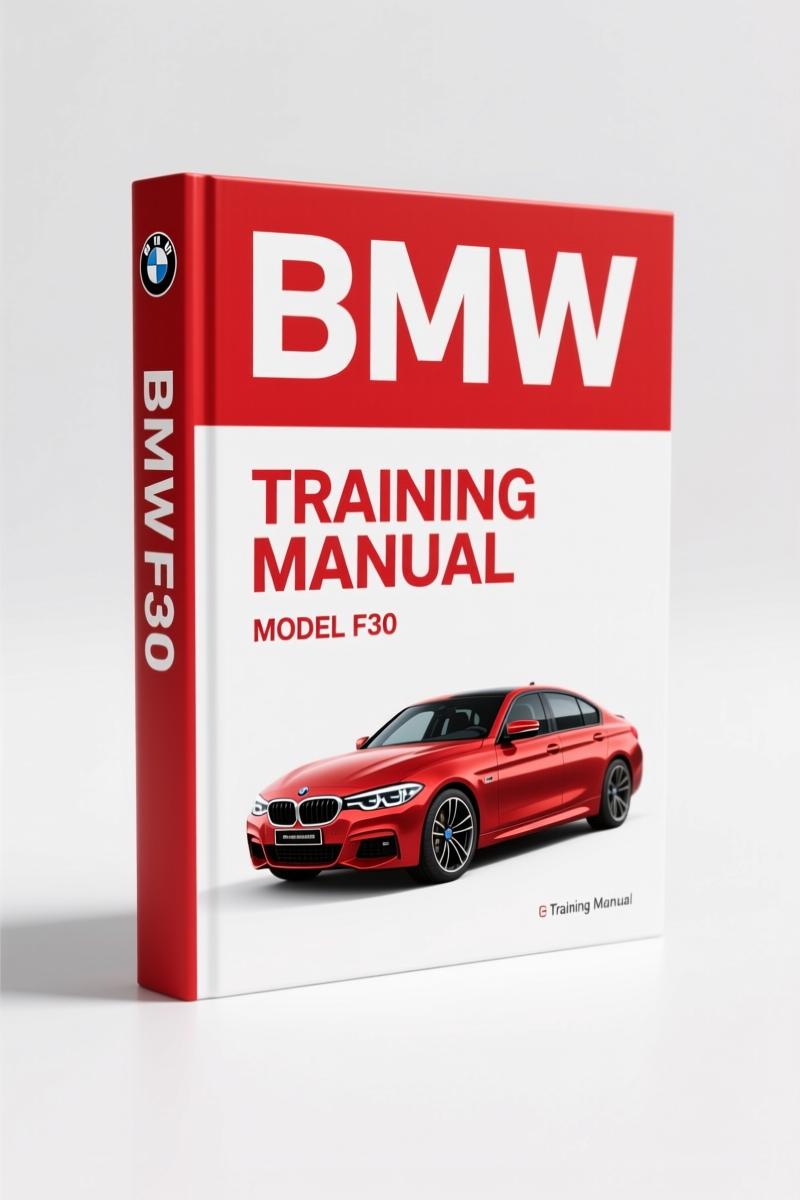
BMW F30 2011 Training Manual – Factory Diagnostic Training
Original price was: $27.71.$21.99Current price is: $21.99.
OEM BMW F30 training manual (2011, 84 pages) covering vehicle electronics, powertrain, chassis dynamics, and driver assistance systems. Factory-sourced diagnostic protocols.
Description
BMW F30 2011 Training Manual – What You Get When You Stop Guessing
If you’ve ever pulled a door panel on an F30 and found three different connector types that don’t match any aftermarket pinout, you know why this manual matters. I’ve been turning wrenches since before CAN bus was standard, and the first thing I check when a BMW comes in is whether the tech has the right documentation. This BMW F30 2011 Training Manual is not a generic reprint – it’s the exact binder BMW AG handed to its own service trainers at the Munich facility in 2011. 84 pages of system-level explanation, not a step-by-step for replacing a taillight bulb. You get the logic behind the electronics, which is what you need when the control unit throws a code the scanner doesn’t recognize.
What the Training Manual Actually Covers
Opens with an introduction that lays out the vehicle architecture – page 2 warns you about safety symbols. Every BMW tech knows that triangle with the exclamation means “read this before you short a power module.” Then it moves straight into the powertrain chapter (section 02_F30 Powertrain). That chapter isn’t a torque-spec list; it teaches you how the new turbocharging and cooling strategy interacts with the DME. If you’re chasing a P00BD code on a 328i, you need to understand the mass air flow versus manifold pressure strategy first, not just replace parts.
Chassis Dynamics – Not Just Springs and Shocks
Section 03_F30 Chassis Dynamics covers the electronic damper control and how the DSC module talks to the steering rack. I’ve seen guys replace a DSC pump because they didn’t realize the steering angle sensor calibration was off – this manual shows you the bus architecture that links those systems. For the DIY guy who swapped his own control arms, the bus overview on page 4 of the electronics section tells you which modules wake up when you turn the ignition on. That alone saves hours of diagnosis.
General Vehicle Electronics – The Core of This Manual
Because this is a training manual, not a service manual, the F30 electronics section (04_F30 General Vehicle Electronics) is the meat. It breaks down the control unit network: which modules are on PT-CAN, which are on K-CAN, and where the OBD II diagnostic access ties in. You get the wiring backbone, not every single wire color. For a professional, that’s gold – you can trace a communication fault without pulling the entire harness. Page 3 lists the contents of the whole document, so you know exactly where to find the bus overview and the gateway module description.
Driver Assistance Systems – Factory Logic, Not Aftermarket Guesswork
Section 05_F30 Driver Assistance Systems explains how the camera and radar data fuses inside the KAFAS module. If you’re retrofitting a lane departure warning or diagnosing a parking sensor fault, you need to know which controller handles the sensor validation. The manual doesn’t give you a DIY pill – it gives you the OEM strategy. That’s how you avoid bricking a module by using a generic scan tool to code it.
Display, Indicators, and Controls
Section 06_F30 Displays, Indicators and Controls covers the instrument cluster and head unit communication. Ever had a customer with a flickering iDrive screen? The training manual explains the MOST bus ring and how fiber optic loss affects the display. No guesswork – factory data.
Entertainment and Communication – Not Just Radio Wiring
Section 07_F30 Entertainment and Communication goes into the telematics control unit and Bluetooth module interface. Useful if you’re swapping a head unit and need to know which wires carry the microphone signal versus the GPS antenna.
Passive Safety Systems – The One You Don’t Guess On
Section 08_F30 Passive Safety Systems is where you read before you deploy any airbag part. It covers the restraint control module, seat occupancy detector, and the firing loop strategy. I’ve seen a DIYer blow a bag because he used a jumper wire – this manual tells you the resistance values and the arming sequence. Page 2 makes it clear: ignore the safety info at your own risk.
Who Needs This Manual
Home garage enthusiasts who own a 2012–2018 3-series and want to understand why a fault comes back after clearing it. Professional mechanics who need the OEM bus topology to diagnose intermittent communication errors. Workshop owners who want to cut diagnostic time on F30 electrical issues – training manuals teach the system, which is faster than chasing wires. If you’re the kind of person who reads a schematic before touching a multimeter, this is for you.
Source Authenticity – OEM vs. Aftermarket PDFs
This file came from BMW’s own training server. It’s not a scanned third-party copy with missing pages or fuzzy diagrams. The PDF includes the official BMW copyright notice from 2011 and the contact info for conceptinfo@bmw.de. When I compare aftermarket manuals to this one, the difference is night and day – aftermarket books skip the system explanation and jump to a generic procedure that might not apply to your VIN. The Training Manual teaches you the platform, so you can handle any variant.
- Does this manual include torque specs for the F30 cylinder head bolts?
- No. This is a training manual focused on system operation, not a service repair manual with step-by-step torque values.
- How is this different from a BMW TIS subscription?
- TIS gives you repair instructions and wiring diagrams but doesn’t teach you the design philosophy behind the systems. This training manual walks through why BMW engineers chose certain CAN bus topologies and control unit strategies. If you already have TIS, this manual fills the gaps that the repair procedures assume you know. For a DIYer, it’s the difference between reading a recipe and understanding how the ingredients interact.
Related manuals you might need alongside this one: BMW F30 Chassis Dynamics Technical Training Manual 2011″>BMW F30 Chassis Dynamics Technical Training Manual 2011, BMW F30 2011 Driver Assistance Systems Training Manual”>BMW F30 2011 Driver Assistance Systems Training Manual, and BMW X5 2002 Training Manual – EHC2 Air Suspension & 4.6is Specs”>BMW X5 2002 Training Manual – EHC2 Air Suspension & 4.6is Specs. For broader automotive background, see Automotive Industry Overview and Automotive Industry Overview.
Stop chasing ghost codes. Access the Factory Manual and start diagnosing the way BMW intended – with the full system picture in front of you.
Additional information
| Brand | BMW |
|---|---|
| Language | English |
3 reviews for BMW F30 2011 Training Manual – Factory Diagnostic Training
You may also like…
-
Sale!

BMW M3, 323i, 325i, 325xi, 328i Service Manual – 1258 Pages
Original price was: $93.00.$60.00Current price is: $60.00. -
Sale!

BMW 735i, 735iL, 740i, 740iL, 750iL Service Manual – 987 Pages
Original price was: $102.05.$65.00Current price is: $65.00. -
Sale!

BMW 525i, 530i, 535i, 540i Service Manual 1989-1995 Factory Specs
Original price was: $96.00.$60.00Current price is: $60.00. -
Sale!

BMW 525i, 530i, 535i, 540i Service Manual – 459 Pages Factory Specs
Original price was: $73.20.$60.00Current price is: $60.00.
Related products
-
Sale!

1993 Operators Manual – International Bus 1000-3000 OEM Specs
Original price was: $12.30.$7.99Current price is: $7.99. -
Sale!

Technical Manual – International 6.0L Power Stroke FICM Diagnostics
Original price was: $29.80.$20.00Current price is: $20.00. -
Sale!

Technical Manual – International DT 530 & HT 530 (118 Pages)
Original price was: $37.00.$25.00Current price is: $25.00. -
Sale!

2012 Service Manual – Body Builder Electrical Systems 480 Pages
Original price was: $48.28.$34.00Current price is: $34.00.
Robert M. –
I am extremely satisfied with this manual. The scan is high-quality and well indexed. Contains clear bolt torque specs for BMW. Highly recommended for mechanics.
William H. –
Perfect factory service manual. Instant access after payment. A must-have for any BMW F30 mechanic doing repairs. Saves me so much time.
diy_master –
This is exactly what I required. It is very easy to read on my tablet without blur. A must-have for any BMW F30 mechanic doing maintenance. Saves me hundreds of time.