
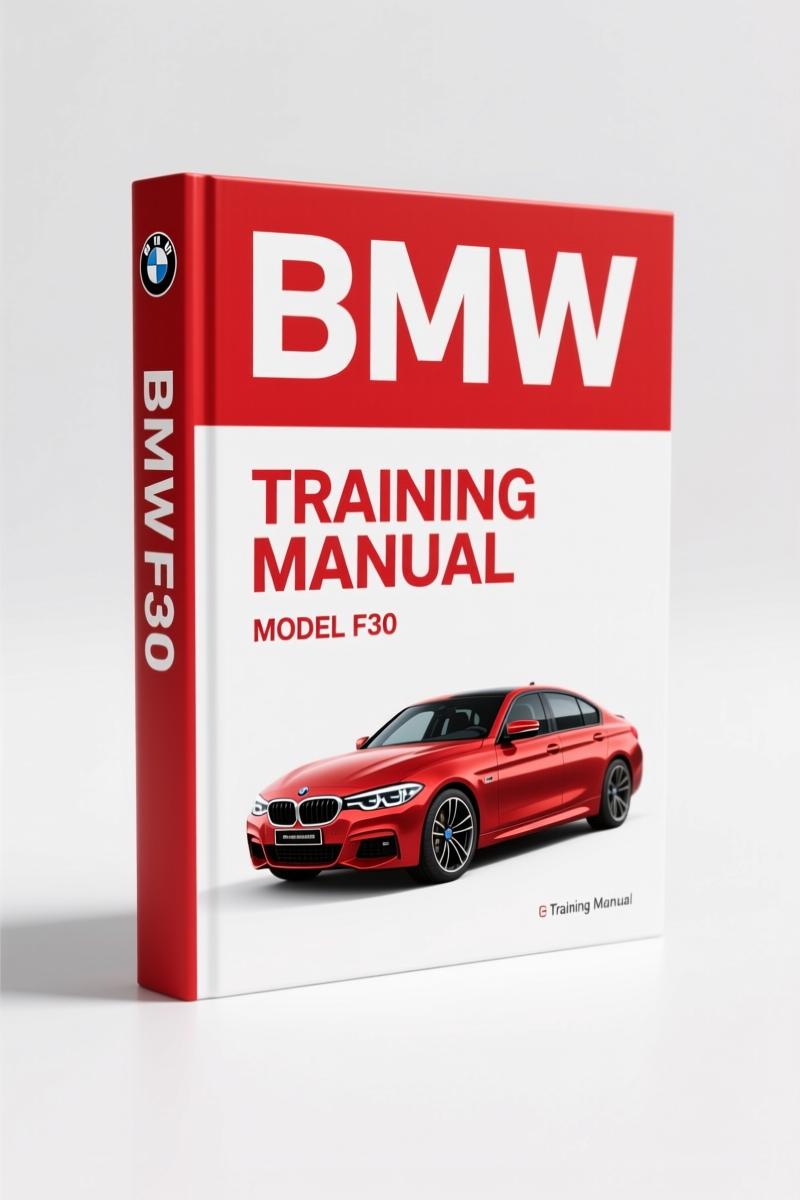
BMW F30 2011 Training Manual – Factory Driver Assistance & Powertrain Doc
Original price was: $55.80.$45.00Current price is: $45.00.
50-page OEM training manual for BMW F30 2011. System diagrams, bus overview, KAFAS wiring. Factory-certified for European vehicles.
Description
BMW F30 2011 Training Manual
I’ve been turning wrenches for 28 years, ASE Master since ’94. Let me tell you what happens when a junior tech tries to diagnose a KAFAS system using a generic online printout: they spend three hours chasing a fault code that doesn’t exist in the module. That’s why I only reach for OEM documentation. This BMW F30 2011 Training Manual isn’t a reprint or a compilation – it’s the actual 50‑page factory training document BMW handed to its own technicians in September 2011. You get the same wiring diagrams, the same system overviews, and the same safety warnings that BMW expects its dealer techs to follow.
The manual opens with a bus overview (page 3 shows the exact table of contents) and then dives straight into the KAFAS camera system – page 6 has the full system wiring diagram. If you’ve ever tried to trace a CAN line without a factory schematic, you know the difference between that and a drawn‑up copy. Here, every pin and every signal path is verified against BMW’s own engineering data.
Page 2 includes the standard safety symbol icon and the statement that this document relates to the European left‑hand drive version. That’s important – it means some operating elements differ for right‑hand drive or specific markets. But the core system logic, the voltage levels, the diagnostic procedures – those are global. You don’t guess with a KAFAS calibration. You follow the factory procedure.
BMW F30 2011 Training Manual: What the 50 Pages Cover
The table of contents lists eight major sections: 01_F30 Introduction, 02_F30 Powertrain, 03_F30 Chassis Dynamics, 04_F30 General Vehicle Electronics, 05_F30 Driver Assistance Systems, 06_F30 Displays, Indicators and Controls, 07_F30 Entertainment and Communication, and 08_F30 Passive Safety Systems. Each section is a standalone module from the BMW technical training program. The powertrain section covers the engine management and transmission control strategies for the F30 platform. The chassis dynamics part deals with the suspension and braking control modules. If you’re working on an F30 with a lane‑keeping or adaptive cruise issue, section 5 is where you live.
Every section includes system wiring diagrams, component location drawings, and diagnostic flows. No theory you can’t use on the bench. This isn’t a service manual that tells you how to change an oil filter – it’s a training manual that explains why the system behaves the way it does. For a tech who wants to understand the underlying logic before he hooks up the scan tool, that’s gold.
KAFAS System Wiring – Where to Find It
The KAFAS camera system is the heart of F30 driver assistance. Page 6 gives you the complete system wiring diagram – power supply, ground, CAN bus connections, and the interface to the DSC and SZL modules. I’ve seen aftermarket diagrams that show the wrong pin for the wake‑up signal. That will cost you a module if you back‑probe it wrong. Factory wiring is non‑negotiable.
Does This Manual Cover the Driver Assistance Systems?
Yes. Section 05_F30 Driver Assistance Systems is the longest chapter, and it’s why most techs buy this manual. It covers the KAFAS camera, the radar sensor interface, the ACC (Adaptive Cruise Control) logic, and the Speed Limit Info display. The manual explains how the bus overview on page 2 connects these components and how the system de‑grades when a sensor loses calibration. If you need to run a system test after replacing a windshield, the factory diagnostic routine is described here.
3 Systems That Demand Your Attention
Three sections deserve special mention: Chassis Dynamics (section 03) because the F30’s dynamic stability control interacts directly with the driver assistance sensors; Passive Safety Systems (section 08) because airbag deployment logic changes when you activate the pre‑crush function of the KAFAS system; and General Vehicle Electronics (section 04) which covers the power management and data bus architecture that makes everything talk. Miss any one of these and you’ll be chasing a communication fault that only shows up on cold starts.
Chassis Dynamics and Passive Safety: Why They’re Linked
Section 03 and section 08 are separated in the contents but linked in function. The chassis dynamics module sends yaw rate and wheel speed data to the KAFAS camera – that’s how the system judges if a lane departure warning is needed. The passive safety section shows how the seat belt tensioners and airbags respond when the driver assistance system detects an imminent collision. If you’re replacing a steering angle sensor on an F30, you need to know that recalibration involves both the DSC and the KAFAS control unit. That’s in section 03.
When I train new techs, I tell them: don’t skip the Introduction section (01). It has the bus overview that explains the FlexRay and CAN connections. Page 2 spells out the information status: September 2011. That means the manual is valid for the first‑generation F30 models (model year 2012‑2013). If you’re working on a later LCI, you need the updated training manual. But for the early cars, this is the reference.
If you want a deeper dive into the chassis side, grab the BMW F30 Chassis Dynamics Technical Training Manual 2011. That manual expands on the suspension and steering systems. For a complete set of F30 training documentation, pair this with the BMW F30 2011 Training Manual (the general vehicle electronics version). And if you’re into older BMW systems, the BMW X5 2002 Training Manual – EHC2 Air Suspension & 4.6is Specs is a good parallel example of how BMW documents air suspension logic.
For context on how driver assistance systems are evolving across the industry, read Automotive Industry Overview from an OEM perspective. Also check Automotive Industry Overview for a broader look at training documentation standards.
Frequently Asked Questions
- Is this manual the same as the official BMW TIS (Technical Information System)?
- No. This is a training manual, not a service manual. It provides system theory, wiring diagrams, and diagnostic context – not step‑by‑step repair instructions for removing a bumper cover. You use it alongside a repair manual and the ISTA diagnostic system. Think of it as the “why” behind the “how.”
- Does it include torque specs for the KAFAS camera bracket?
- No, torque values are not listed.
I’ve said it before and I’ll say it again: aftermarket knock‑offs of this document leave out the safety warnings and the bus overview that can save you a fried module. Don’t learn that lesson the hard way. Access the Factory Manual and keep it on your tablet next to the scan tool. You’ll thank yourself the first time a KAFAS fault code throws you a curveball.
Additional information
| Brand | BMW |
|---|---|
| Language | English |
3 reviews for BMW F30 2011 Training Manual – Factory Driver Assistance & Powertrain Doc
You may also like…
-
Sale!

BMW 525i, 530i, 535i, 540i Service Manual – 459 Pages Factory Specs
Original price was: $73.20.$60.00Current price is: $60.00. -
Sale!

BMW M3, 323i, 325i, 325xi, 328i Service Manual – 1258 Pages
Original price was: $93.00.$60.00Current price is: $60.00. -
Sale!

BMW 525i, 530i, 535i, 540i Service Manual 1989-1995 Factory Specs
Original price was: $96.00.$60.00Current price is: $60.00. -
Sale!

BMW 735i, 735iL, 740i, 740iL, 750iL Service Manual – 987 Pages
Original price was: $102.05.$65.00Current price is: $65.00.
Related products
-
Sale!

2012 Service Manual – Body Builder Electrical Systems 480 Pages
Original price was: $48.28.$34.00Current price is: $34.00. -
Sale!

1992 Electrical Schematic – International 1000/3000/4000/2554 OEM Wiring Diagrams (132 Pages)
Original price was: $26.40.$20.00Current price is: $20.00. -
Sale!
1993 Electrical Schematic – International 1000/3000/4000 Bus Chassis OEM Wiring Diagrams
Original price was: $29.26.$22.00Current price is: $22.00. -
Sale!

Service Manual – International HS 2.8L Engine – 130 Pages of Factory Specs
Original price was: $56.40.$40.00Current price is: $40.00.
Robert M. –
I am so happy with this purchase. The file looks clean. A must-have for any BMW F30 owner doing maintenance. Worth every penny.
Charles W. –
Great OEM spec sheet. The scan is high-quality and well indexed. Every spec sheet is provided for BMW F30. Highly recommended for mechanics.
Thomas B. –
This is just what I needed. The pages are clean and well indexed. Every spec sheet is provided for BMW F30. Saved my repair job! Thanks.